Algeria
 Egypt
 Libya
 Morocco
 Sudan
 Tunisia
 Benin
 Burkina Faso
 Cabo Verde
 Côte d'Ivoire
 Guinea
 Guinea-Bissau
 Liberia
 Mali
 Mauritania
 Niger
 Nigeria
 Senegal
 Sierra Leone
 The Gambia
 Togo
 Cameroon
 Central African Republic
 Chad
 DR Congo
 Equatorial Guinea
 Gabon
 Republic of the Congo
 São Tomé and Príncipe
 Burundi
 Comoros
 Djibouti
 Eritrea
 Ethiopia
 Kenya
 Madagascar
 Malawi
 Mauritius
 Mozambique
 Rwanda
 Seychelles
 Somalia
 South Sudan
 Tanzania
 Uganda
 Angola
 Botswana
 Eswatini
 Lesotho
 Namibia
 South Africa
 Zambia
 Zimbabwe
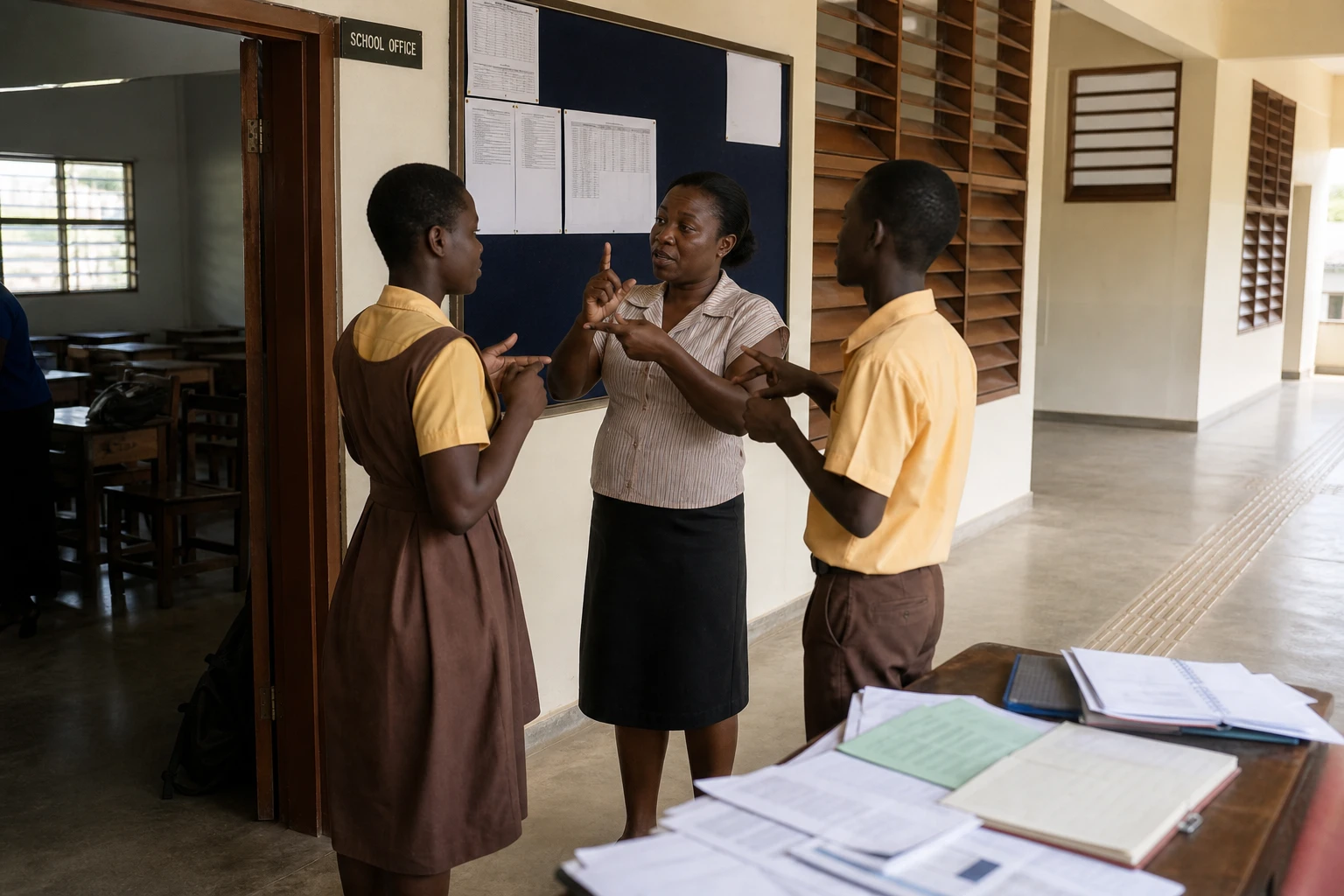
In Accra and across Ghana’s regions, access to school depends on more than the availability of a classroom. For many deaf children, it first depends on the opportunity to learn in a language they understand, which is taught and recognised by the education system.
Ghana is now making progress on this front with a reform that puts Ghanaian Sign Language at the heart of education for deaf pupils. The aim goes beyond creating a few specialised resources. It is to build an unbroken educational pathway from kindergarten through secondary school, and on to higher education and employment.
A national undertaking in a changing education system
The Ghana Education Service, the administration responsible for implementing pre-tertiary school policies, is working with the National Council for Curriculum and Assessment, the body responsible for curricula and assessment. The Ghana National Association of the Deaf is also involved in the process.
This cooperation has resulted in a harmonised Ghanaian Sign Language curriculum, often abbreviated to GhSL. The framework covers levels from kindergarten to the end of secondary school. It aims to give teachers, pupils and families a common foundation, rather than a succession of different practices from one school to another.
The programme was approved after workshops bringing together curriculum specialists, teachers from schools for the deaf and representatives of organisations advocating for the rights of deaf people. The work covered the curriculum, teachers’ manuals, learner resources and lesson-planning tools. The National Council for Curriculum and Assessment described the approval as a step towards more consistent instruction.
In September 2025, Ghana also marked the International Day of Sign Languages with the public launch of the national curriculum. The initiative is supported in particular by Transforming Teaching, Education and Learning and the Mastercard Foundation, alongside Ghanaian institutions and the Ghana National Association of the Deaf. The Ghana News Agency reported the launch of the programme from kindergarten through senior high school.
Resources for learning and assessment
The new approach is not simply about translating lessons. It envisages a bilingual approach combining Ghanaian Sign Language with written English and, as needed, other languages used in the country.
This distinction matters. A pupil may understand a concept in sign language but struggle when assessment is conducted solely in written English. Conversely, an education that does not develop reading and writing skills can limit access to higher education, vocational training and employment.
The system therefore needs to address several links in the chain. It provides for adapted teaching resources, better teacher preparation, and stronger training and certification for interpreters. Sign-language skills are also to be integrated more fully into teacher-training pathways.
The Ghana Education Service said the curriculum had been piloted with the participation of teachers and special education officials. The Ghanaian education service describes a pilot based on the combined use of signs, speech and text.
Urgent need to tackle barriers to access
The reform addresses a situation that remains highly unequal. In September 2024, Juventus Duorinaah, executive director of the Ghana National Association of the Deaf, estimated that 30 to 50% of children with hearing impairments were not in school.
This figure should be understood as an estimate attributed to the representative organisation for deaf people. It nevertheless reflects a widely documented challenge: the existence of a school does not guarantee educational accessibility. Some families lack information. Mainstream schools are still reluctant to enrol deaf pupils. Others have neither trained teachers nor interpreters.
The Ghana News Agency reported the Ghana National Association of the Deaf’s estimate in September 2024, along with the barriers identified by its officials. The same report cited 17 special schools, 14 of them public, as well as persistent difficulties in mainstream schools.
The Ghana Education Service also said that only 1.6% of children with disabilities attended school, from kindergarten to senior high school. This rate concerns all children with disabilities and should therefore not be confused with the specific situation of deaf pupils.
There are also geographical disparities. Families in Accra can more easily find a special school, an interpreter or an association. In rural areas, transport, accommodation costs and the shortage of qualified staff can interrupt schooling. For households that rely mainly on the informal economy, these constraints have a direct impact on income and on their ability to keep a child in school.
Funding will determine the reform’s reach
Curricula cannot be separated from the question of resources. In July 2026, Education Minister Haruna Iddrisu asked the Ghana Education Trust Fund, the public fund dedicated to education financing, to provide 100 million cedis a year for special education from 2027.
The allocation is intended to support 39 special and integrated schools. The authorities said it could directly benefit more than 9,000 learners. The Ghana News Agency confirmed the budget announcement and its planned start in 2027. An independent Ghanaian media outlet also reported the breakdown of schools covered and the funding target. Citi Newsroom documented the same decision and the number of learners concerned.
However, funding will need to cover more than infrastructure. Resources will have to be produced and distributed, interpreters paid, teachers trained, accessible assessments organised and pupils monitored. Without this recurring expenditure, a national curriculum risks remaining confined to a handful of pilot schools.
From school to higher education
The pathway does not end at secondary school. Deaf students still face difficulties at universities and technical institutions, particularly because of the limited number of interpreters and a lack of adapted resources.
This transition will be a decisive test. Better primary and secondary education will inevitably increase the number of young people wishing to continue their studies. Universities will therefore need to anticipate requirements for interpreting, accessible examinations and educational support.
Ultimately, the issue also affects the labour market. Accessible education can improve qualifications, but it will not automatically eliminate discrimination in hiring. Government departments, businesses and training centres will also need to build their capacity to communicate with deaf people.
A signal for West Africa
Ghana’s undertaking is taking place in a region where education systems must contend with considerable linguistic diversity, unevenly distributed resources and growing demand for inclusion. The Economic Community of West African States, ECOWAS, does not replace national education policies. It does, however, provide a forum for dialogue among countries facing comparable challenges.
Ghana’s trajectory shows above all that an inclusion policy cannot be reduced to a declaration of principle. It requires a structured language of instruction, trained professionals, identified budgets and monitoring mechanisms. The next measure will therefore be a concrete one: how many schools will actually have the resources, teachers and interpreters needed to implement the curriculum in the regions as well as in the capital.
For deaf pupils, the reform’s success will be measured less by its official launch than by their ability to enrol in school, make progress, pass exams and continue their education without interruption. It is at this level—the actual educational journeys of learners—that Ghana will have to demonstrate the reach of its commitment.