Algeria
 Egypt
 Libya
 Morocco
 Sudan
 Tunisia
 Benin
 Burkina Faso
 Cabo Verde
 Côte d'Ivoire
 Guinea
 Guinea-Bissau
 Liberia
 Mali
 Mauritania
 Niger
 Nigeria
 Senegal
 Sierra Leone
 The Gambia
 Togo
 Cameroon
 Central African Republic
 Chad
 DR Congo
 Equatorial Guinea
 Gabon
 Republic of the Congo
 São Tomé and Príncipe
 Burundi
 Comoros
 Djibouti
 Eritrea
 Ethiopia
 Kenya
 Madagascar
 Malawi
 Mauritius
 Mozambique
 Rwanda
 Seychelles
 Somalia
 South Sudan
 Tanzania
 Uganda
 Angola
 Botswana
 Eswatini
 Lesotho
 Namibia
 South Africa
 Zambia
 Zimbabwe
A country where almost everything depends on roads
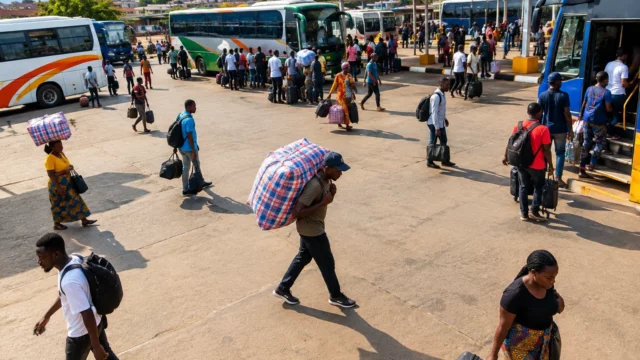
In Ghana, a truck carrying cocoa, an urban minibus and a neighbourhood market all depend on the same thread: the road. In this West African country, the movement of people and goods relies overwhelmingly on tarmac, gravel or dirt roads, with few alternatives able to absorb the flow. This reality affects prices, delivery times and, more broadly, the competitiveness of the Ghanaian economy.
The issue extends beyond Accra. It also concerns the corridors linking production areas to Tema, the country’s main port, and then to the markets of ECOWAS, the Economic Community of West African States. In a region where intra-African trade is still held back by logistics costs, the condition of roads has become an issue of economic sovereignty as much as one of public engineering.
A longer network, but not yet a stronger one
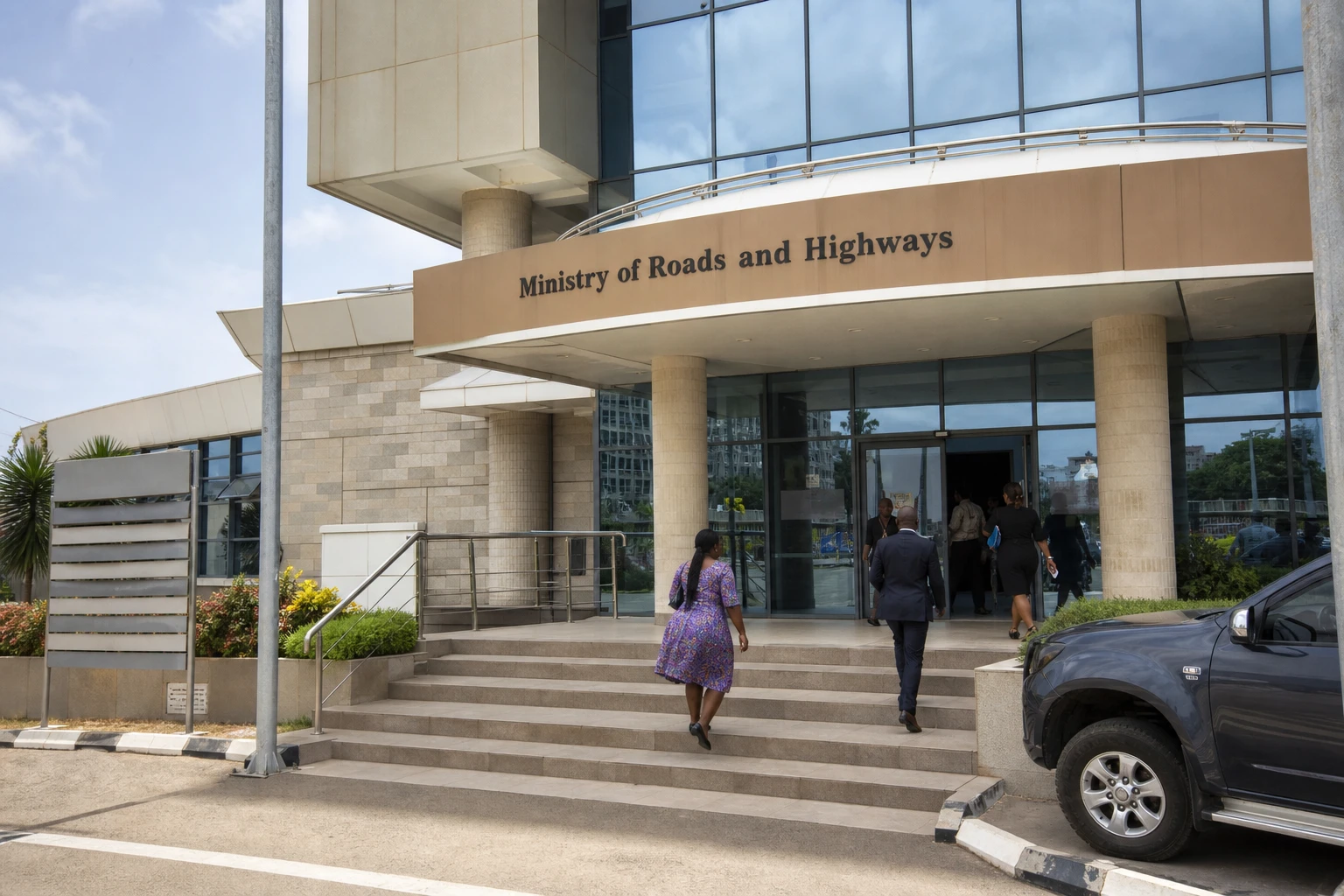
Available figures show a marked increase in the length of Ghana’s road network. The Ministry of Roads and Highways had already reported a network of 94,203 km in 2023, of which 27% was paved and 73% unpaved. The same order of magnitude is cited by the World Bank in its tenth Ghana Economic Update, published in August 2026. Between 2017 and 2024, the country’s network grew from around 78,400 km to 94,203 km, a significant expansion of its coverage.
But this increase does not mean that Ghana has built 15,000 km of new roads. Sector documents show that part of the growth stems from the reclassification of existing routes, while the number of genuinely new kilometres remains limited. In practice, the state has focused mainly on gravel surfacing, resurfacing, rehabilitation and upgrading. The network is therefore growing on paper, but its quality remains uneven.
The picture remains mixed. At the end of 2024, around 27% of the network was paved, leaving a large majority of roads made of earth or gravel and therefore more vulnerable to rain and disruptions to traffic. The share of roads considered to be in good condition reached 47%, up from 41% in 2021. However, major roads remain more fragile than is often assumed: only 35% were considered to be in good condition, while urban and feeder roads remained highly exposed to deterioration.
The real bottleneck: maintenance, funding and trade-offs
Ghana’s central problem is no longer just building. It is maintaining. The Road Fund, which finances maintenance, covers an insufficient share of needs. Finance Ministry reports indicate that its revenue relies mainly on fuel taxes, while road tolls were abolished from the 2022 budget, reducing one dedicated source of funding. The fund now relies on four main sources: fuel tax, vehicle registration, road-user charges and international transit taxes.
In this context, maintenance needs exceed the funding actually made available. The country must therefore choose between building new roads, rehabilitating deteriorated ones and carrying out routine maintenance, which prevents a still-acceptable road surface from becoming infrastructure that needs to be rebuilt entirely. This is a familiar equation in West Africa: without sustainable funding for maintenance, every new kilometre can become a physical liability over the medium term.
The road network also faces excessive pressure because rail has declined sharply. World Bank documents note that the operational railway network, which was 947 km long in 1960, had shrunk to just 160 km by 2020. The railways’ capacity to carry heavy freight has therefore collapsed. As a result, roads carry even more passengers and goods, and bear more risks.
This dependence has a visible cost for households and for both the formal and informal economies. In major cities, particularly Accra and Kumasi, congestion lengthens journeys, eats into working hours and raises distribution costs. In recent years, the Ministry of Roads and Highways has itself documented targeted measures to reduce congestion on major routes, showing that the problem is not theoretical but part of daily life.
What the “Big Push” means for Ghana and the region
In response, the Ghanaian government is promoting an investment programme called the “Big Push”. The 2026 budget provides for around $2.2 billion under this framework, with a total allocation of $10 billion announced over time. The objective is clear: to accelerate the construction of roads, bridges and major infrastructure that supports domestic trade, exports and regional connections.
This programme has very practical implications for Ghanaians in Tamale as well as for logistics operators in Accra. A more reliable road cuts delays, limits additional transport costs and secures the delivery of harvests to urban and port markets. Conversely, a deteriorated road first penalises rural areas, where alternatives are scarce, and then peri-urban neighbourhoods, where travel depends almost entirely on collective road transport.
The programme’s significance, however, goes beyond the national context. In ECOWAS, where the smooth flow of traffic along corridors is regularly cited as a way to boost trade, Ghana’s case is a reminder that a longer network is not enough. Maintenance standards, stable funding sources and better integration of roads, railways, ports and digital logistics are also needed. This is one of the key lessons highlighted by the World Bank for 2026: public investment has a lasting effect only when accompanied by credible governance and regular maintenance.
In other words, Ghana is not simply moving towards more kilometres of road. Above all, it is seeking to turn its road network into a tool for productivity. That is the challenge: to make roads not merely a response to the lack of alternatives, but a reliable means of linking production, markets and jobs across the country and throughout West Africa.