
 Algeria
 Egypt
 Libya
 Morocco
 Sudan
 Tunisia
 Benin
 Burkina Faso
 Cabo Verde
 Côte d'Ivoire
 Guinea
 Guinea-Bissau
 Liberia
 Mali
 Mauritania
 Niger
 Nigeria
 Senegal
 Sierra Leone
 The Gambia
 Togo
 Cameroon
 Central African Republic
 Chad
 DR Congo
 Equatorial Guinea
 Gabon
 Republic of the Congo
 São Tomé and Príncipe
 Burundi
 Comoros
 Djibouti
 Eritrea
 Ethiopia
 Kenya
 Madagascar
 Malawi
 Mauritius
 Mozambique
 Rwanda
 Seychelles
 Somalia
 South Sudan
 Tanzania
 Uganda
 Angola
 Botswana
 Eswatini
 Lesotho
 Namibia
 South Africa
 Zambia
 Zimbabwe
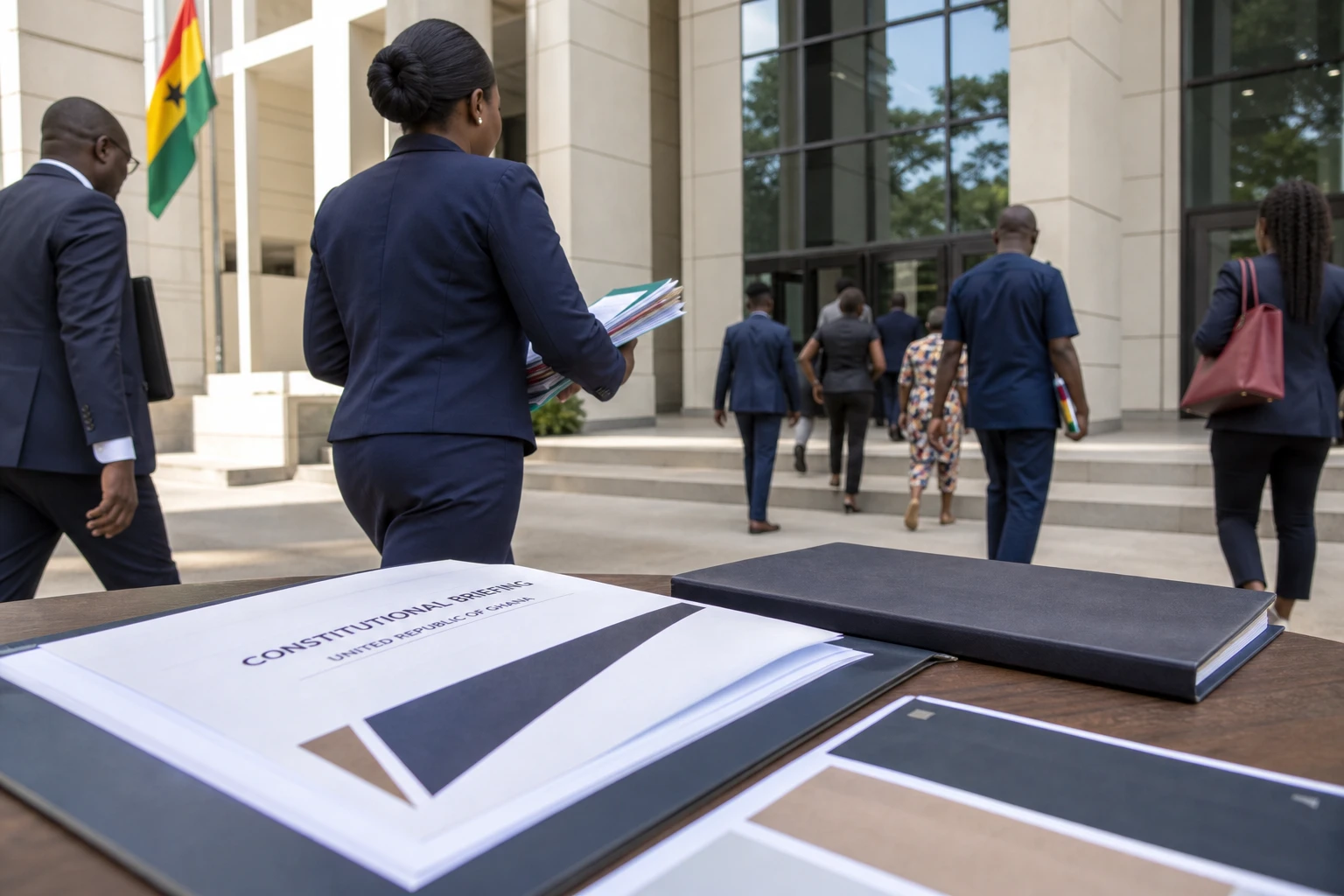
A constitutional overhaul that goes beyond the length of a term
In Accra, the debate is not just about giving a head of state a few months more or less in office. It concerns the very rhythm of Ghanaian democracy: how the country is governed, and when leaders return to voters. In a country often cited for the regularity of its transfers of power, political time has become a very concrete issue for institutions, parties and citizens.
Under the 1992 Constitution, Ghana still operates on a four-year presidential cycle, with Parliament elected on the same timetable. Presidential and parliamentary elections are held on the same day, and a president must secure more than 50% of valid votes to win in the first round.
What the current reform recommends
The proposal took shape after Ghanaian President John Dramani Mahama set up a constitutional review committee in January 2025. The presidency confirmed receipt of the committee’s final report on 22 December 2025, and later made it public. The document recommends extending the presidential term from four to five years and aligning Parliament’s term with the new length.
The government has since given its agreement in principle to the proposal, according to information made public on the issue. The reasoning is straightforward: campaigning takes too much time away from governing. The first months of a term are spent assembling the team, revising priorities and taking charge of the state apparatus. The final year, meanwhile, is often absorbed by electoral competition.
The reform does not stop there. The committee has also proposed bringing the presidential election forward to the first week of November, to allow more time before the inauguration on 7 January. The government has also agreed to review the minimum age for presidential candidates, setting it at 35 rather than 30. A new commission must now draft two amendment bills, expected by October 2026.
A far-reaching reform, because the Constitution protects its safeguards
In Ghana’s system, revising a so-called “entrenched” provision is not an administrative act. The Constitution requires a parliamentary vote, followed by a national referendum. For such a proposal to pass, at least 40% of registered voters must participate and 75% of votes cast must be in favour. This is a high threshold, designed to prevent ad hoc revisions.
This framework explains why the Electoral Commission is following the proposal closely. It notes that presidential and parliamentary elections are held every four years, and that Ghana’s institutional calendar is based on close synchronisation between the vote and the inauguration. The country already has a dense electoral tradition, but also sees occasional tensions over party competition, legal challenges and the political cost of successive campaigns.
The debate therefore concerns a delicate balance: giving the executive more time to act without weakening democratic oversight. In the view of reform supporters, five years would make it possible to move beyond time lost to changes of team and the electoral cycle. Critics, however, argue that a longer term could distance those in government further from the verdict of the ballot box.
What this means for Ghanaians and West Africa
For public administrations, a longer term could provide useful breathing space. Public policies, investment budgets and infrastructure projects rarely fit into a four-year period. For citizens, however, extending the electoral cycle makes sense only if it comes with clearer oversight of promises, spending and results. Otherwise, the reform could be seen as merely providing institutional convenience for the elites.
Parliament would also be affected, as the committee recommends aligning its term with the president’s. This consistency would avoid staggered timetables in which the executive and legislature are not renewed at the same time. But it would also concentrate more attention on a single electoral period, with all that implies for mobilisation, funding and election monitoring.
Regionally, the issue resonates beyond Ghana. In West Africa, ECOWAS continues to face fragile political transitions, coups and growing distrust of electoral timetables seen as too short or too contentious. Ghana, often regarded as a democratic anchor in the subregion, shows here that institutional reform can be considered without a sudden rupture, while still prompting a substantive debate about the duration of power.
The continental significance is clear: several African countries are now revisiting their constitutions, terms of office and amendment mechanisms. Some debates are intended to entrench power further, while others seek to correct institutions seen as too restrictive. In Accra, the current process will show above all whether Ghana can modernise its political framework while preserving what has earned it a reputation in the region: electoral competition, alternation in power and predictable rules. The next steps will be decisive, with amendment bills expected to be drafted by October 2026, followed by the prospect of a referendum in 2027.



