
 Algeria
 Egypt
 Libya
 Morocco
 Sudan
 Tunisia
 Benin
 Burkina Faso
 Cabo Verde
 Côte d'Ivoire
 Guinea
 Guinea-Bissau
 Liberia
 Mali
 Mauritania
 Niger
 Nigeria
 Senegal
 Sierra Leone
 The Gambia
 Togo
 Cameroon
 Central African Republic
 Chad
 DR Congo
 Equatorial Guinea
 Gabon
 Republic of the Congo
 São Tomé and Príncipe
 Burundi
 Comoros
 Djibouti
 Eritrea
 Ethiopia
 Kenya
 Madagascar
 Malawi
 Mauritius
 Mozambique
 Rwanda
 Seychelles
 Somalia
 South Sudan
 Tanzania
 Uganda
 Angola
 Botswana
 Eswatini
 Lesotho
 Namibia
 South Africa
 Zambia
 Zimbabwe
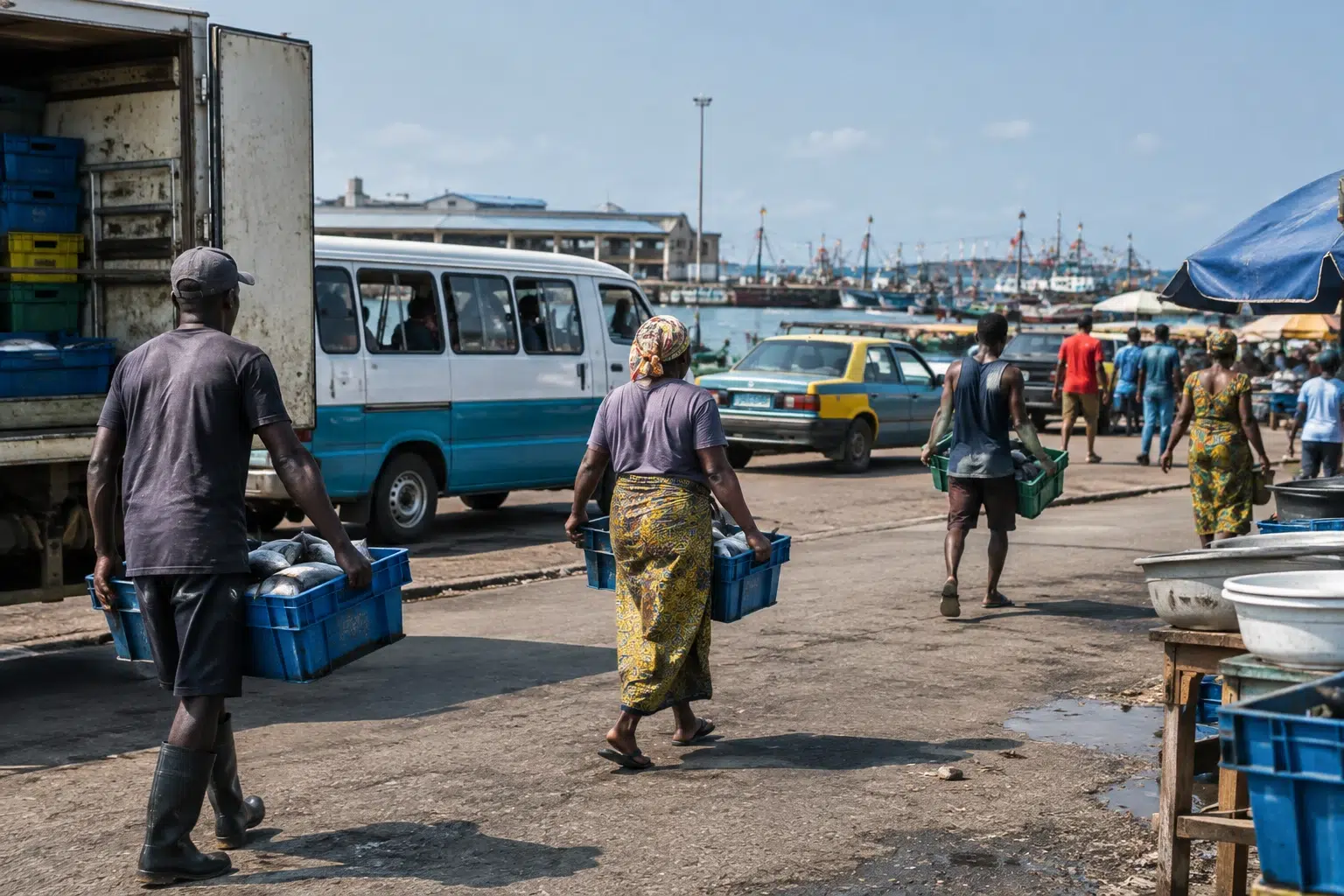
In Accra, the agreement announced with Norway promises expertise and funding to improve the management of Ghanaian waters. But its impact will be measured above all on the ground: in fish landings, coastal incomes and the ability of institutions to enforce the rules.
A partnership within an existing strategy
Ghana is seeking to organise its maritime activities without setting ecosystem protection against economic development. Fisheries, aquaculture, ports and coastal tourism fall into different sectors, but share the same spaces and depend on coherent governance.
The country has published a Sustainable Ocean Plan for 2025-2030. This framework aims to guide the management of marine and coastal environments around several priorities, including ocean health, economic activities and maritime security. The initiative is also part of Ghana’s commitment to the High Level Panel for a Sustainable Ocean Economy. Ghana’s Sustainable Ocean Plan thus sets a national direction that goes beyond fisheries management alone.
At regional level, Ghana is a member of ECOWAS, the Economic Community of West African States. Marine resource management also concerns its coastal neighbours: fish, shipping routes and port activities do not stop at national borders. The West African WASOP programme, run with ECOWAS and the region’s coastal countries, is also working on ocean governance and the blue economy. This regional programme for West African oceans highlights the importance of cooperation that complements national policies.
Five-year agreement subject to budget approval
Ghana and Norway signed a five-year cooperation agreement called “Oceans for Development” on 19 October 2026. The announcement appears in a statement published the same day by Ghana’s Ministry of Finance. According to the ministry, Norwegian support will take the form of technical assistance drawing on the relevant institutions in the Nordic country.
The associated financial contribution is capped at 100 million Norwegian kroner. The amount remains subject to appropriations approved by the Norwegian parliament. It is therefore not a sum guaranteed in full upon signature. Ghana’s Ministry of Finance sets out the terms of the agreement.
The programme aims to strengthen the governance of marine ecosystems and inland waters, improve compliance with environmental and fisheries rules, and reduce illegal, unreported and unregulated fishing. It also plans to support livelihoods and food security. The Fisheries Commission, the Environmental Protection Authority and the Blue Economy Secretariat are among the Ghanaian institutions expected to coordinate its implementation.
Deputy Finance Minister Thomas Nyarko Ampem described the cooperation as a means of strengthening institutions and the responsible management of resources. He also stressed transparency and the effective use of the resources mobilised. These remarks were reported by Ghana’s ministry; no independent assessment of the programme’s results is yet available at the time of the announcement.
Results must be felt in coastal communities
For the authorities, the ocean’s economic value is not limited to exports. Households that depend on fishing, processing and selling fish rely directly on the availability of resources. Better monitoring and more effective rules can help preserve stocks. But their enforcement must also take account of artisanal fishers, whose livelihoods differ from those of large companies or port operators.
The distribution of benefits will therefore be decisive. Stronger governance can protect resources and incomes in the long term; it can also create tensions if restrictions fall mainly on small-scale fishers, without suitable alternatives or support. Likewise, imported expertise will have lasting effects only if Ghanaian administrations have the skills, data and budgets needed to continue the work after the cooperation ends.
The partnership draws on the experience of previous programmes between the two countries, notably in fisheries and oil. This continuity can facilitate technical exchanges. It also makes clarity on responsibilities, expenditure monitoring and measurable objectives important, particularly for coastal communities and the institutions responsible for enforcement.
Next step: coordinating commitments
The Sustainable Ocean Plan and the Norwegian agreement fall under complementary frameworks, but their coordination will need to be practical. In February 2026, Ghana’s Ministry of Foreign Affairs had already reported on government discussions aimed at aligning the blue economy strategy and the ocean plan, with a proposal for a joint technical committee. This institutional coordination initiative is a reminder that the challenge is not simply to attract partners, but to avoid duplication between government departments and programmes.
Across West Africa, Ghana’s experience will be watched for its effects on fisheries management, food security and maritime cooperation. The decisive test will be whether commitments translate into practices that can be monitored: appropriations actually approved, responsibilities clearly allocated and results accessible to citizens. The signing establishes a framework for work; by itself, it is not proof of improvements in resources or incomes.



