Algeria
 Egypt
 Libya
 Morocco
 Sudan
 Tunisia
 Benin
 Burkina Faso
 Cabo Verde
 Côte d'Ivoire
 Guinea
 Guinea-Bissau
 Liberia
 Mali
 Mauritania
 Niger
 Nigeria
 Senegal
 Sierra Leone
 The Gambia
 Togo
 Cameroon
 Central African Republic
 Chad
 DR Congo
 Equatorial Guinea
 Gabon
 Republic of the Congo
 São Tomé and Príncipe
 Burundi
 Comoros
 Djibouti
 Eritrea
 Ethiopia
 Kenya
 Madagascar
 Malawi
 Mauritius
 Mozambique
 Rwanda
 Seychelles
 Somalia
 South Sudan
 Tanzania
 Uganda
 Angola
 Botswana
 Eswatini
 Lesotho
 Namibia
 South Africa
 Zambia
 Zimbabwe
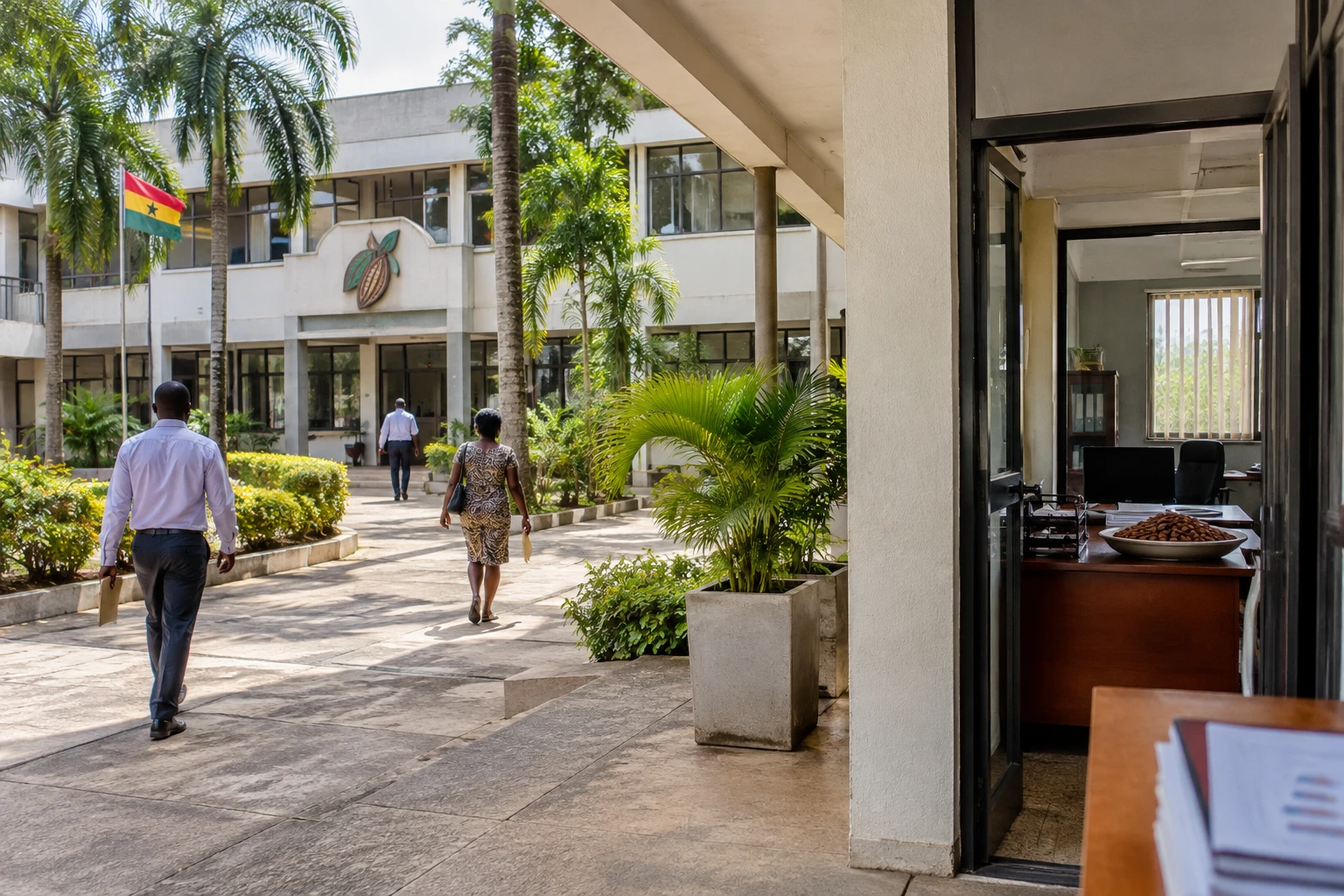
For cocoa farmers, the season does not really begin until buyers can pay for their beans. In Ghana, financing for these purchases now depends more heavily on local savings and investors, following delays with international loans and traders’ advances.
Domestic financing to keep payments flowing
On 5 October 2026, Cocoa Capital, a subsidiary of the Ghana Cocoa Board (COCOBOD), raised 3.39 billion cedis, or about $288 million, on the Ghanaian market. The securities offer a yield of 11% and mature on 28 June 2027. The amount represents about 85% of the 4 billion cedis envisaged for this first issue. These terms have been reported by several Ghanaian and South African media outlets, based on the results of the operation. GBC Ghana Online detailed the fund-raising and its maturity date.
The money is intended to provide liquidity to licensed buying companies (LBCs), which purchase beans from farmers on behalf of COCOBOD. The 2026/2027 season began on 25 September. In mid-September, the Ghana Cocoa Traders’ Chamber estimated that nearly 4 billion cedis was still owed to buyers for the previous season. It warned that these companies were struggling to obtain new credit while their earlier loans remained unpaid.
COCOBOD acknowledged that payments were outstanding, while stating that delays after a season were not new and did not mean it was unable to meet its obligations. The disagreement is therefore also about the significance of these arrears: for buyers, the timing threatens the collection; for the public body, they are part of the usual payment cycle. Citi Newsroom reported both positions.
A broader reform backed by cocoa sales
The first fund-raising is part of a domestic programme of up to 16.3 billion cedis. Presented by Cocoa Capital on 25 September, it provides for up to 14 billion in short-term securities to finance purchases for the 2026/2027 season. The remaining 2.3 billion is to come from medium- or long-term bonds intended to restructure COCOBOD’s old debts. Issues are to be staggered according to cash-flow needs and market conditions. COCOBOD published the programme’s general terms.
The scheme is not financed solely by tax revenues. Repayment is to be backed by receivables from certain forward cocoa sales contracts, transferred to Cocoa Capital. The relevant revenues will pass through dedicated accounts and be distributed according to a defined order of priority. In other words, investors lend on the Ghanaian market, but repayments remain linked to future bean sales.
This arrangement gives Ghana a domestic lever, but does not eliminate commercial risk. Revenues depend in particular on harvest volumes, sale prices and compliance with contracts. In addition, the short-term securities create a repayment deadline as early as 2027. The programme’s success will therefore be measured as much by the regularity of payments to buyers as by COCOBOD’s ability to service its debt.
Limits exposed by previous models
For more than 30 years, COCOBOD financed purchases through syndicated loans, meaning credit facilities involving several international banks. But for the 2023/2024 season, the first tranche did not arrive until 22 December 2023, four months after the season opened, according to COCOBOD’s review. The organisation had forecast a harvest of 800,000 tonnes and committed 786,672 tonnes under contracts. Actual production was limited to 432,145 tonnes. The shortfall led to deferred deliveries and difficulties repaying loans. In July 2024, the Ministry of Finance provided $70 million in bridge financing to prevent a default on the final tranche. COCOBOD’s review covers these delays and production shortfalls.
The mechanism that followed relied more heavily on advances from international traders. It reduced immediate dependence on banks, but left collection contingent on their willingness to finance purchases. In February 2026, the Ghanaian government deemed this model difficult to sustain: according to its analysis, buyers’ interest in advancing funds was waning as old contracts, concluded at less favourable prices, were fulfilled. Turning to the domestic market is therefore an attempt to gain greater control over the timing of liquidity, rather than a complete break from dependence on markets and forward sales.
What is at stake for farmers and the region
The effects will be felt first in production areas. If LBCs actually receive funds on time, they can resume purchases and pay farmers in line with the rules of the sector. If disbursements are delayed, smaller buying companies, which have fewer reserves than major operators, risk cutting back on purchases. Farmers remain the first to bear the brunt of payment delays; the announcement of a fund-raising alone does not guarantee that the money will reach them immediately.
The issue also concerns Ghana’s place in regional trade. A member of ECOWAS, the Economic Community of West African States, the country shares with Côte d’Ivoire a major role in global cocoa supply. Ghana’s difficulties could therefore affect supply schedules and trade relations in the region, although the two sectors are not identical. The question to watch is now a concrete one: will the next planned issues complete the season’s financing, and will payments to licensed companies be fast enough to sustain collection in producing regions?