Algeria
 Egypt
 Libya
 Morocco
 Sudan
 Tunisia
 Benin
 Burkina Faso
 Cabo Verde
 Côte d'Ivoire
 Guinea
 Guinea-Bissau
 Liberia
 Mali
 Mauritania
 Niger
 Nigeria
 Senegal
 Sierra Leone
 The Gambia
 Togo
 Cameroon
 Central African Republic
 Chad
 DR Congo
 Equatorial Guinea
 Gabon
 Republic of the Congo
 São Tomé and Príncipe
 Burundi
 Comoros
 Djibouti
 Eritrea
 Ethiopia
 Kenya
 Madagascar
 Malawi
 Mauritius
 Mozambique
 Rwanda
 Seychelles
 Somalia
 South Sudan
 Tanzania
 Uganda
 Angola
 Botswana
 Eswatini
 Lesotho
 Namibia
 South Africa
 Zambia
 Zimbabwe
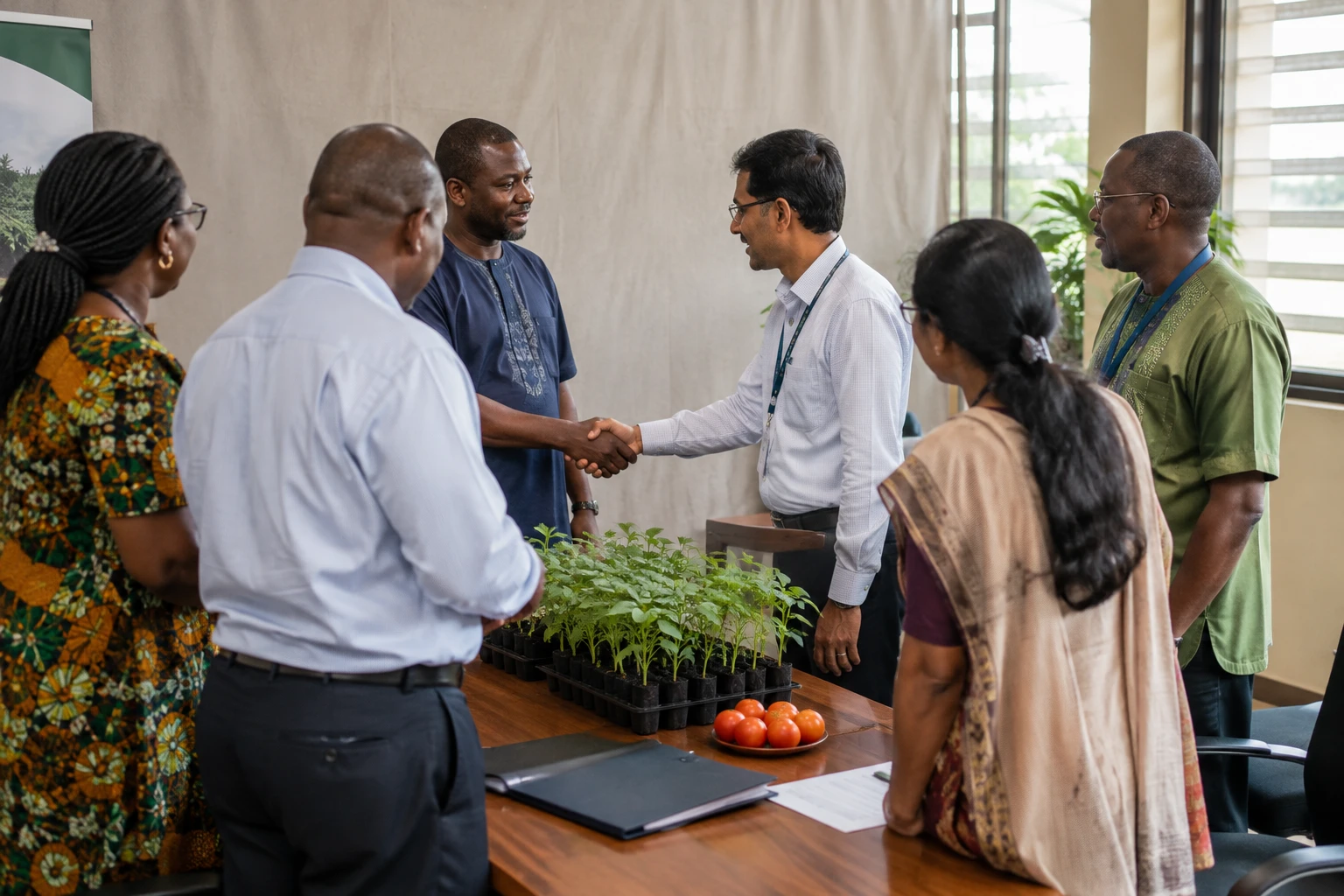
In Ghana, producing more tomatoes depends on more than seeds. Water, markets and equipment capable of preserving harvests are also needed. A new research agreement with India focuses on varieties and the transfer of expertise. Its value, however, will be measured in the fields and all the way to the markets.
Scientific cooperation focused on local needs
On 7 October 2026, the Indian Council of Agricultural Research (ICAR) and Ghana’s Council for Scientific and Industrial Research–Crops Research Institute (CSIR-CRI) signed a five-year memorandum of understanding. It provides for joint research projects, exchanges of scientists and plant material, as well as training and technology transfer. Tomatoes are among the first priorities. The announcement was confirmed by the Indian government and relayed by Ghanaian institutions.
ICAR is expected, in particular, to help disseminate proven agricultural technologies and introduce high-yielding tomato lines and varieties suited to local conditions. Ghanaian company Arima Farms Ltd. is involved in some research and commercialisation activities. The partnership thus brings together two public institutes and a private-sector player, with the aim of bringing scientific research closer to agricultural practice.
This adaptation matters. A variety that performs well in another country will not automatically produce the same results in Ghana. Temperatures, diseases, water availability, farming practices and access to inputs all affect yields. The seeds will therefore need to be tested in different production areas, and their cost and availability to farms assessed.
The shortfall is about more than yields
In March, Agriculture Minister Eric Opoku estimated annual demand for tomatoes at about 805,000 tonnes, against domestic production of 510,000 tonnes. He cited a gap of nearly 300,000 tonnes, made up through imports. These figures, provided by the ministry and reported by Ghanaian news agency GNA, give an indication of the scale of the challenge. They vary, however, according to estimates and the periods considered.
Average yields stand at around eight tonnes per hectare, according to ministerial statements reported by several Ghanaian media outlets. But producing more per hectare will not be enough to secure supply. In March, the ministry also said that nearly 30% of local production could be lost after harvest. Losses, a lack of irrigation and transport difficulties therefore reduce the quantity actually sold.
The effects are not the same for everyone. Consumers may face price rises when local supply falls. Producers, meanwhile, may see their tomatoes spoil or prices drop when several harvests arrive at the same time, without enough buyers or storage capacity. Processors need a regular supply. An increase in production that is not accompanied by organised markets thus risks shifting the problem rather than solving it.
In March, Eric Opoku also announced a target of 15 tonnes per hectare for new seeds developed with Ghanaian institutions. This domestic initiative, separate from the agreement with India, illustrates the importance attached to varietal research. The figures announced remain targets: they are not yet results observed on a large scale among producers.
A broader strategy spanning seeds and markets
The agreement with India is part of a wider agricultural policy. On 15 September, the government launched the Ghana Tomato Self-Sufficiency Initiative (GHATSI), a public-private partnership implemented with FarmMate. It aims to produce 100,000 tonnes in its first phase, in the 2026-2027 season, followed by annual production of 400,000 tonnes in the longer term. These official targets do not guarantee that they will be met: the programme will need to coordinate funding, inputs, irrigation, processing and access to buyers.
The ministry has also set out a roadmap to improve access to quality seeds and seedlings suited to the country. These measures address a structural issue: a significant share of commercial seeds is imported, while local research bodies are seeking to develop varieties suited to Ghanaian conditions. The Indian partnership could bring expertise and genetic material, but its coordination with national institutes and farmers’ needs will be decisive.
For farmers, particularly those operating on a small scale or dependent on rainfall, practical access to new seeds will matter as much as their agronomic potential. Trials will need to be accessible, technical advice available and supplies offered at prices compatible with farm incomes. At the same time, investment in water, roads, storage and processing could help get harvests to urban and rural markets.
A West African issue to watch
The issue extends beyond Ghana’s borders. Within the Economic Community of West African States (ECOWAS), trade in agricultural products links production areas with neighbouring markets. Imports help fill periods of shortage, but they also expose local prices to fluctuations in supply and regional trade policies. The supply crisis in the spring, following a restriction on tomato exports from Burkina Faso, underscored this interdependence.
At the continental level, the partnership is an example of South-South cooperation: an African country and India are pooling research, training and technology. Its value will depend not only on the yields announced, but also on its ability to strengthen Ghanaian expertise over the long term and spread innovations beyond the partner institutions.
The next steps to watch are concrete: publication of varietal trial results, producers’ access to seeds, the results of GHATSI’s first season and changes in post-harvest losses. These are the measures by which the contribution of research to more regular supply, more predictable farm incomes and affordable tomatoes for consumers will be judged.