
 Algeria
 Egypt
 Libya
 Morocco
 Sudan
 Tunisia
 Benin
 Burkina Faso
 Cabo Verde
 Côte d'Ivoire
 Guinea
 Guinea-Bissau
 Liberia
 Mali
 Mauritania
 Niger
 Nigeria
 Senegal
 Sierra Leone
 The Gambia
 Togo
 Cameroon
 Central African Republic
 Chad
 DR Congo
 Equatorial Guinea
 Gabon
 Republic of the Congo
 São Tomé and Príncipe
 Burundi
 Comoros
 Djibouti
 Eritrea
 Ethiopia
 Kenya
 Madagascar
 Malawi
 Mauritius
 Mozambique
 Rwanda
 Seychelles
 Somalia
 South Sudan
 Tanzania
 Uganda
 Angola
 Botswana
 Eswatini
 Lesotho
 Namibia
 South Africa
 Zambia
 Zimbabwe
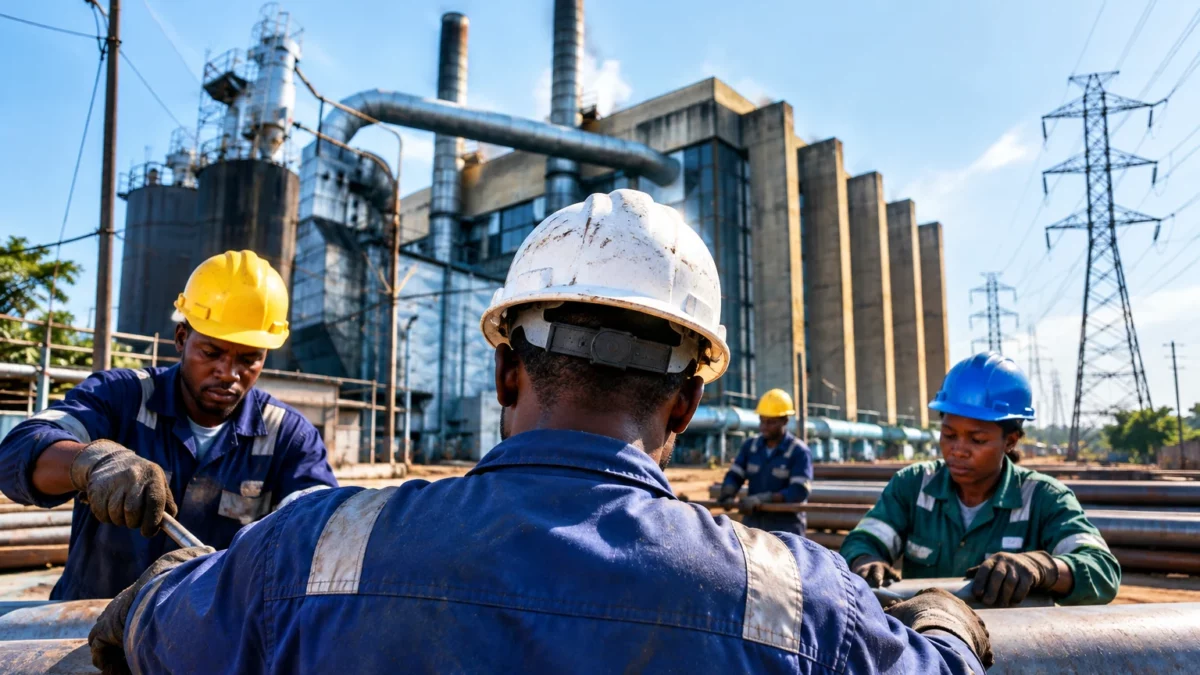
For factories in Dawa and Tema, the issue is not just producing more. It is also about securing affordable electricity, as thermal fuels still dominate Ghana’s power system. New private financing is set to support a solar plant intended to supply more than 95 industrial businesses.
Industrial demand weighs heavily
In Ghana, industry consumed 8,585 GWh of electricity in 2024, or 42.3% of national consumption, according to the Energy Commission. This was the largest share among the sectors recorded, ahead of households at 41.4%. Industrial activity is therefore highly dependent on the continuity and cost of supply.
The energy context makes this issue tangible. In 2025, thermal plants supplied 66.8% of the electricity produced in Ghana, compared with 32.4% for hydropower. Grid-connected solar and the other renewables recorded accounted for just 0.8%. The Energy Commission also reported rising demand and increased use of liquid fuels to offset constraints on gas supply. Data from Ghana’s Energy Outlook 2026 thus describe a system in which diversification remains a major undertaking.
This dependence affects the sector’s finances as well as businesses. When thermal generation relies more heavily on costly fuels, manufacturers remain exposed to supply pressures and cost fluctuations. For those processing cocoa, cement or steel, electricity has a direct bearing on production costs and the ability to fulfil contracts.
A phased project in Dawa
On 12 November 2026, the Emerging Africa & Asia Infrastructure Fund (EAAIF) announced a commitment of $18.15 million for the first phase of a 100 MWp solar photovoltaic plant in Dawa, in the Greater Accra Region. The project is being developed by Solar for Industries, a subsidiary of Ghanaian group LMI Holdings. The announced sum comprises $15.65 million from EAAIF and $2.5 million from Ninety One’s Africa Credit Opportunities strategy. EAAIF’s financing announcement describes the plant as the first stage of a project expected to reach 200 MW.
The total cost of this first phase is estimated at $88.6 million. The financing package combines $60.6 million in debt, mobilised with the International Finance Corporation (IFC) and the International Development Association (IDA), with $28 million in equity from LMI Holdings. EAAIF and Ninety One’s contribution forms part of this overall financing.
Annual generation is expected to reach 129.5 GWh. Enclave Power Company, another LMI subsidiary, is to transport the electricity over about 40 kilometres via the national grid to the industrial zones of Dawa and Tema. The power will therefore travel over shared infrastructure, while distribution to businesses will be handled by a private operator. The arrangement combines solar generation with transmission over Ghana’s grid, rather than limiting supply to the plant site.
The project was publicly launched in November 2025, with the first 100 MWp phase announced for December 2026. Ghana’s presidency had at the time referred to a subsequent installation of a further 100 MW. This deadline does not confirm that the plant will be commissioned: in its November 2026 announcement, EAAIF still described the project as under development. The presidency’s statement on the launch of construction also set out a longer-term ambition to expand the project.
Savings promised, but not yet quantified
For manufacturers, the expected benefit is cleaner, cheaper energy. But the electricity sale tariff and the charges associated with its transport have not been published in the available information. The promised savings therefore remain an expectation to be tested, rather than a gain that businesses can already measure.
How the benefits are distributed will also depend on access arrangements. Businesses in the areas served are the first to benefit; households and economic activity elsewhere will not automatically receive this dedicated generation. The project could, however, reduce some of the industrial demand met by thermal plants. Its impact on the grid as a whole will depend on commissioning, actual performance, and the rules governing injection and transmission.
The development of a private distributor raises another issue: co-ordination between businesses, private operators and the national grid. Enclave Power Company will provide the planned commercial supply, but the electricity will travel through the country’s infrastructure. The system’s reliability will therefore also depend on transmission agreements, grid capacity and tariff transparency.
Solar provides renewable generation, but its output varies throughout the day. The announced plant does not, on its own, guarantee a continuous supply. The sources consulted do not specify an associated storage system. It will therefore be important to track how solar generation is integrated with other sources and meets factories’ needs when sunshine levels fall.
A test for industrialisation and the energy transition
Nationally, the facility forms part of Ghana’s aim to increase the share of renewables in its electricity mix. The Energy Commission notes that renewable generation excluding large-scale hydropower remains very low. The projected annual output at Dawa would be significant compared with grid-connected solar generation in 2025, but would represent only a fraction of total electricity generation. A comparison of generation and consumption figures highlights this difference in scale.
The project is also of interest to West Africa, where the Economic Community of West African States (ECOWAS) brings the region’s countries together around economic and energy co-operation. For economies seeking to process more raw materials locally, the question is similar: how to generate enough electricity at a sustainable cost without deepening dependence on fuels.
The Dawa project will not solve this equation on its own. Its importance will be measured by its results: the actual commissioning date, the energy delivered, the price paid by businesses and the reliability of transmission to Tema. These factors will show whether the partnership between a Ghanaian group, international financiers and a private distributor can become a replicable model, or remain a solution concentrated in two industrial zones.



