Algeria
 Egypt
 Libya
 Morocco
 Sudan
 Tunisia
 Benin
 Burkina Faso
 Cabo Verde
 Côte d'Ivoire
 Guinea
 Guinea-Bissau
 Liberia
 Mali
 Mauritania
 Niger
 Nigeria
 Senegal
 Sierra Leone
 The Gambia
 Togo
 Cameroon
 Central African Republic
 Chad
 DR Congo
 Equatorial Guinea
 Gabon
 Republic of the Congo
 São Tomé and Príncipe
 Burundi
 Comoros
 Djibouti
 Eritrea
 Ethiopia
 Kenya
 Madagascar
 Malawi
 Mauritius
 Mozambique
 Rwanda
 Seychelles
 Somalia
 South Sudan
 Tanzania
 Uganda
 Angola
 Botswana
 Eswatini
 Lesotho
 Namibia
 South Africa
 Zambia
 Zimbabwe
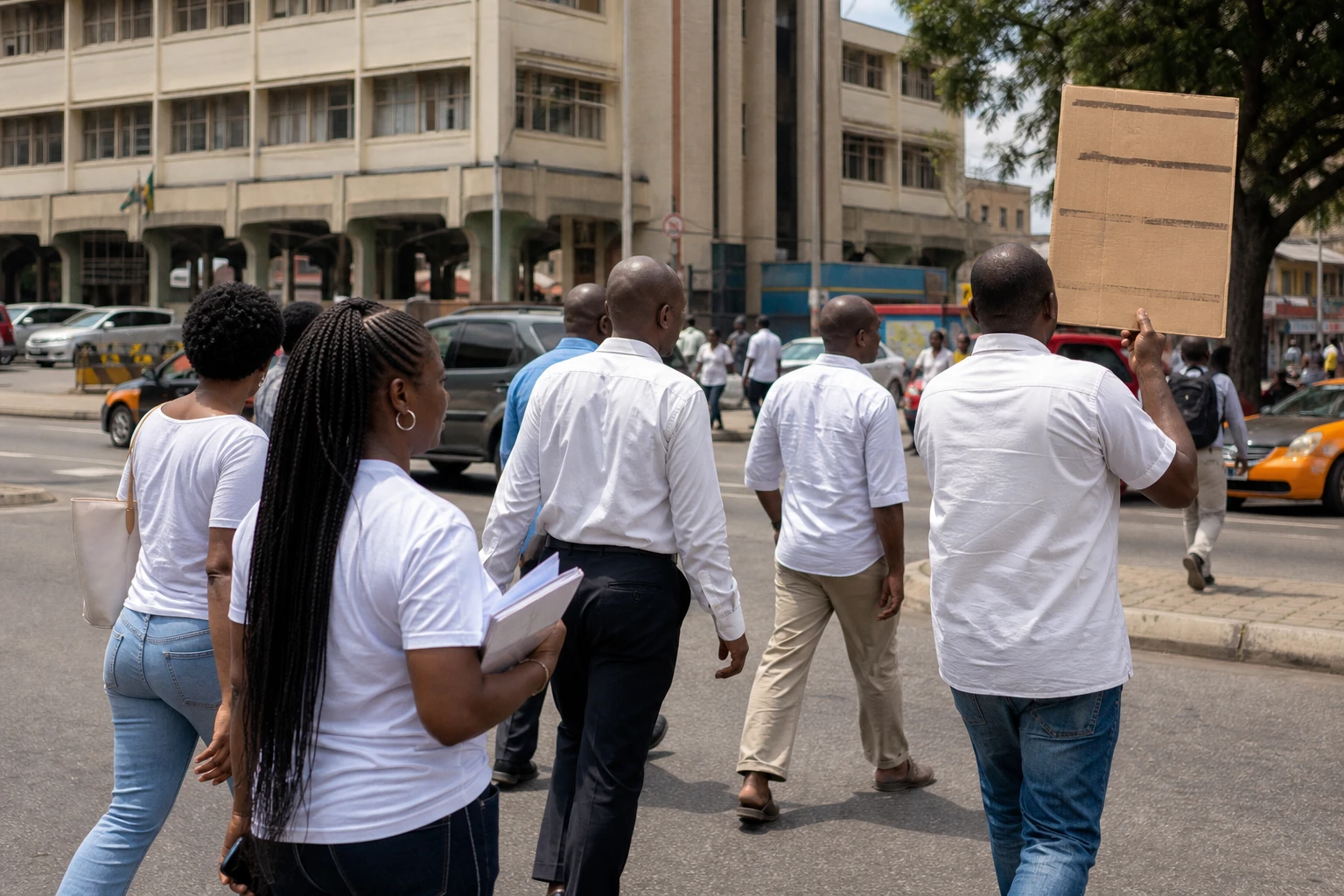
In Accra, the fight against corruption is no longer being waged only in the courts. It is also playing out in the streets, as citizens demand that accountability transcend partisan changes of power. On Friday 2 October 2026, a rally organised by the Democracy in Progress collective put this demand at the centre of Ghana’s public debate.
A citizens’ rally in the capital
Demonstrators gathered in the streets of Accra dressed in white, carrying placards calling for the law to take precedence over political loyalties. Their message was simple: public officials must answer for how they manage state resources, regardless of their party affiliation.
The collective says it acts without a party mandate. It is calling, however, for investigations into former officials to continue and for any misappropriated funds to be recovered. A petition was due to be submitted to the institutions concerned, including the presidency and the judiciary.
The organisers also want to extend their initiative to other regions of Ghana. This would give the rally a national dimension beyond the capital alone. It could also gauge the actual reach of a movement that presents itself as civic and non-partisan.
The debate comes in a country where changes of power between the National Democratic Congress, or NDC, and the New Patriotic Party, or NPP, strongly shape political life. Since John Dramani Mahama returned to the presidency in January 2025, every case involving a former NPP official has been viewed through this lens.
ORAL, a promise turned political test
The rally builds on Operation Recover All Loot, known by the acronym ORAL. The initiative gathers reports of suspected corruption and mismanagement for referral to the relevant authorities.
The ORAL committee submitted its first report to the presidency in February 2025. The Ghanaian presidency then said 36 cases had been reviewed, with an estimated value of $20.49 billion. This figure is an estimate of the cases examined, not a final judicial assessment. It is therefore not, on its own, enough to establish the extent of each loss.
President John Dramani Mahama had promised that the operation would not target only members of the former administration. In a statement reported by the Ghana News Agency, he said that officials from his own camp would be held to the same standard.
It is precisely on this point that political pressure is now focused. An anti-corruption campaign gains credibility when it produces transparent proceedings, robust cases and equal application of the law. Conversely, poorly explained decisions to drop prosecutions quickly fuel suspicion that justice is being applied selectively.
Dropped prosecutions fuel controversy
In January 2025, prosecutors dropped the charges against Stephen Opuni, former chief executive of the Ghana Cocoa Board, and businessman Seidu Agongo. They faced 27 counts, including alleged fraud, money laundering and wilfully causing financial loss to the state. The case was discontinued before it concluded, as reported by the Ghana News Agency.
The following month, prosecutors also entered a nolle prosequi in the Saglemi housing project case. This legal procedure allows the prosecution to end proceedings. The case involved Collins Dauda, former Minister for Water Resources, Works and Housing, as well as several co-defendants.
The case concerned an affordable housing project valued at $200 million. The accused denied the allegations against them. The Accra High Court ultimately discharged them after the charges were dropped, according to the Ghana News Agency and Ghanaian daily Graphic Online.
Justice Minister Dominic Ayine defended the decisions, citing a lack of evidence in some cases. Legally, dropping a prosecution does not amount to a conviction. Politically, however, it requires the government to explain its choices, particularly when they involve figures linked to the governing party.
The Wontumi case at the heart of the NPP’s counterattack
The NPP alleges that targets are being selected on political grounds. The party points in particular to Bernard Antwi-Boasiako, better known as Chairman Wontumi, a former NPP regional official in the Ashanti Region. His case concerns the Ghana Export-Import Bank, a public institution tasked with supporting foreign trade and financing Ghanaian businesses.
In September 2026, prosecutors filed new charges in the case, including alleged fraud, the use of forged documents and money laundering. The next hearing was set for 13 October 2026, according to information available on the case’s referral to the Accra High Court.
At this stage, the allegations remain contested and do not constitute a finding of guilt. Their political significance is nevertheless considerable. The NPP argues that cases against its officials are moving forward while those involving NDC figures are being halted or reviewed.
This criticism does not absolve the opposition of the need to answer allegations against its own members. It does, however, underscore a central rule of the rule of law: the fight against corruption must be measured against public criteria, traceable procedures and reasoned decisions.
A test for Ghana’s institutions
For the public, the stakes go beyond the contest between the NDC and the NPP. Corruption cases have a direct impact on public services, state finances and trust in institutions. They also affect citizens differently: lower-income households feel the effects of failing services more quickly, while informal-sector businesses have fewer resources to absorb delays, costs and uncertainty.
In Accra, the protest is taking visible form. In the regions, it could focus on unfinished projects, public contracts and access to essential services. The challenge will therefore be to turn a national demand for transparency into concrete oversight mechanisms, without reducing the debate to a confrontation between supporters of rival parties.
Ghana remains one of West Africa’s most closely watched electoral democracies. It is a member of ECOWAS, the Economic Community of West African States, where the credibility of national institutions also shapes regional confidence. In a region marked by political crises and military transitions, a country’s ability to handle corruption cases in accordance with due process sends an important signal.
The next step will be judicial, with the hearing announced for 13 October 2026 in the case linked to Ghana Exim Bank. It will also be political: the authorities will have to show whether ORAL can become a lasting tool of public oversight or remain associated with a change of government and its opponents. For the Democracy in Progress collective and the parties alike, the question is now the same: will accountability really apply to all political camps?