Algeria
 Egypt
 Libya
 Morocco
 Sudan
 Tunisia
 Benin
 Burkina Faso
 Cabo Verde
 Côte d'Ivoire
 Guinea
 Guinea-Bissau
 Liberia
 Mali
 Mauritania
 Niger
 Nigeria
 Senegal
 Sierra Leone
 The Gambia
 Togo
 Cameroon
 Central African Republic
 Chad
 DR Congo
 Equatorial Guinea
 Gabon
 Republic of the Congo
 São Tomé and Príncipe
 Burundi
 Comoros
 Djibouti
 Eritrea
 Ethiopia
 Kenya
 Madagascar
 Malawi
 Mauritius
 Mozambique
 Rwanda
 Seychelles
 Somalia
 South Sudan
 Tanzania
 Uganda
 Angola
 Botswana
 Eswatini
 Lesotho
 Namibia
 South Africa
 Zambia
 Zimbabwe
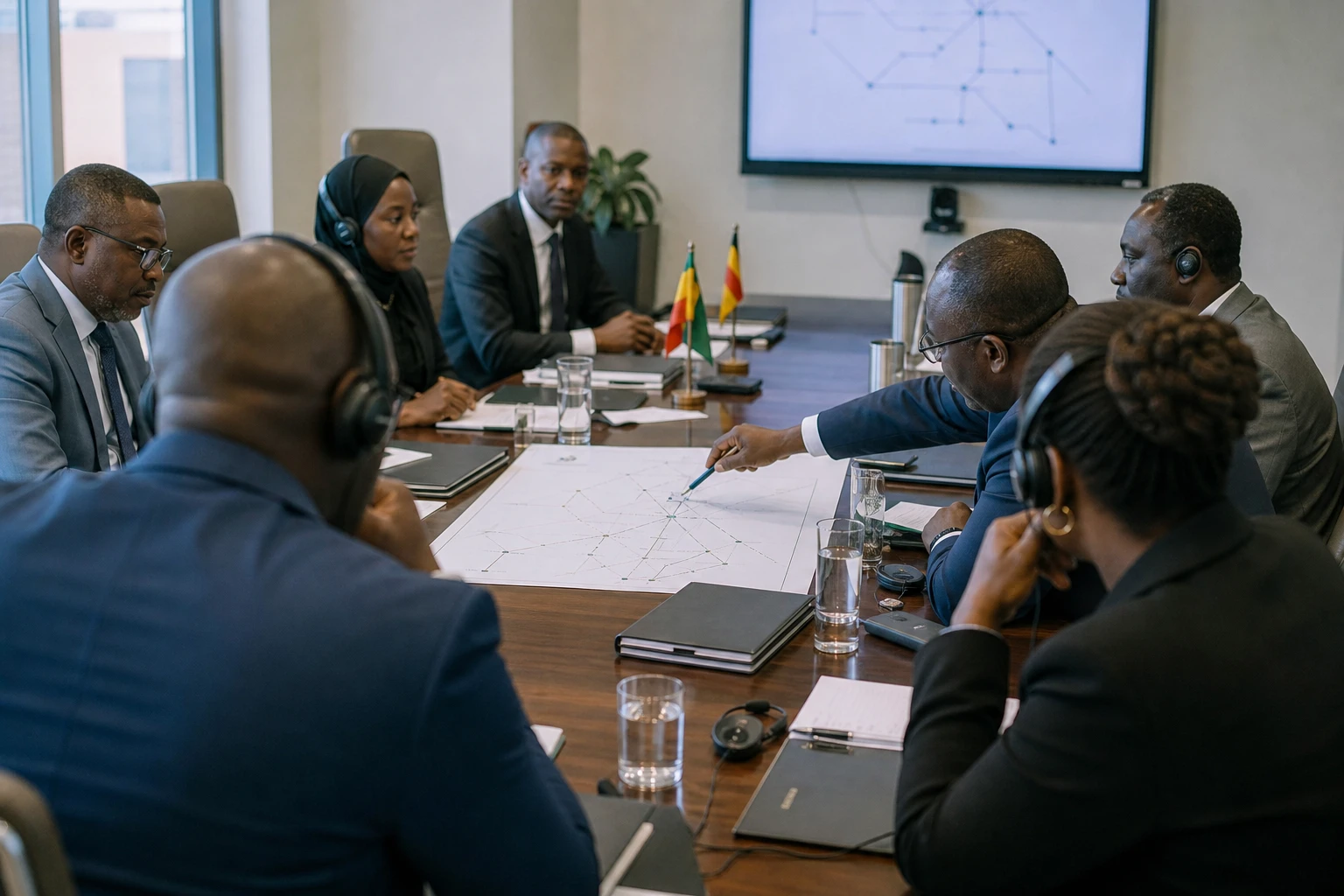
Northern Ghana is still looking for the right shortcut to broadband
In several parts of Ghana, the question is no longer simply who has a phone. It is who can actually get online, afford a reliable service and derive economic benefit from it. The gap remains visible in the north of the country, even as digital use grows nationwide. Internet penetration is now close to 70%, but many districts in the northern regions remain below that average.
For people in Ghana’s secondary cities, schools, health centres and small businesses, the real issue is infrastructure. Without a network to carry digital traffic, services remain slow, expensive or uneven. Csquared wants to address this gap with an aerial fibre-optic project running along power lines in northern Ghana.
A project building on an existing national strategy
Ghana is not embarking on its first network-sharing project. In 2021, Ghana Grid Company signed an agreement with Csquared to lease fibre capacity from its electricity transmission infrastructure, a model presented as a faster and less costly route to digital coverage. The new project extends that approach, shifting its focus to the north of the country and to the networks of NEDCo, the distribution subsidiary that covers about 64% of Ghana’s land area, according to the Volta River Authority.
This continuity matters. Connectivity in Ghana depends on more than telecoms operators. It also rests on the ability to use public or semi-public assets, such as pylons and electricity corridors, to cut deployment costs. In a market where competition is also shaped by wholesale prices, an open-access network can change the equation for internet service providers, public authorities and decentralised services.
What the agreement signed in Accra provides for
On 9 September 2026, USTDA announced in Accra a feasibility-study funding agreement with Csquared Ghana. The study will assess the commercial viability of a fibre network laid along the electricity distribution lines operated by NEDCo, estimate market demand, specify technical requirements and develop a financing strategy. The US agency also describes the project as open-access infrastructure, meaning a network that several operators can lease rather than each building their own lines.
The rationale for the arrangement is clear. Csquared is not just seeking to carry data. The company also aims to create a leasable asset capable of generating wholesale revenue from mobile operators, internet service providers, schools, hospitals, public authorities and businesses. The study must therefore determine whether northern Ghana’s market can support this model, and at what cost.
The project is being developed in a society where usage figures still point to a clear digital divide. The Ghana Statistical Service said that in several northern regions, the share of people not using the internet remained above half in 2021, with a marked north-south divide. The World Bank Africa blog, meanwhile, noted that usage rates vary sharply between districts, from 24% in some northern areas to 92% in some urban coastal areas.
What aerial fibre could mean for local stakeholders
For operators, the proposal makes financial sense. Leasing shared infrastructure is often cheaper than building an entire fibre network from scratch. For consumers, the expected benefits are better service quality, more wholesale competition and, in time, more affordable prices. For public authorities, the stakes are broader: connecting less well-served areas to basic digital services.
Northern Ghana is not economically peripheral. It is a hub for movement, agricultural trade, education and public services, connected to the rest of the country and, in some places, neighbouring states. NEDCo also supplies some border communities in Burkina Faso, Côte d’Ivoire and Togo, a reminder that Ghanaian infrastructure often has a subregional reach. Fibre installed along these routes could therefore support commercial and institutional activity beyond Ghana’s borders.
The project must still clear a decisive hurdle: the feasibility study. Until profitability is demonstrated, financing remains to be secured and implementation is not guaranteed. Experience nevertheless shows that the growth of wholesale networks, in West Africa and elsewhere on the continent, is becoming a lever for competitiveness. It can reduce infrastructure duplication, a key issue in markets where deployment costs still hinder service expansion.
A development to watch in West Africa
At the regional level, the project points to a broader trend within ECOWAS: connectivity is no longer advancing only along major coastal routes, but also through shared-use solutions that make better use of existing infrastructure. Ghana, often described as a relatively advanced digital market in the subregion, shows here that a country can have high nationwide penetration while still leaving some areas far behind.
This tension between overall progress and local inequalities is also of interest to the African Union, which has for several years promoted digital integration and the African Continental Free Trade Area. Without reliable regional backbones and affordable last-mile connections, the movement of digital services, payments and data remains incomplete. The Csquared-NEDCo project is therefore about more than a single investment; it signals a strategy of connecting areas where the market alone is not moving fast enough, without simply duplicating existing networks.