
 Algeria
 Egypt
 Libya
 Morocco
 Sudan
 Tunisia
 Benin
 Burkina Faso
 Cabo Verde
 Côte d'Ivoire
 Ghana
 Guinea
 Guinea-Bissau
 Liberia
 Mali
 Mauritania
 Niger
 Nigeria
 Senegal
 Sierra Leone
 The Gambia
 Togo
 Cameroon
 Central African Republic
 Chad
 Equatorial Guinea
 Gabon
 Republic of the Congo
 São Tomé and Príncipe
 Burundi
 Comoros
 Djibouti
 Eritrea
 Ethiopia
 Kenya
 Madagascar
 Malawi
 Mauritius
 Mozambique
 Rwanda
 Seychelles
 Somalia
 South Sudan
 Tanzania
 Uganda
 Angola
 Botswana
 Eswatini
 Lesotho
 Namibia
 South Africa
 Zambia
 Zimbabwe
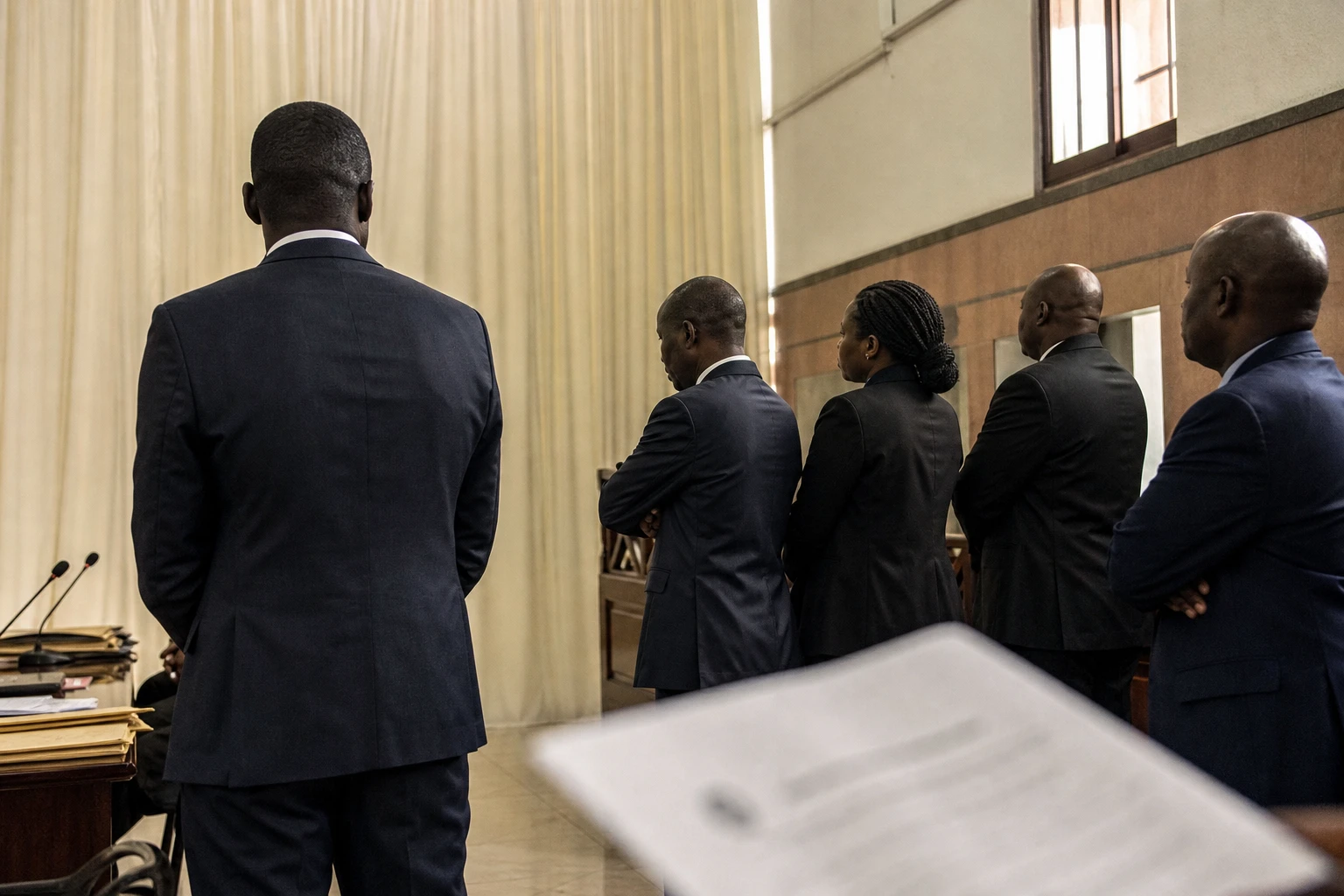
In Kinshasa, a fund meant to compensate victims is at the centre of a second legal battle
In the Congolese capital, a budgetary case has taken on political and symbolic significance. It touches on justice, reparations for victims and confidence in public financial management, at a time when the Democratic Republic of the Congo is still seeking to turn promises of compensation into concrete action. The trial linked to FRIVAO, the fund responsible for providing reparations and compensation to victims of Uganda’s illicit activities in the DRC, is part of this wider tension.
The issue goes beyond the fate of Constant Mutamba. It concerns the implementation of a decision by the International Court of Justice, which in 2022 set the amount owed by Uganda to the DRC at $325 million, to be paid in five annual instalments of $65 million starting on 1 September 2022. Kinshasa then announced the creation of a dedicated mechanism, FRIVAO, to manage these reparations.
Prosecutors’ demands on 19 August follow several months of proceedings
On Wednesday 19 August 2026, prosecutors sought 15 years of forced labour for former Justice Minister Constant Mutamba and his co-defendant Chançard Bolukola in the FRIVAO case. The prosecution also requested additional penalties, including a five-year ban on voting and standing for election after the sentence has been served, a ban on holding public and public-sector posts, and joint repayment of the disputed sums. This remains a request by the prosecution and does not amount to a conviction.
The case opened before the Court of Cassation in Kinshasa on 21 April 2026, followed by several adjournments and procedural hearings. On 13 July, the court summoned Constant Mutamba and Chançard Bolukola to appear. On 27 July, the former minister walked out of the hearing, denouncing serious irregularities. On 5 August, closing arguments were postponed until 19 August.
According to information presented during the investigation, prosecutors accuse the defendants of several disbursements deemed irregular, totalling more than $20 million. The disputed transactions include $14.299 million for Congo Energy, $4 million for the Congolese Institute for Nature Conservation, $200,000 for the Tshopo Provincial Assembly, $1.024 million for Divo SARL and $715,864 for Tropic Architecture. Other sources cited in the proceedings also refer to payments to Global Assurance Service.
What the case reveals about reparations for conflict in Central Africa
FRIVAO emerged from a difficult context: the Six-Day War in Kisangani at the turn of the 2000s, and the ICJ ruling on Uganda’s armed activities in the DRC. In practice, it was intended to channel international reparations to Congolese victims. When such a mechanism is suspected of mismanagement, the stakes are twofold: to punish any potential abuses, while also preserving the credibility of a reparative justice mechanism awaited by the families concerned.
For the Congolese state, the case affects the reputation of the public spending system and the justice system’s ability to handle sensitive cases without political protection. For residents of Kisangani and Tshopo, it raises a simple question: will funds linked to reparations actually reach victims, collective projects and affected communities, or disappear into opaque channels? In an economy where a large share of activity remains informal, even a small loss of trust in institutions can quickly affect daily life.
Constant Mutamba’s name gives the case added political significance. The former justice minister was already sentenced on 2 September 2025 to three years of forced labour in a separate embezzlement case, this time linked to a prison project in Kisangani. That earlier conviction has reinforced, in the public eye, the image of a legal dispute that has become central to his political trajectory. It also serves as a reminder that the Court of Cassation remains one of the places where power dynamics between the government, the justice system and the criminal accountability of senior officials play out in the DRC.
A Congolese case with repercussions far beyond Kinshasa
At regional level, the case points to a question that has become continental: how can international reparations decisions be put into practice in states marked by conflict, population displacement and competition between security emergencies and transitional justice? In Central Africa, where CEMAC has no comparable judicial mechanism, the DRC is often seen as an imperfect test case for post-conflict reparations.
The case also comes amid continued insecurity in the east of the country. The African Union recently called for de-escalation in the Kisangani region and eastern DRC, warning that attacks on civilian infrastructure worsen national and regional fragility. In this context, reparations mechanisms are not merely an accounting matter. They are part of the political response to the memory of conflict and the rebuilding of public trust.
The next decisive step now lies with the Court of Cassation. It will have to determine whether the alleged facts have been established, and to what extent. Beyond the Mutamba case, the trial puts the DRC’s ability to protect reparations funds, ensure accountability and strengthen the credibility of its institutions in the balance.



