Algeria
 Egypt
 Libya
 Morocco
 Sudan
 Tunisia
 Benin
 Burkina Faso
 Cabo Verde
 Côte d'Ivoire
 Ghana
 Guinea
 Guinea-Bissau
 Liberia
 Mali
 Mauritania
 Niger
 Nigeria
 Senegal
 Sierra Leone
 The Gambia
 Togo
 Cameroon
 Central African Republic
 Chad
 Equatorial Guinea
 Gabon
 Republic of the Congo
 São Tomé and Príncipe
 Burundi
 Comoros
 Djibouti
 Eritrea
 Ethiopia
 Kenya
 Madagascar
 Malawi
 Mauritius
 Mozambique
 Rwanda
 Seychelles
 Somalia
 South Sudan
 Tanzania
 Uganda
 Angola
 Botswana
 Eswatini
 Lesotho
 Namibia
 South Africa
 Zambia
 Zimbabwe
A fund financed by mining does not fulfil its promise simply by spending its revenues. It must also preserve some of the wealth and account for what it yields. In the Democratic Republic of the Congo (DRC), the launch of a major subsurface mapping project has brought this requirement back into focus.
A savings vehicle facing a question of trust
The Mining Fund for Future Generations (FOMIN) was established as part of the 2018 reform of the Mining Code. Its purpose is to convert some of the revenue from non-renewable resources into lasting wealth. This can be done through saving, investment or projects linked to geological knowledge and economic diversification.
This ambition concerns a sector central to Congolese public finances, but whose benefits are not automatically shared among the state, mining areas and households. Formal companies pay royalties; local authorities and provinces receive shares prescribed by law. At the same time, artisanal activities and regions far from major mining centres do not necessarily benefit from the same redistribution channels.
FOMIN also operates in a region where minerals cross borders. The DRC is a member of the Southern African Development Community (SADC), which brings together states in southern Africa, and the East African Community (EAC). Traceability, knowledge of deposits and local processing therefore have national and regional implications.
Mapping, the first operational showcase
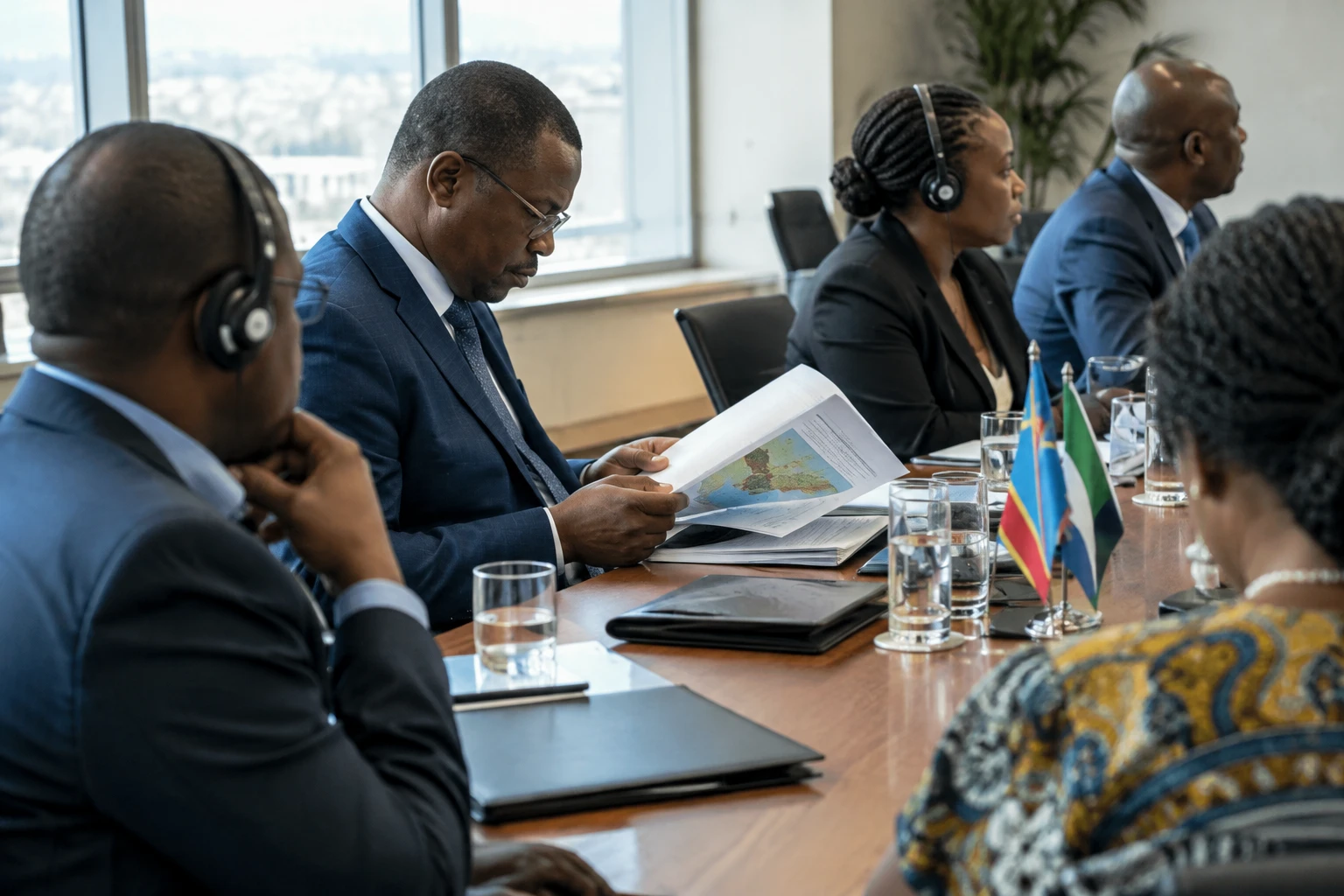
On 5 October 2026, in Kinshasa, the authorities launched the DRC Airborne Geophysical and Geological Mapping Project, known as PC2G-RDC. Funded by FOMIN and implemented with the Congo National Geological Survey, the programme is intended to improve knowledge of the subsurface. Aerial surveys identify anomalies; subsequent ground work is intended to verify them.
The project follows a contract signed in January 2026 with the Spanish company Xcalibur Multiphysics Group SL, for an announced sum of $297.87 million. This new phase builds on a research programme whose initial contract dates back to 2017. In 2025, the Fund’s director-general referred to a commitment of $60 million, of which $24 million had already been disbursed for the initial operations. These amounts relate to separate stages and contracts: they should not be added together as though they described a single allocation.
Mapping can strengthen the state’s ability to negotiate with investors and plan exploration. But knowledge of a deposit guarantees neither responsible exploitation, nor the creation of local jobs, nor funding for public services. These outcomes will depend on investment choices, the applicable rules and project monitoring.
Significant revenues, but accounts that need clarifying
It took time to establish the Fund. Between 2018 and 2021, revenues were deposited in an escrow account managed by the Mining Cadastre, pending the establishment of FOMIN’s governing bodies. The Extractive Industries Transparency Initiative in the DRC (EITI-DRC) reports that Fund officials referred to $68 million collected during this period, of which $30 million was transferred. EITI says, however, that the supporting documents requested did not substantiate these amounts or their transfer.
The first executives were appointed in December 2021. Then, in 2023, management rules were revised and FOMIN’s share of the mining royalty was set at 8%, down from 10%. The royalty is a levy paid by holders of mining rights. The 2023 allocation decree also assigns shares to the central government, provinces, decentralised territorial entities and the National Fund for Reparations for Victims (FONAREV).
A study by the Centre for Research in Public Finance and Local Development (CREFDL), published in September 2026, estimates that FOMIN received $857 million between 2020 and the first half of 2025. It identifies $441 million allocated to 11 projects and programmes, and about $415 million unused within the scope of the study. These figures are those of CREFDL’s analysis: they do not, on their own, constitute a certified statement of the Fund’s net assets.
The same study identifies discrepancies between investment spending reported to parliament and that recorded in financial accountability documents. It also notes that budget documents do not provide a complete picture of funding. These findings make it difficult for elected representatives and the public to track where the money goes and assess the results achieved.
Investing, yes, but with verifiable rules
FOMIN has also acquired stakes in commercial activities. In November 2024, DRC Gold Trading announced that its capital was held 55% by the Congolese state, 30% by FOMIN and 15% by Gécamines. The company aims to organise the collection and marketing of artisanal gold. This stake could support the formalisation of the sector; its value for future generations will nevertheless depend on its profitability, governance and publication of results.
In 2026, the government also approved the creation of ADEX RDC, a joint venture equally owned by FOMIN and ADEX Platform AG. The project aims to modernise the diamond sector and develop more local value-adding activities. Here too, the announcement of a partnership is not enough to measure its benefits: the investments actually made, the risks taken by the Fund and any income received will need to be known.
Congolese organisations, including Afrewatch and La Sentinelle, have called for an independent audit and regular publication of revenues, expenditure, stakes and returns. They are particularly concerned about the lack of public information on investment choices and oversight procedures. These are civil society warnings, not judicial findings; they nevertheless highlight an accountability requirement set out in the Fund’s management rules.
The test: turning resource revenues into lasting wealth
For communities near mining sites, the issue is concrete: are subsurface revenues being translated into infrastructure, skills and economic activities that endure after deposits are exhausted? For the national budget, the question is different: how can long-term saving be reconciled with immediate public needs without blurring parliamentary oversight?
PC2G-RDC gives FOMIN a visible achievement, while its investments in gold and diamonds expand its role. The next step will be to make these commitments assessable: publish audited accounts, specify project selection rules and document expected benefits as well as risks. At regional level, the DRC’s ability to gain better knowledge of its resources and capture their value will also matter in cross-border mining trade. The Fund’s intergenerational promise will be judged less by the amount committed than by transparency and the lasting revenues actually preserved.