Algeria
 Egypt
 Libya
 Morocco
 Sudan
 Tunisia
 Benin
 Burkina Faso
 Cabo Verde
 Côte d'Ivoire
 Ghana
 Guinea
 Guinea-Bissau
 Liberia
 Mali
 Mauritania
 Niger
 Nigeria
 Senegal
 Sierra Leone
 The Gambia
 Togo
 Cameroon
 Central African Republic
 Chad
 DR Congo
 Equatorial Guinea
 Gabon
 Republic of the Congo
 São Tomé and Príncipe
 Burundi
 Comoros
 Djibouti
 Eritrea
 Ethiopia
 Kenya
 Madagascar
 Malawi
 Mauritius
 Mozambique
 Rwanda
 Seychelles
 Somalia
 South Sudan
 Tanzania
 Uganda
 Angola
 Botswana
 Eswatini
 Lesotho
 Namibia
 South Africa
 Zambia
 Zimbabwe
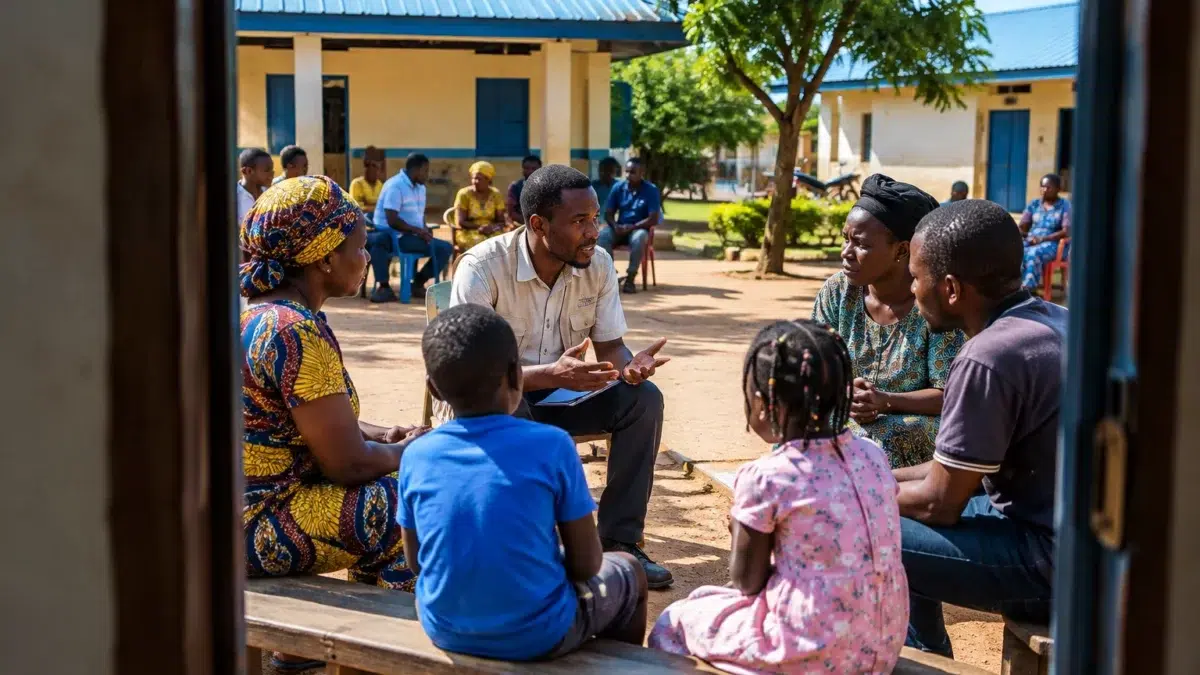
When aid budgets contract, knowing which programmes genuinely protect people becomes more than a methodological concern. In the Central African Republic, a family support initiative aims to reduce the risk of children joining armed groups. But the results announced should be treated with caution: public information on the evaluation does not yet confirm a final quantified impact.
A global decline intensifies tough choices
In 2025, official development assistance from the member and associate countries of the OECD’s Development Assistance Committee fell by 23.1% in real terms compared with 2024. This was the steepest annual drop on record, bringing funding down to $174.3bn, according to preliminary data published by the organisation on 9 April 2026. Humanitarian aid also declined. Final figures are due to be published in December 2026.
This trend extends the decline already seen in 2024, but it does not mean that every African country experienced the same change. That year, total aid to sub-Saharan Africa rose by 5.2%, driven in particular by multilateral organisations. Aggregate data therefore mask differences between countries, sectors and forms of funding. For governments and local organisations, the question is twofold: which budgets will remain available, and how can they be used to best effect?
In this context, the Humanitarian Protection Initiative (HPI), run by J-PAL and Innovations for Poverty Action, funds research into protecting people affected by conflict. J-PAL is an economic research network that studies the effects of public policies. The initiative focuses in particular on violence, the psychological consequences of abuse and ways to prevent conflicts from escalating.
Supporting families to protect children in the Central African Republic
In the Central African Republic, a landlocked country in Central Africa whose capital is Bangui, the “Growing Up Together” programme aims to strengthen the skills of adults caring for children. Run by the International Rescue Committee (IRC), it includes group and family sessions. Its aim is to reduce the risk of children being recruited or re-recruited into armed groups, and to support their reintegration into their families.
The stakes go beyond immediate security. Children associated with armed groups may be exposed to violence and lasting ruptures with those around them. Their relatives, meanwhile, often have to support their return while coping with the difficulties of everyday life. The programme therefore focuses on the family environment and parenting practices, rather than on an intervention aimed at the child alone.
A presentation of the programme attributes encouraging results to researcher Kathryn Falb of Johns Hopkins University: improved family well-being, a decline in severe disciplinary practices and lower levels of children’s involvement in armed groups. A reduction of about one-third was cited for the last of these indicators, but analyses were still under way. This figure should therefore not be presented as a definitive result.
A caveat is needed: the public study page on the Innovations for Poverty Action website says that researchers were developing and validating measurement tools for a future randomised evaluation. It does not publish a final result establishing this one-third reduction. The aim is to measure the effects of an intervention, but also to distinguish what results from the programme from what might have happened without it. This distinction is essential before an initiative is expanded on a large scale.
Different approaches for different contexts
HPI-supported evaluations cover other situations. In Burkina Faso, a Sahelian country in West Africa, teams are studying training for first responders dealing with injuries caused by explosions. In Nigeria, they are examining community initiatives aimed at easing tensions between farmers and herders. These interventions address different realities: they cannot be evaluated or applied as a single solution for the entire region.
A rigorous evaluation does not simply count beneficiaries or activities carried out. It seeks to establish which changes are associated with the programme, for whom and under what conditions. In protection work, this also means measuring less visible aspects: the family environment, mental health, a sense of security and parenting practices. These indicators take time to assess and must be adapted to the communities concerned.
Research can therefore help decision-makers compare options, but it does not replace their judgement. Results from a study conducted in one area of the Central African Republic cannot automatically be applied to another region, let alone to Burkina Faso or Nigeria. Conflicts, available services, relations with the authorities and families’ resources differ. The people concerned and local stakeholders must also be able to inform how the results are interpreted.
Measuring impact without confusing evidence with political choices
Falling funding increases pressure to demonstrate the value of programmes. But effectiveness cannot be reduced to the cost per beneficiary. One intervention may have a significant impact on a small group, while another reaches more people with more modest results. Those responsible must also consider how long the effects last, implementation risks and needs that indicators do not capture.
The OECD notes that in 2024 multilateral organisations helped sustain the volume of aid to sub-Saharan Africa. Their role could become more decisive if bilateral funding continues to shrink. However, data covering the region as a whole do not show which programmes will be funded in each country. National budgets, African organisations and communities remain central to decisions on priorities and their implementation.
The reach of this research will therefore depend on two things: the strength of the results and their uptake by the stakeholders concerned. In the Central African Republic, it will be important in particular to distinguish interim results from final conclusions on child recruitment. In Burkina Faso and Nigeria, evaluations will also need to take local realities into account. As final data on 2025 aid are published, another question will remain open: will donors turn the available evidence into more predictable funding, or will they continue to demand ever more results with declining resources?
OECD preliminary data on aid in 2025 · OECD final statistics on aid in 2024 · About the HPI humanitarian initiative · Study page on child protection in the Central African Republic