Algeria
 Libya
 Morocco
 Sudan
 Tunisia
 Benin
 Burkina Faso
 Cabo Verde
 Côte d'Ivoire
 Ghana
 Guinea
 Guinea-Bissau
 Liberia
 Mali
 Mauritania
 Niger
 Nigeria
 Senegal
 Sierra Leone
 The Gambia
 Togo
 Cameroon
 Central African Republic
 Chad
 DR Congo
 Equatorial Guinea
 Gabon
 Republic of the Congo
 São Tomé and Príncipe
 Burundi
 Comoros
 Djibouti
 Eritrea
 Ethiopia
 Kenya
 Madagascar
 Malawi
 Mauritius
 Mozambique
 Rwanda
 Seychelles
 Somalia
 South Sudan
 Tanzania
 Uganda
 Angola
 Botswana
 Eswatini
 Lesotho
 Namibia
 South Africa
 Zambia
 Zimbabwe
For Egypt, securing electricity is no longer just a matter of producing more. The country must also transport energy, limit losses and diversify sources as its needs grow. The agreements with South Korea open a new framework for cooperation on these challenges, without announcing any funding or implementation timetable for now.
Power grids at the heart of the agreement
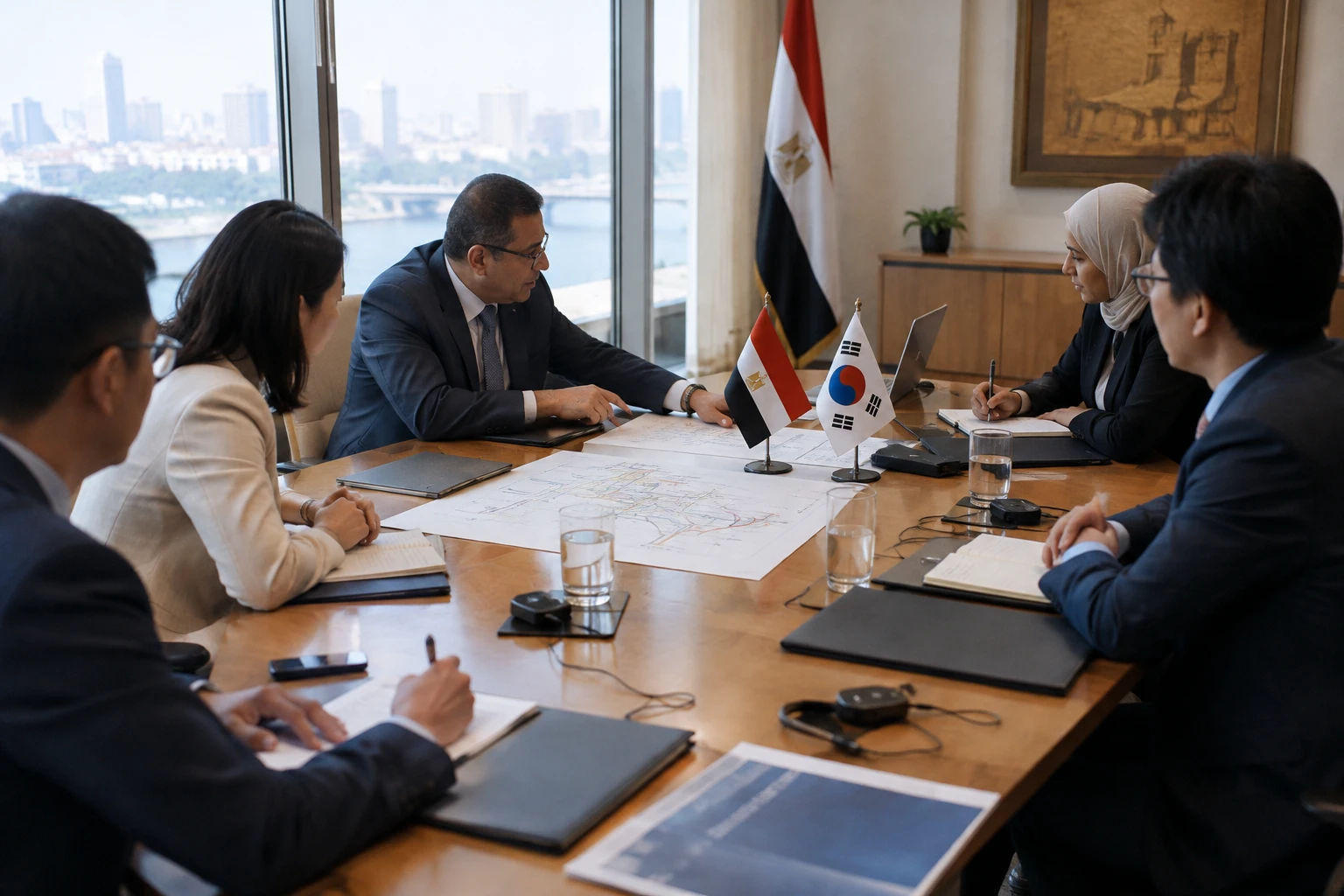
On 8 October 2026, during a three-day state visit to Seoul, Egyptian President Abdel Fattah al-Sissi and his South Korean counterpart Lee Jae-myung attended the signing of two memoranda of understanding on energy. The visit marked al-Sissi’s first trip to South Korea since 2016, according to South Korean news agency Yonhap. The two leaders also upgraded their ties to a strategic partnership. Yonhap’s report on the visit to Seoul and KBS World’s French-language report confirm the date and the signing of the agreements.
The first protocol covers clean energy. It provides for exchanges on public policy and expertise in solar, wind, biomass, energy recovery from waste and the peaceful use of nuclear power. The second focuses on electricity infrastructure: equipment modernisation, grid reinforcement and cooperation on high-voltage direct-current lines, known as HVDC, as well as energy storage systems, or ESS. These systems make it possible to store electricity and release it when production fluctuates or demand rises.
South Korea’s Ministry of Climate, Energy and Environment describes the two texts as a framework to encourage exchanges between government agencies and businesses, and to develop joint projects. However, the statement gives no investment figure, locations or timetable. It is therefore an intention to cooperate, not an announcement of work under way or additional generating capacity. The official South Korean statement details the areas covered.
A national challenge that goes beyond generation
Egypt, a North African country whose capital is Cairo, has developed substantial electricity generation capacity in recent years. But the availability of electricity also depends on the condition of the grid and the balance between supply and demand. Ageing lines, inadequate storage capacity or peaks in consumption can limit the benefits of new power plants. That is why the focus on transmission and distribution may matter as much as announcements on renewable energy.
The pressure is particularly tangible for households, public services and businesses. A more regular power supply supports shops, industry and urban infrastructure. It can also facilitate the integration of renewable sources, whose output varies according to sunshine or wind. However, the protocols do not yet indicate whether projects will prioritise major cities, industrial zones or less well-served regions. That allocation will depend on studies and investment decisions to come.
For public finances, the challenge also involves reducing vulnerabilities linked to energy supplies and fluctuations in demand. But modernising grids and installing storage require capital, expertise and long-term planning. Without specific contracts, identified funding and clearly assigned responsibilities, a diplomatic framework does not guarantee a rapid improvement in service for users.
Turning cooperation into projects
Energy ties between Cairo and Seoul are not starting from scratch. South Korean companies are already involved in building the El-Dabaa nuclear power plant, a project on Egypt’s Mediterranean coast. This experience could provide a precedent for industrial cooperation, but the new protocols cover broader areas. They name no company to carry out a specific project and should not be confused with a purchase or construction contract.
President al-Sissi’s statement highlights Egypt’s interest in South Korean investment in industrial sectors and renewable energy. It forms part of a strategy to diversify economic partnerships. For Seoul, the agreement could open opportunities for its companies in infrastructure and energy technologies, while strengthening its presence in Africa and the Middle East. The two governments are thus emphasising converging interests, but the benefits will depend on financing conditions, local content and skills transfers. The Egyptian presidency set out the visit’s economic priorities.
A regional signal, not yet an exportable model
For North Africa and the continent, the agreement’s significance lies in the growing role of grids and storage in energy strategies. A power plant is not enough if electricity cannot be transmitted efficiently. HVDC equipment can carry large amounts of energy over long distances, while storage helps balance the grid. Their relevance, however, depends on local needs, project costs and institutions’ ability to operate them.
Egypt is a member of the African Union and the Arab League, but it does not belong to ECOWAS or to a regional economic community in sub-Saharan Africa. Bilateral cooperation with Seoul is therefore not, by itself, a regional programme. It could nevertheless contribute to exchanges of expertise if concrete projects are carried out and their results shared with African partners.
The next step will be to see whether the two protocols lead to studies, tenders, financing and identifiable projects. The announcement’s significance for Egyptians and the country’s energy ambitions will be judged by these elements — and by their measurable effect on grid reliability.