
 Algeria
 Libya
 Morocco
 Sudan
 Tunisia
 Benin
 Burkina Faso
 Cabo Verde
 Côte d'Ivoire
 Ghana
 Guinea
 Guinea-Bissau
 Liberia
 Mali
 Mauritania
 Niger
 Nigeria
 Senegal
 Sierra Leone
 The Gambia
 Togo
 Cameroon
 Central African Republic
 Chad
 DR Congo
 Equatorial Guinea
 Gabon
 Republic of the Congo
 São Tomé and Príncipe
 Burundi
 Comoros
 Djibouti
 Eritrea
 Ethiopia
 Kenya
 Madagascar
 Malawi
 Mauritius
 Mozambique
 Rwanda
 Seychelles
 Somalia
 South Sudan
 Tanzania
 Uganda
 Angola
 Botswana
 Eswatini
 Lesotho
 Namibia
 South Africa
 Zambia
 Zimbabwe
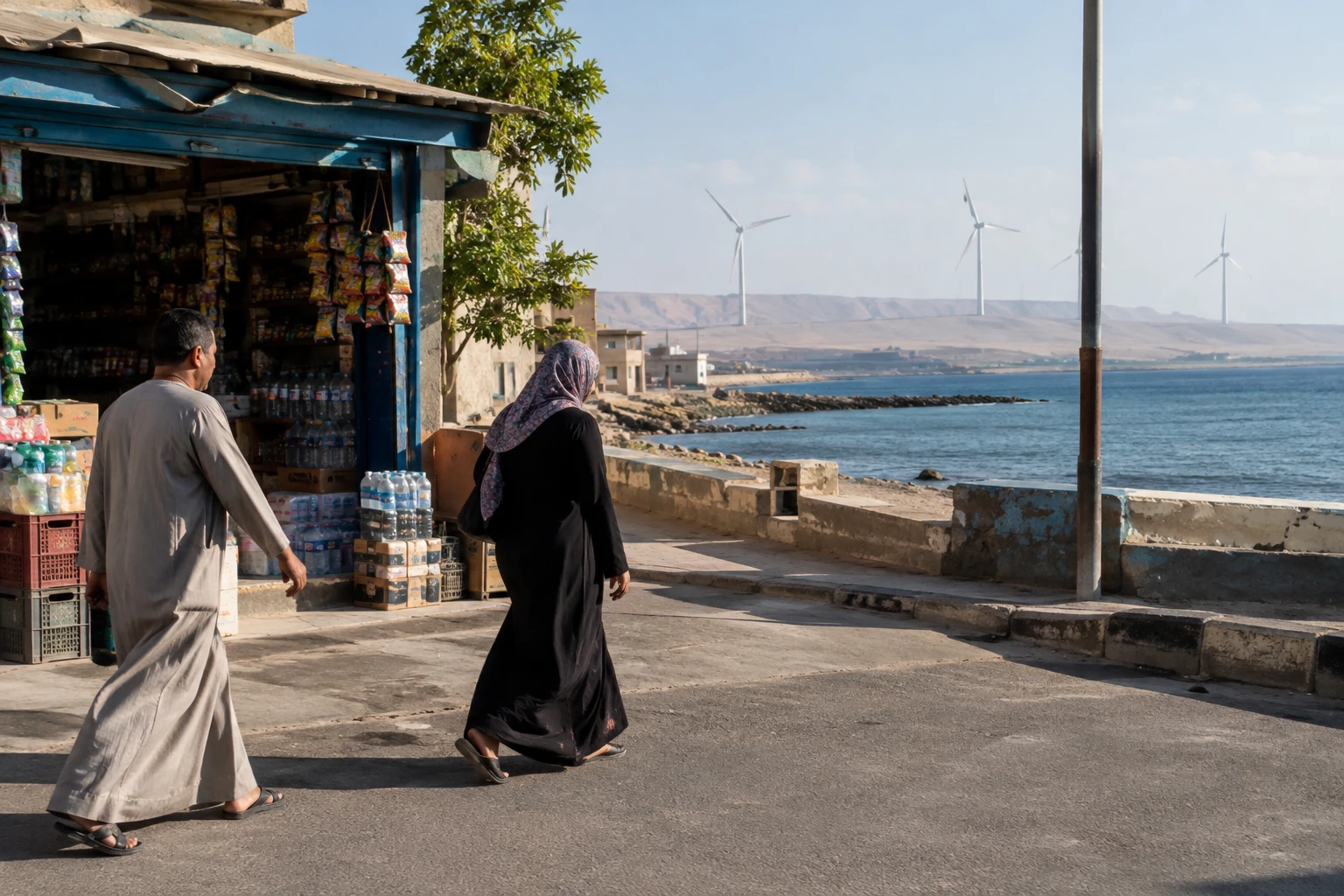
In the Gulf of Suez, wind is becoming a lever for energy security as well as an industrial bet. For Egypt, which wants to reduce its electricity network’s exposure to gas market tensions and fuel prices, the challenge now is to turn announcements into reliable generation.
The Gulf of Suez, a key part of the energy transition
The choice of site is not new. The Gulf of Suez’s steady winds have already attracted several wind power projects, while Egyptian authorities seek to diversify an electricity system still heavily dependent on hydrocarbons. This direction is part of the country’s national energy strategy and climate commitments, without removing immediate supply needs.
However, the trajectory has a gap that warrants attention. Egypt’s strategy refers to a target of 42% renewable electricity by 2030. At the same time, the government has announced other generation and storage portfolios, whose schedules and financing will need to be specified to assess their actual contribution.
The two new wind farms, Niat and Rasgha, will be located near Ras Ghareb, on the Red Sea coast. Each is set to provide 250 megawatts, or 500 MW in total. The electricity generated will be purchased by the Egyptian Electricity Transmission Company, the state-owned company responsible for national transmission, under 25-year contracts.
Financing secured, commissioning still pending
On 10 November 2026, Alcazar Energy Partners announced the close of $436 million in debt financing for the two facilities. The EBRD, the European Investment Bank and Germany’s DEG are each participating in the financing. Published figures differ depending on whether they refer to the total package or each institution’s loans: the EBRD, for example, puts its support at a maximum of $145 million.
The project’s total cost is announced at $626 million. Siemens Gamesa is to supply and maintain the turbines, while Orascom Construction will carry out the civil and electrical works. Commercial commissioning is scheduled by the end of 2028. These dates therefore remain targets, not electricity already available on the grid.
According to the developers, the wind farms are expected to generate more than 2.3 terawatt-hours a year. Alcazar has announced a purchase price of 3 cents per kilowatt-hour. This figure should be read as a contractual term announced by the developer; on its own, it is not enough to establish the final cost to the grid or consumers.
From installed megawatts to electricity actually delivered
The project is entering a sector that is already expanding. According to Egyptian government figures reported by Ahram Online, installed wind capacity reached 2,199 MW in 2024, up from 1,890 MW in 2023, an increase of 16.3%. The Niat-Rasgha wind farm would eventually add capacity equivalent to nearly a quarter of the 2024 total.
But announced capacity is no guarantee of supply. Connection lines must also be completed, variable wind generation balanced, and storage or other sources provided for when the wind drops. Long-term contracts can secure producers’ revenues; for the state and the EETC, they also entail lasting commitments to purchase power and manage the grid.
Increased renewable supply could reduce the amount of gas needed for electricity generation, especially during periods of high demand. It does not automatically guarantee lower bills or an end to power cuts: those outcomes also depend on demand, infrastructure, gas availability and the grid’s capacity to transmit electricity to areas where it is consumed.
Energy ambitions also depend on industry
The construction project is part of a broader set of wind projects announced along the Red Sea coast. The government is also exploring cooperation with Chinese manufacturer SANY to develop a 2 GW project and establish a turbine factory. The stakes then go beyond electricity generation: Egypt wants to attract investment, develop local skills and reduce its dependence on imported equipment.
This industrial ambition will need to be assessed against tangible results: lasting jobs, training, the share actually manufactured in the country and the transfer of know-how. A factory established in Egypt does not, on its own, mean that the entire technology chain will be mastered locally. The ability to supply other African and Middle Eastern markets will also depend on costs, standards and production capacity.
The bet also concerns communities near the facilities. Expected benefits — economic activity, jobs and access to more diversified energy — are not automatically shared among project companies, workers, local authorities and residents. Environmental assessments, local consultation and monitoring of impacts around Ras Ghareb therefore matter as much as capacity announcements.
An Egyptian issue with regional reach
For Egypt, the balance is twofold: meeting national demand while making renewables an economic sector. Across Africa, the projects illustrate a question shared by several countries: how to finance clean infrastructure, integrate its output into the grid and retain a greater share of the value on the continent. The African Union advocates regional energy cooperation, but interconnections and electricity trading require agreements and equipment that go beyond a single construction project.
The next steps will be decisive: the effective start of construction, adherence to the timetable through the end of 2028, grid connection and publication of the purchase terms. For Niat and Rasgha, financing is a major milestone. Their success, however, will be measured more concretely: in megawatt-hours delivered regularly, integrated into Egypt’s grid, and verifiable local benefits.
Project data are documented by the European Investment Bank’s project page for Niat and Rasgha and the EBRD’s presentation of the financing. Installed wind capacity figures were reported by Ahram Online, drawing on an Egyptian government report. The financial close was also covered by EnterpriseAM.



