Algeria
 Libya
 Morocco
 Sudan
 Tunisia
 Benin
 Burkina Faso
 Cabo Verde
 Côte d'Ivoire
 Ghana
 Guinea
 Guinea-Bissau
 Liberia
 Mali
 Mauritania
 Niger
 Nigeria
 Senegal
 Sierra Leone
 The Gambia
 Togo
 Cameroon
 Central African Republic
 Chad
 DR Congo
 Equatorial Guinea
 Gabon
 Republic of the Congo
 São Tomé and Príncipe
 Burundi
 Comoros
 Djibouti
 Eritrea
 Ethiopia
 Kenya
 Madagascar
 Malawi
 Mauritius
 Mozambique
 Rwanda
 Seychelles
 Somalia
 South Sudan
 Tanzania
 Uganda
 Angola
 Botswana
 Eswatini
 Lesotho
 Namibia
 South Africa
 Zambia
 Zimbabwe
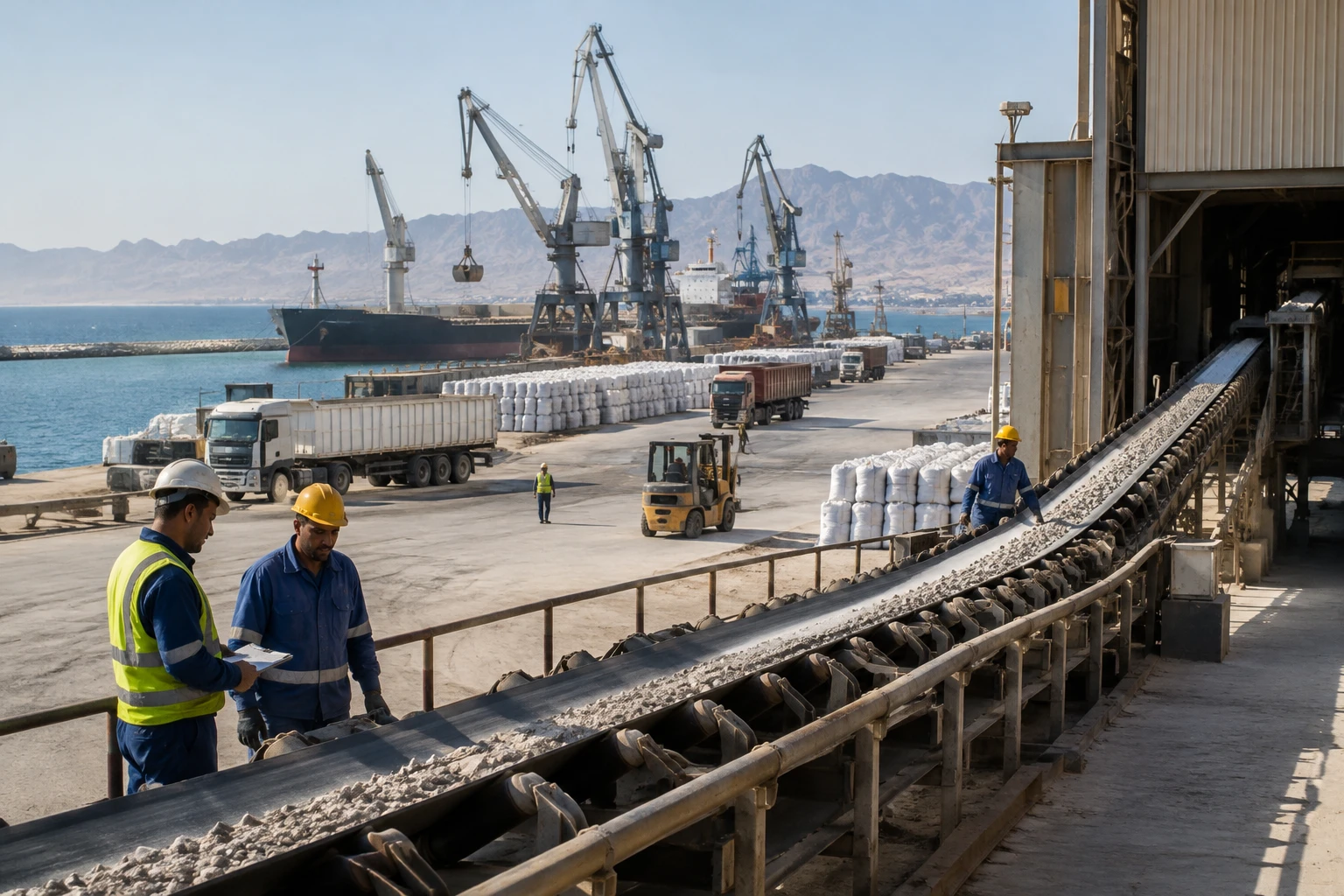
Processing phosphate locally rather than shipping it mainly as ore is the industrial bet Egypt is seeking to accelerate. At Ain Sokhna, on the Red Sea, a new project could bring mines, chemical plants and export markets closer together. But the decisive steps of completing studies and securing supply remain.
A project still under study, not a confirmed plant
On 18 October 2026, Egypt’s Minister of Petroleum and Mineral Resources, Karim Badawi, discussed an integrated phosphate fertiliser complex at Ain Sokhna with Ahmed El-Hoshy, chief executive of Fertiglobe. The company, which specialises in nitrogen fertilisers and ammonia, belongs to the UAE’s ADNOC group. The ministry estimates the proposed investment at more than $1.5bn.
The site could produce 1.3 million tonnes a year of diammonium phosphate, or DAP, a fertiliser combining phosphorus and nitrogen. Commercial operations are envisaged to begin in 2031. However, these figures describe a preliminary project: Fertiglobe is still finalising feasibility studies with consultants. The announced schedule and capacity therefore do not amount to a final investment decision.
The starting point is access to a reliable resource. The authorities and the company must identify deposits capable of supplying ore over the long term. The studies must also specify the technologies, energy requirements and infrastructure needed. In other words, the announcement marks the start of an industrial and economic assessment, not construction.
From ore to processed products
Egypt has a significant mining base. According to the US Geological Survey, it ranked seventh among global producers of phosphate rock in 2024, with about 5.3 million tonnes, or nearly 2.2% of world production. The agency also ranks it third for reserves, behind Morocco and China. This position gives the country an opportunity to play a greater role in the stages that follow extraction.
Local processing can create more value than selling raw ore, but it requires capital, energy, water, equipment and markets. DAP production requires, in particular, phosphoric acid and ammonia. That is why mining supply and integration with existing industrial facilities are at the heart of the discussions. Without long-term contracts for phosphate rock and controlled production costs, a large theoretical capacity does not guarantee a profitable plant.
Fertiglobe is already familiar with Egypt’s industrial landscape. In the country, the company operates the Egyptian Fertilizer Company, whose stated capacities are 1.7 million tonnes of urea and 900,000 tonnes of ammonia a year, as well as EBIC, which can produce 700,000 tonnes of ammonia. Both sites are in the Suez Industrial Development Company industrial park, with access to several Egyptian ports. A phosphate project would therefore complement activities that have so far focused on ammonia and nitrogen fertilisers.
A strategy attracting several investors
The project is part of a series of initiatives aimed at developing the phosphate value chain. In Abu Tartour, in the New Valley Governorate, the foundation stone for a phosphoric acid complex was laid on 19 August 2026. Egypt’s ministry has announced an investment of $658m and an initial capacity of 250,000 tonnes a year. Locally mined rock is to be processed there into an intermediate chemical product.
At Ain Sokhna, Indorama has also launched a phosphate fertiliser and chemicals project, with an announced initial investment of $525m and initial annual capacity of 600,000 tonnes. A phosphate supply contract with state-owned Phosphate Misr accompanies the project. These two initiatives show that Fertiglobe is not alone in its interest in local processing. They could form complementary links in the chain, but could also compete for raw materials, infrastructure and markets.
This concentration of projects in the Suez Canal area offers a logistical advantage: proximity to ports makes it easier to import inputs and ship finished products. It can support industrial employment and exports. However, the benefits will depend on the share of equipment, services and skills sourced locally. Construction jobs are not the same as permanent operating roles, and benefits for mining regions are not automatic when processing plants are concentrated near ports.
Next steps will be decisive
For Cairo, the stakes go beyond a single investment. Egypt is seeking to increase the contribution of its mineral resources to industry and exports, in a sector where it already produces phosphate, ammonia and phosphoric acid. This development also matters across Africa for fertiliser supply chains, which are essential to agricultural systems. It does not mean the fertilisers produced will necessarily be accessible to all farmers: prices, distribution and export contracts will influence where they go.
The next milestone will be the completion of feasibility studies, followed by confirmation of phosphate sources and energy requirements. Any formal investment decision, supply agreements and infrastructure works will then need to be monitored. The target of starting operations in 2031 remains, at this stage, a proposed date for a project in preparation. Whether Egypt can turn its reserves into sustainable industrial capacity will depend on the completion of these steps — and on co-ordination with the Abu Tartour and Indorama projects.
Institutional sources and data: Egyptian State Information Service on discussions with Fertiglobe, Egyptian Ministry of Petroleum and Mineral Resources, US Geological Survey data on Egypt, Fertiglobe’s production facilities, Egyptian State Information Service on supply for the Indorama project and Egyptian ministry on the Abu Tartour complex.