Algeria
 Libya
 Morocco
 Sudan
 Tunisia
 Benin
 Burkina Faso
 Cabo Verde
 Côte d'Ivoire
 Ghana
 Guinea
 Guinea-Bissau
 Liberia
 Mali
 Mauritania
 Niger
 Nigeria
 Senegal
 Sierra Leone
 The Gambia
 Togo
 Cameroon
 Central African Republic
 Chad
 DR Congo
 Equatorial Guinea
 Gabon
 Republic of the Congo
 São Tomé and Príncipe
 Burundi
 Comoros
 Djibouti
 Eritrea
 Ethiopia
 Kenya
 Madagascar
 Malawi
 Mauritius
 Mozambique
 Rwanda
 Seychelles
 Somalia
 South Sudan
 Tanzania
 Uganda
 Angola
 Botswana
 Eswatini
 Lesotho
 Namibia
 South Africa
 Zambia
 Zimbabwe
An air show, but also a map of power relations
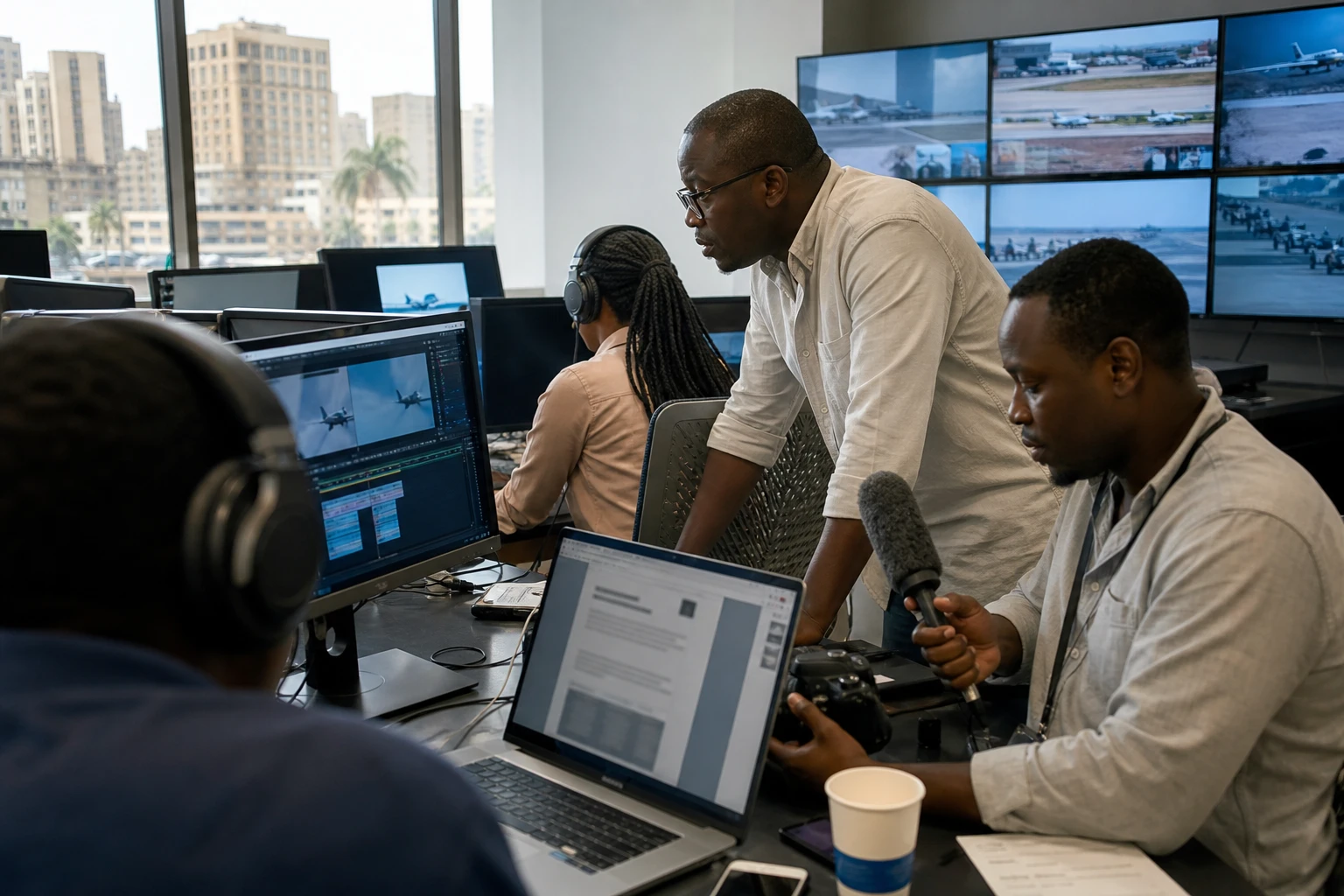
In El Alamein, on Egypt’s Mediterranean coast, an air show is not just about admiring gleaming aircraft in the sunshine. It also shows who is talking to whom, who is selling what, and which technical alliances are gaining strength in a region where security remains a central issue. For Egypt, the stakes are clear: to turn an industrial and military event into a showcase for its power, while preserving room for manoeuvre between Washington, Paris, Moscow and other partners.
The second edition of the El Alamein International Air Show is being held from 8 to 10 September 2026 at El Alamein International Airport, with a symposium opening on 7 September. Organisers present the event as a regional platform linking aviation, defence and space across Africa, the Middle East and Europe. The Egyptian government had announced in advance that more than 250 exhibitors from 50 countries would attend, alongside around 12,000 expected visitors.
Cairo wants to demonstrate its industrial depth
The core of Egypt’s message rests on a simple idea: Cairo no longer wants to be just an arms buyer. It wants to present itself as a hub capable of attracting manufacturers, air forces, public agencies and investors. The Egyptian presidency confirmed that President Abdel Fattah al-Sisi had inaugurated the second edition in El Alamein, in the presence of his Cypriot counterpart, Nikos Christodoulides. This signalled that, beyond the aerial spectacle, the show also has a diplomatic dimension in the eastern Mediterranean.
The show features a mix of participants from different backgrounds. Egypt hosted demonstrations by its air force alongside teams from Russia, Spain, Turkey, Saudi Arabia, the United Arab Emirates, France and India. On the US side, the US Air Force announced the participation of several aircraft, including C-130J Super Hercules, C-130H Hercules, A-10 Thunderbolt II, F-16 Fighting Falcon and F-15E Strike Eagle aircraft. Washington has also opened a pavilion featuring more than 25 US companies.
The facts: a highly visible US presence
The US Air Force has chosen this show to make a strong presence felt, not a discreet or symbolic one. US Air Forces Central said the exhibition was intended to strengthen the strategic partnership with Egypt across the military, commercial, private and industrial sectors. The official statement emphasises long-term cooperation and the idea of regional stability built with international allies and partners. In short, Washington is not just there to show off aircraft. It is there to consolidate a defence relationship and industrial opportunities.
This stance comes in a particular context. Egypt remains one of the region’s major buyers of military equipment, with a diverse fleet combining US, French and Russian systems. Specialist sources and reference inventories continue to describe a force that includes US F-16s, French Rafales and Russian MiG-29M/M2s. This diversity is more than a technical detail. It reflects a policy of securing supplies and limiting dependence on a single supplier.
The US message is also evident in the make-up of the assets deployed. The C-130s and F-16s represent two complementary roles: transport, support and interoperability on one hand; tactical superiority on the other. At a show of this kind, a demonstration can be worth as much as a negotiation. It shows client states, and competitors, what manufacturers and air forces can still offer the regional market.
A signal for Egypt, and for the region
For Egypt, the benefits are twofold. First, the event supports an image of an organised power, useful for a country seeking to make El Alamein an international showcase beyond its role as a seaside resort. Second, it allows Egyptian diplomacy to be underpinned by a tangible economic rationale: showcasing value chains, promoting domestic industries, and bringing together armed forces, states and private groups. The show thus gives the Ministry of Defence, the Ministry of Civil Aviation and the Arab Organisation for Industrialisation a shared stage.
For foreign partners, the calculation is more pragmatic. The United States is reaffirming its place in military cooperation with Egypt at a time when the country is seeking to diversify its support without breaking with its longstanding suppliers. France, Russia, Spain and Turkey are also using events of this kind to maintain their visibility in a highly competitive market. The show thus becomes a diplomatic arena that appears calm, but is intensely competitive beneath the surface.
For the Egyptian population, the benefits are mainly indirect. Events of this kind primarily involve formal sectors: civil aviation, maintenance, subcontracting, logistics, technology and exports. They can lead to contracts, transfers of expertise and discussions on training. But they do not, on their own, transform everyday economic life. Their value is measured over time, through orders, skilled jobs and the strengthening of local capabilities.
What to watch after El Alamein
The significance of this show extends beyond Egypt. In North Africa, where security balances are closely tied to the eastern Mediterranean, the Sahel, the Red Sea and trade corridors, the event serves as a meeting point for several regional dynamics. It speaks to capitals seeking defence partners, manufacturers looking for markets and armed forces aiming to modernise their fleets without becoming locked into a single dependency.
The next test will be political as well as industrial. It will be important to see whether the announcements translate into contracts, technical cooperation or joint exercises, and whether Egypt succeeds in turning El Alamein into a regular fixture on the African and Mediterranean calendar. In a region where air security, technological sovereignty and military alliances are increasingly important, this kind of show often says more than a press release: it reveals the direction states want to take.