Algeria
 Libya
 Morocco
 Sudan
 Tunisia
 Benin
 Burkina Faso
 Cabo Verde
 Côte d'Ivoire
 Ghana
 Guinea
 Guinea-Bissau
 Liberia
 Mali
 Mauritania
 Niger
 Nigeria
 Senegal
 Sierra Leone
 The Gambia
 Togo
 Cameroon
 Central African Republic
 Chad
 DR Congo
 Equatorial Guinea
 Gabon
 Republic of the Congo
 São Tomé and Príncipe
 Burundi
 Comoros
 Djibouti
 Eritrea
 Ethiopia
 Kenya
 Madagascar
 Malawi
 Mauritius
 Mozambique
 Rwanda
 Seychelles
 Somalia
 South Sudan
 Tanzania
 Uganda
 Angola
 Botswana
 Eswatini
 Lesotho
 Namibia
 South Africa
 Zambia
 Zimbabwe
A powerful tool, but no replacement
In Cairo, artificial intelligence is seen as more than a technical feat. It has already entered everyday conversation, where work, studies and trust in digital tools intersect. The recurring question is simple: how can efficiency be improved without delegating human judgement to a machine? This question carries particular weight in Egypt, where the authorities have made AI a driver of modernisation, but also a matter of governance.
The country is not starting from scratch. Egypt adopted a national AI strategy, then updated it for the 2025-2030 period. The official document sets out a clear direction: develop an AI sector, strengthen local talent, organise data, and anchor innovation in an ethical and responsible framework. The African Union, for its part, adopted a continental AI strategy in 2024, urging member states to develop their own national approaches, tailored to their development priorities.
Practical caution in Cairo
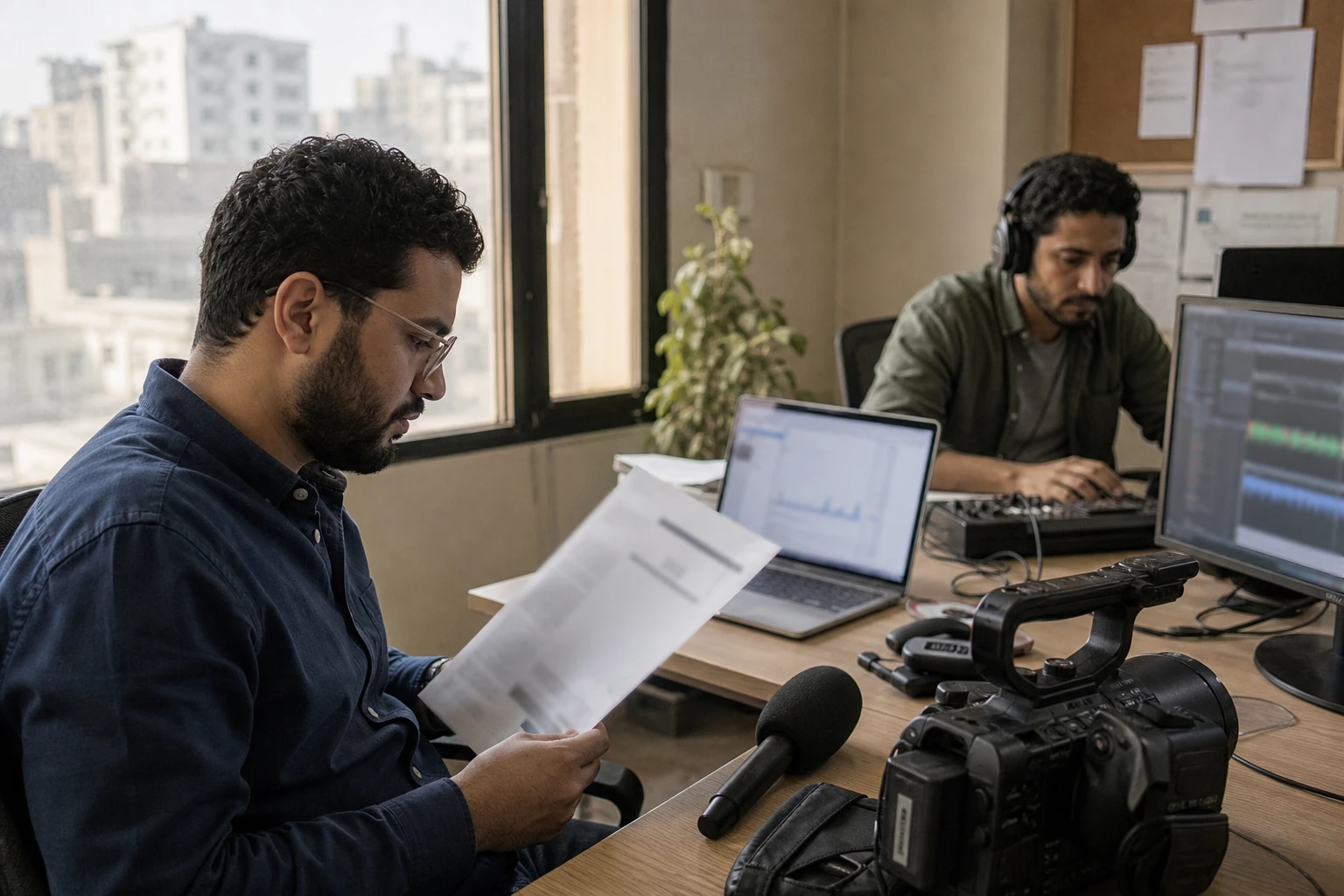
In this context, several Egyptian professionals interviewed in Cairo share a common view: AI helps, but it does not make decisions on its own. A web developer sees it first and foremost as a way to speed up tasks, provided human validation is retained. This point echoes the approach set out in international reference texts: UNESCO says AI systems must respect human dignity and remain under human oversight.
The same caution is evident in education. Egypt’s AI framework emphasises continuous training, skills retraining and the responsible use of digital tools in schools and universities. This direction has recently taken concrete form: in June 2026, UNESCO and Egypt’s Ministry of Education launched a national AI competency framework for teachers. The goal is clear: to equip teachers without turning them into passive users of automated platforms.
The same logic applies in technical professions. A petroleum engineering professor cited in the Egyptian debate does not describe AI as a blunt threat. Rather, he sees it as a demand for adaptation. Students, teachers and engineers must learn to work with these tools while retaining their own analytical capacity. This view echoes the national strategy, which places skills development on a par with infrastructure and data.
Governance is already taking shape
The issue is no longer purely technical. It is institutional, too. Egypt has established a National Council for Artificial Intelligence and relies on several bodies to oversee the digital sphere: the Ministry of Communications, the National Telecommunications Regulatory Authority, the Supreme Cybersecurity Council and the Personal Data Protection Centre. The country has also published an Egyptian Charter for Responsible AI, adapting UNESCO and OECD principles to the local context.
This choice matters. It shows that Egypt’s debate is not limited to a contest between progress and fear. It is about how responsibilities should be allocated. Who checks the results? Who oversees sensitive uses? Who protects the data? The Egyptian authorities’ response is a governance framework, while the national charter emphasises transparency, fairness, non-discrimination and accountability.
This approach is in line with international standards. UNESCO advocates a framework centred on human rights, dignity, fairness and human oversight. The OECD has also published a review of AI in Egypt, noting that the Egyptian charter seeks to embed these principles in the country’s realities. In other words, Cairo is seeking less to copy foreign models than to develop its own digital doctrine.
Jobs, education and innovation: the real trade-offs
The economic stakes are high. The national strategy aims to raise the ICT sector’s contribution to GDP to 7.7% by 2030, double the number of AI specialists to 30,000 professionals, and support more than 250 specialist companies. These targets point to industrial ambition, but also to a social one: AI should help improve public services, healthcare, education and business productivity.
For formal businesses, AI promises rapid gains in automation, data analysis and customer service. In the informal economy, which is widespread in Egyptian cities as elsewhere on the continent, the benefits will depend above all on access to tools, training and reliable connectivity. Without these, AI risks widening the gap between those who know how to use it and those left on the sidelines. This concern is not theoretical: the African Union’s strategy itself warns of a risk of an “AI divide” between Africa and the rest of the world, owing to a shortage of data, computing infrastructure and skills.
Egypt’s debate therefore reflects a continental question. Africa is discussing more than regulation. It is debating technological sovereignty, training and its place in digital value chains. The goal is not to imitate Silicon Valley. It is to build useful, safe and job-creating applications in sectors where social needs are immediate: education, healthcare, public administration, agriculture, energy and services.
A wider African resonance
What is at stake in Cairo therefore goes beyond Egypt. Egypt holds a particular position in North Africa and in African debates on the digital sphere. It has already incorporated AI into public policy, teacher training and data regulation. At continental level, this kind of approach carries weight, showing that an African AI strategy can be ambitious, governed and connected to real social needs.
One milestone remains to be watched: the practical implementation of the 2025-2030 strategy in schools, public administrations and businesses. That is where the gap between promises and real-world use will be measured. If governance keeps pace with innovation, AI can strengthen human capabilities rather than bypass them. If training and regulation fall behind, the country risks creating new imbalances just as it seeks to accelerate its digital transformation.