
 Algeria
 Egypt
 Libya
 Morocco
 Sudan
 Tunisia
 Benin
 Burkina Faso
 Cabo Verde
 Côte d'Ivoire
 Ghana
 Guinea
 Guinea-Bissau
 Liberia
 Mali
 Mauritania
 Niger
 Nigeria
 Senegal
 Sierra Leone
 The Gambia
 Togo
 Cameroon
 Central African Republic
 Chad
 Equatorial Guinea
 Gabon
 Republic of the Congo
 São Tomé and Príncipe
 Burundi
 Comoros
 Djibouti
 Eritrea
 Ethiopia
 Kenya
 Madagascar
 Malawi
 Mauritius
 Mozambique
 Rwanda
 Seychelles
 Somalia
 South Sudan
 Tanzania
 Uganda
 Angola
 Botswana
 Eswatini
 Lesotho
 Namibia
 South Africa
 Zambia
 Zimbabwe
An epidemic already spilling beyond the health sector
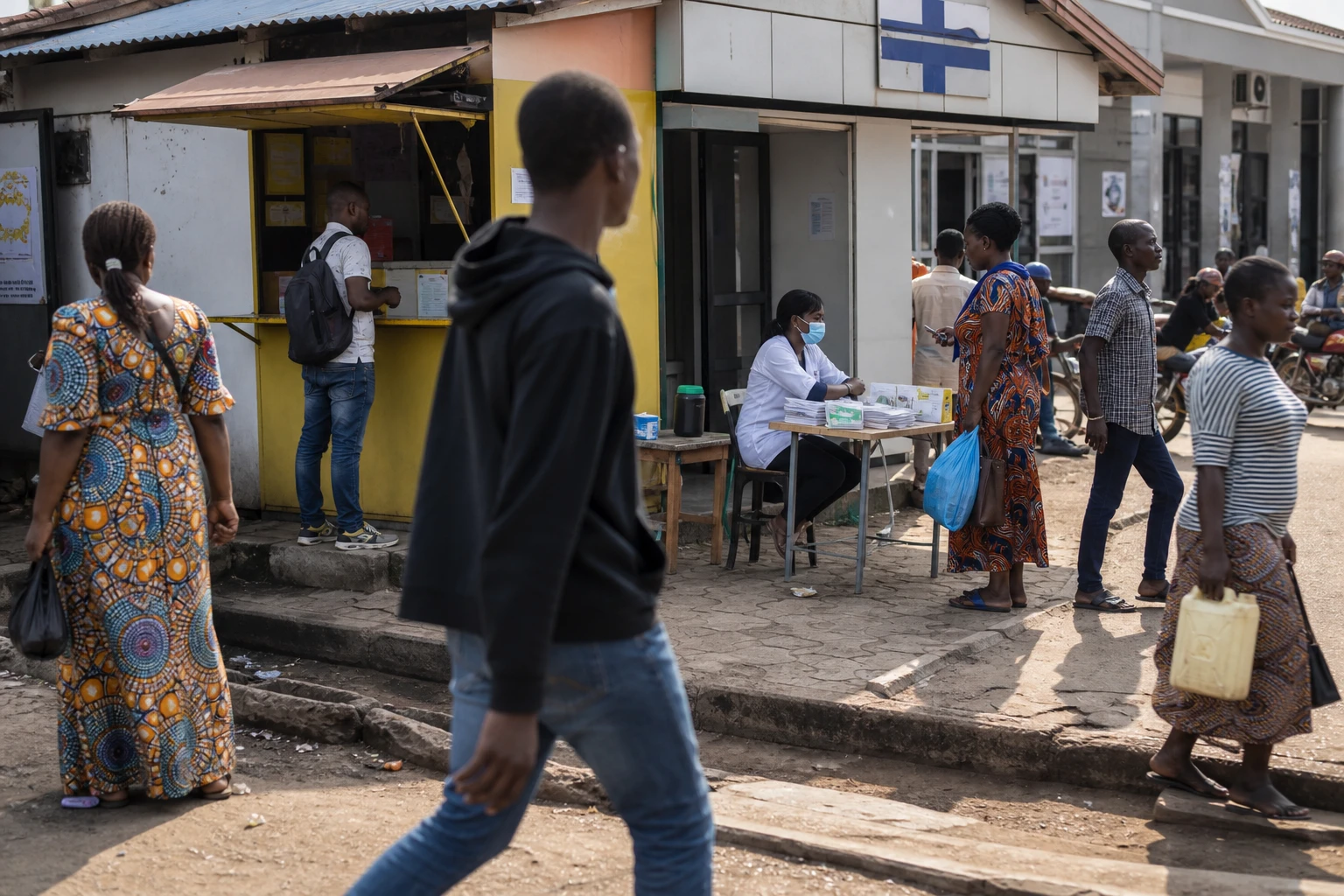
In eastern Democratic Republic of the Congo, Ebola is about more than counting cases. The disease is taking hold in an area where health teams must contend with insecurity, population displacement and roads that are sometimes difficult to access. In this kind of crisis, every hour counts. Every delay in care affects families, health workers and services already under pressure.
The outbreak’s centre of gravity is in Ituri, around Bunia, the provincial capital and the area’s main health hub. Congolese authorities and the World Health Organization have stepped up the response there following the detection of the first warning signs in early May 2026. The fact that a case was also exported to Uganda, followed by alerts in other countries, shows that an outbreak originating in a mining area with high levels of mobility does not remain confined to an administrative territory.
What the verified figures show
The WHO director-general’s visit to Bunia comes amid a sequence that began on 15 May 2026, when the DRC declared its 17th Ebola outbreak. The alert was subsequently deemed serious enough to be classified as a public health emergency of international concern. This classification, provided for under the International Health Regulations, triggers increased mobilisation by partners and neighbouring states.
The latest data available from the WHO, dated 15 July 2026, report 2,124 confirmed cases and 828 deaths in the Democratic Republic of the Congo. The organisation also says transmission remains active in 38 health zones across five provinces. On the same date, the WHO said the outbreak had continued to spread since its previous update, with 664 additional confirmed cases and 376 additional confirmed deaths in less than two weeks.
These figures should be read with caution, but not played down. The WHO itself notes that some of the newly reported cases may reflect a backlog in testing and surveillance. That does not alter the broader trend: the outbreak has spread beyond Ituri to North Kivu, South Kivu, Haut-Uele and Tshopo. In short, the crisis is no longer merely local; it has become regional.
Why Bunia is the focus of efforts
Bunia is now more than a transit point. The city is the main hub for the clinical response, with treatment centres, isolation units and surveillance work that must cover hospitals, neighbourhoods and transport routes. The WHO said it had rehabilitated a treatment centre in Bunia, while teams had set up isolation tents at the general referral hospital to better receive suspected cases.
Material capacity alone is not enough, however. In the first days of the outbreak, facilities were set on fire in Rwampara, on the outskirts of Bunia, underscoring that community mistrust can hamper the response as much as a shortage of medicines. The WHO also reported the deaths of four health workers within a few days in Mongbwalu, an alarming sign for the safety of medical staff and the continuity of services.
The WHO chief’s visit therefore has practical significance. It helps consolidate the response, support the Congolese authorities and keep donors’ attention focused. In Bunia, the organisation also welcomed the refurbishment of a treatment centre and the recovery of several health workers, showing that early care can save lives when access to treatment is swift.
What this outbreak means for DR Congo and the region
For Congolese people, the issue is not only medical. It also affects the day-to-day economy. When markets slow, movement is monitored and some facilities close temporarily, households dependent on informal trade feel the effects immediately. Health workers, meanwhile, are working in a more exposed environment. Local authorities must therefore protect both public health and the essential workings of urban life.
At regional level, the DRC and Uganda have already shown that a coordinated response reduces the risk of cross-border spread. The WHO has also confirmed imported cases in Uganda, France and Germany, underscoring how an outbreak in the Great Lakes region can quickly become an international concern. This is also why preparedness mechanisms in Central and East Africa matter as much as crisis announcements in Kinshasa or Bunia.
This period also resonates beyond the DRC. It tests the continent’s ability to mount a rapid, coordinated response drawing on African expertise. WHO Africa has stressed the role of communities in recent progress, while the Congolese authorities have had to bring together surveillance, laboratories, treatment and community engagement. What happens next will depend above all on how quickly the health zones where transmission remains active are brought under control, and on the ability to preserve trust between residents, health workers and the state.



