
 Algeria
 Egypt
 Libya
 Morocco
 Sudan
 Tunisia
 Benin
 Burkina Faso
 Cabo Verde
 Côte d'Ivoire
 Ghana
 Guinea
 Guinea-Bissau
 Liberia
 Mali
 Mauritania
 Niger
 Nigeria
 Senegal
 Sierra Leone
 The Gambia
 Togo
 Cameroon
 Central African Republic
 Chad
 Equatorial Guinea
 Gabon
 Republic of the Congo
 São Tomé and Príncipe
 Burundi
 Comoros
 Djibouti
 Eritrea
 Ethiopia
 Kenya
 Madagascar
 Malawi
 Mauritius
 Mozambique
 Rwanda
 Seychelles
 Somalia
 South Sudan
 Tanzania
 Uganda
 Angola
 Botswana
 Eswatini
 Lesotho
 Namibia
 South Africa
 Zambia
 Zimbabwe
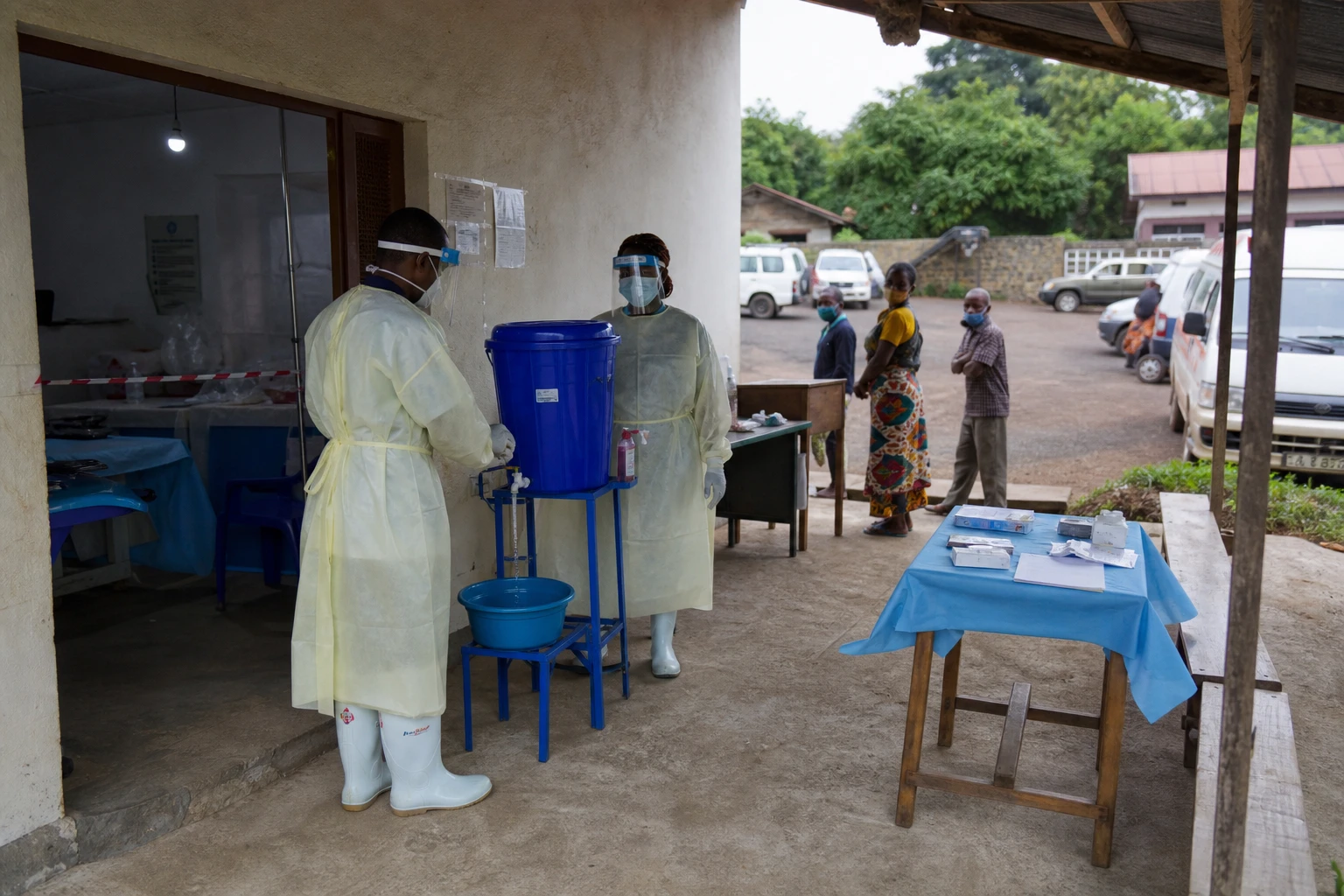
In eastern Democratic Republic of the Congo, Ebola virus disease is spreading not only through infections. It is also advancing amid population movements, attacks on medical teams and fragile health centres. In North Kivu, this combination is reducing the capacity to screen, isolate and treat patients while transmission remains active.
An epidemic caught between insecurity and weak health services
Declared on 1 August 2018, the 10th known Ebola outbreak in DR Congo mainly affected North Kivu and Ituri. These two eastern provinces are separated by an administrative boundary, but share transport routes, markets and hard-to-reach health zones.
The security situation complicates every stage of the response. Clashes and the presence of armed groups limit health workers’ movements. They also disrupt evacuations and residents’ access to treatment centres. In several localities, families must therefore weigh the risk of travelling against that of remaining without care.
The World Health Organization had already warned in spring 2019 that the risk of new chains of transmission remained high in several areas of North Kivu and Ituri. Health authorities and their partners were then continuing vaccination, contact tracing and active case finding.
North Kivu emerges as a major flashpoint
In autumn 2019, Médecins Sans Frontières estimated that nearly 40% of newly confirmed cases were being recorded in North Kivu. The proportion pointed to a shift in the epidemic’s centre of gravity, while Ituri also remained heavily affected.
In Mambasa territory, in Ituri, health teams had reported several deaths in quick succession. However, daily tallies had to be interpreted with caution. Figures could change following laboratory tests, epidemiological investigations and the identification of probable cases.
The problem was not just the number of patients. Some people who tested positive were being admitted to facilities without a specialist Ebola unit. These facilities sometimes lacked protective equipment, isolation areas and staff trained to triage suspected cases.
In these conditions, the risk of transmission rises within the health system itself. Patients may be examined close to other sick people. Health workers may also be exposed if they lack the necessary equipment or if procedures are not consistently followed.
Médecins Sans Frontières was already describing in August 2019 a situation marked by a high number of new cases each week. The organisation reported an average of between 80 and 100 new patients a week in July.
Deaths occurring far from specialist centres
According to MSF, most deaths occurred outside health facilities. This made epidemiological surveillance more difficult. It also reduced the chances of administering available treatments promptly, protecting relatives and arranging safe burials.
A death at home does not automatically mean that someone was infected with Ebola. An investigation and, where possible, a biological sample are needed. However, every undocumented death can leave a period of transmission unmonitored, particularly when a family moves or the body is handled before teams arrive.
In its early days, the disease can also be difficult to distinguish from other common illnesses in eastern DR Congo. Fever, fatigue, diarrhoea and vomiting may also be symptoms of malaria or other infections. Rapid screening and triage are therefore essential.
MSF noted in spring 2019 that nearly half of newly confirmed cases in some periods had no identified link to another patient. The organisation also reported that some cases were confirmed only after death, making it harder to reconstruct chains of transmission.
Community trust is a health imperative
The response does not rely solely on treatment centres. It also depends on trust between residents, authorities and medical teams. In a region marked by years of violence, the arrival of workers accompanied by escorts or security measures can fuel mistrust.
This mistrust has tangible consequences. Families delay seeking care. Contacts fail to attend follow-up appointments. Patients sometimes leave facilities before their treatment is complete. Attacks on centres and interruptions to activities make these difficulties worse.
The response must therefore combine Ebola care with routine health services. Residents continue to face malaria, measles, malnutrition and maternity-related complications. A strategy focused exclusively on Ebola risks neglecting communities’ immediate needs.
Vaccines and treatments have nevertheless strengthened DR Congo’s medical capacity. The targeted vaccination campaign has helped protect people at risk, while several experimental treatments have been used in specialist centres. These tools can have their full effect only if cases are detected early and patients agree to seek treatment.
An issue that extends beyond provincial borders
North Kivu and Ituri are part of a regional area connected to the Great Lakes countries. Exchanges with Uganda and Rwanda make cross-border co-ordination essential, though borders alone cannot provide the answer. Surveillance, traveller information and continuity of care must operate on both sides of crossing points.
As of 29 September 2019, the West African Health Organisation’s bulletin reported 3,191 confirmed or probable cases and 2,129 deaths in the provinces of North Kivu, Ituri and South Kivu. This tally, distinct from figures reported at other points in the epidemic, illustrates the importance of dating every health statistic.
The regional epidemiological bulletin published on 30 September 2019 confirmed that the outbreak remained concentrated in eastern DR Congo, with a high fatality rate among recorded cases.
The next phase of the crisis would have to be fought on several fronts: securing access to affected areas, strengthening ordinary health centres, improving dialogue with communities and maintaining surveillance at borders. For people in North Kivu and Ituri, the challenge was not only to contain a virus. It was also to preserve regular access to care in territories where war had already weakened essential services.



