
 Algeria
 Egypt
 Libya
 Morocco
 Sudan
 Tunisia
 Benin
 Burkina Faso
 Cabo Verde
 Côte d'Ivoire
 Ghana
 Guinea
 Guinea-Bissau
 Liberia
 Mali
 Mauritania
 Niger
 Nigeria
 Senegal
 Sierra Leone
 The Gambia
 Togo
 Cameroon
 Central African Republic
 Chad
 Equatorial Guinea
 Gabon
 Republic of the Congo
 São Tomé and Príncipe
 Burundi
 Comoros
 Djibouti
 Eritrea
 Ethiopia
 Kenya
 Madagascar
 Malawi
 Mauritius
 Mozambique
 Rwanda
 Seychelles
 Somalia
 South Sudan
 Tanzania
 Uganda
 Angola
 Botswana
 Eswatini
 Lesotho
 Namibia
 South Africa
 Zambia
 Zimbabwe
A reparations fund under scrutiny
When war reparations are meant to compensate victims, every dollar counts. In the Democratic Republic of the Congo, the FRIVAO case is a reminder that a fund established to redress collective trauma can quickly become a test of the state’s credibility, justice and public financial management.
The mechanism was created after the International Court of Justice ruling of 9 February 2022, which set at $325 million the amount Uganda owed the DRC in reparations for violations committed during the 1998-2003 period. The Congolese government then set up FRIVAO, a public body tasked with distributing the compensation between direct victims and collective reparations, with Kinshasa as its decision-making centre and Kisangani as the case’s symbolic starting point.
In the east and north-east of the country, this issue extends beyond the judicial sphere. It touches on the memory of the Six-Day War in Kisangani, trust in compensation mechanisms, and the way public money moves between ministries, public bodies and contractors. In a country where budget transparency remains a strong public demand, even the smallest movement of funds quickly becomes political.
Prosecutors toughen their stance against Constant Mutamba
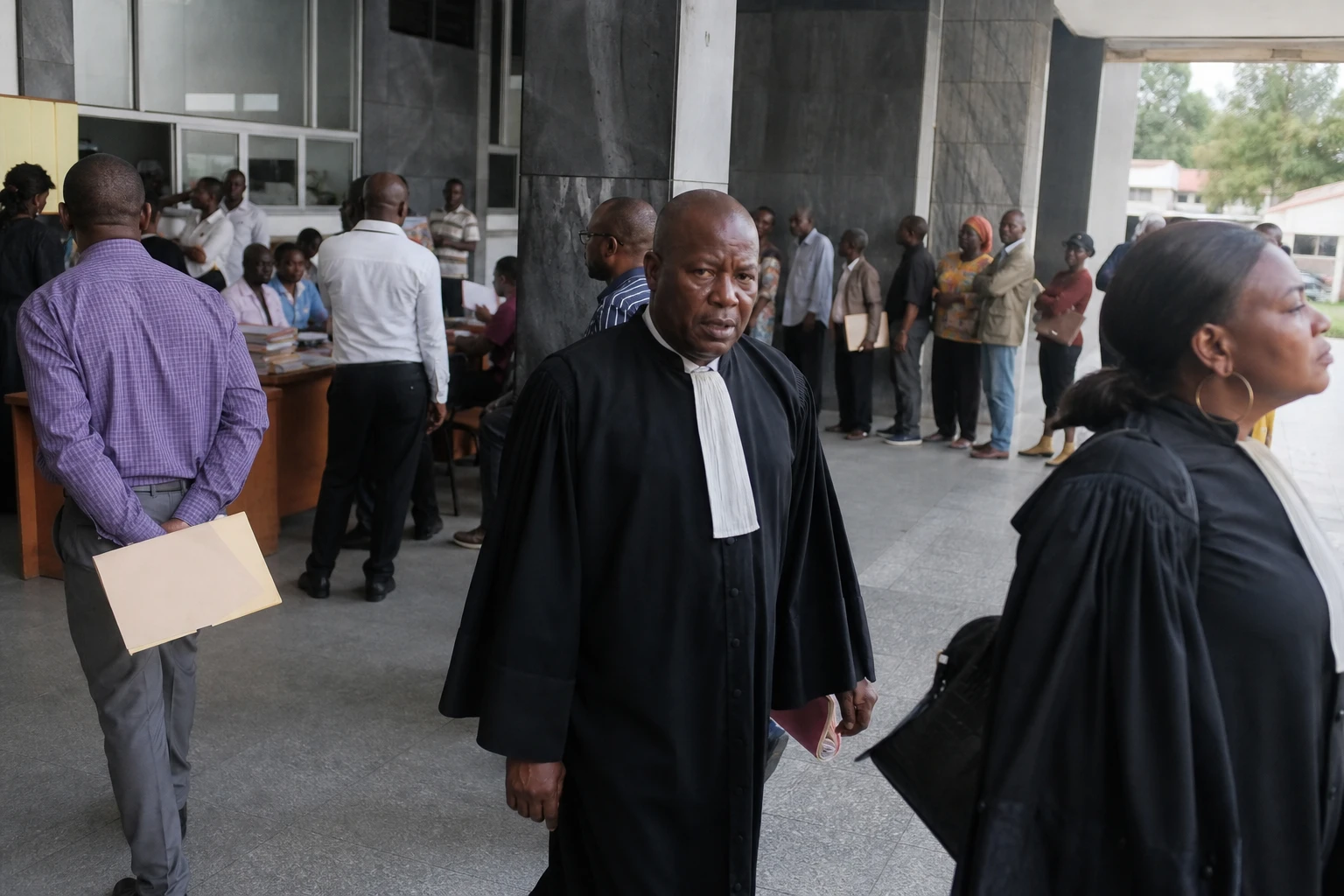
Prosecutors have sought 15 years of hard labour for former Justice Minister Constant Mutamba and his co-defendant Chancard Bolukola, the former FRIVAO co-ordinator, in the case before the Court of Cassation in Kinshasa. The two men are accused of the alleged embezzlement of about $20 million linked to the management of compensation funds.
According to accounts in the Congolese press, the suspicions concern disbursements made under certain public contracts, including disputed payments involving the company Congo Energy. The case is not an isolated one. In 2025, Constant Mutamba had already been sentenced to three years of hard labour in another case, this time linked to an alleged attempt to embezzle $19 million intended for the construction of a prison in Kisangani.
The former justice minister’s court appearances have not been without incident. He walked out of a hearing on 27 July 2026, denouncing procedural irregularities, after having already challenged the validity of the summons and access to the case file. This defence places the trial in two arenas: criminal responsibility and procedural wrangling.
A matter of justice, but also of governance
FRIVAO was meant to embody a simple promise: to turn international reparations into tangible compensation for Congolese people who were victims of wartime violence. Yet every suspicion of embezzlement weakens this moral contract. In Kisangani, the question is not only who will be convicted. It is also how many victims have actually received compensation, on what timetable and under what safeguards.
This point is crucial. In practice, a compensation fund can become a source of tension between social urgency, political pressure and administrative procedures. Victims are waiting for visible redress. The state, for its part, must prove it can trace every franc, every dollar and every contract. When this chain breaks, the consequences do not fall only on those suspected of wrongdoing. They also affect the institution itself, and then public trust.
The debate is all the more sensitive because FRIVAO is part of a wider architecture of reparative justice in the DRC, alongside other mechanisms dedicated to victims of conflict-related violence. In a country where the consequences of the wars in the east continue to weigh on families, reparations are not an optional extra. They are an instrument of public trust.
What the trial’s outcome will tell the DRC and the region
Politically, the case tests the Congolese justice system’s ability to deal with a former government member without favour or theatrics. Regionally, it also points back to a still fraught history between neighbours: the 2022 ruling arose from a dispute between Kinshasa and Kampala over military occupation, reparations and the memory of victims.
For the DRC, then, the stakes go beyond Constant Mutamba’s personal fate. They concern how the state administers reparations arising from an international dispute, at a time when public trust is already being tested by judicial delays and suspicions of mismanagement. For Central Africa, the episode is a reminder that an international ruling has real force only if its implementation at national level is rigorous, transparent and open to scrutiny.
The next stage will play out before the Court of Cassation in Kinshasa, but also in FRIVAO’s offices, where reparations for victims must still prove they can withstand procedural disputes, embezzlement allegations and institutional rivalries. That is where the strength of the Congolese commitment to victims will be measured in practical terms.



