
 Algeria
 Egypt
 Libya
 Morocco
 Sudan
 Tunisia
 Benin
 Burkina Faso
 Cabo Verde
 Côte d'Ivoire
 Ghana
 Guinea
 Guinea-Bissau
 Liberia
 Mali
 Mauritania
 Niger
 Nigeria
 Senegal
 Sierra Leone
 The Gambia
 Togo
 Cameroon
 Central African Republic
 Chad
 Equatorial Guinea
 Gabon
 Republic of the Congo
 São Tomé and Príncipe
 Burundi
 Comoros
 Djibouti
 Eritrea
 Ethiopia
 Kenya
 Madagascar
 Malawi
 Mauritius
 Mozambique
 Rwanda
 Seychelles
 Somalia
 South Sudan
 Tanzania
 Uganda
 Angola
 Botswana
 Eswatini
 Lesotho
 Namibia
 South Africa
 Zambia
 Zimbabwe
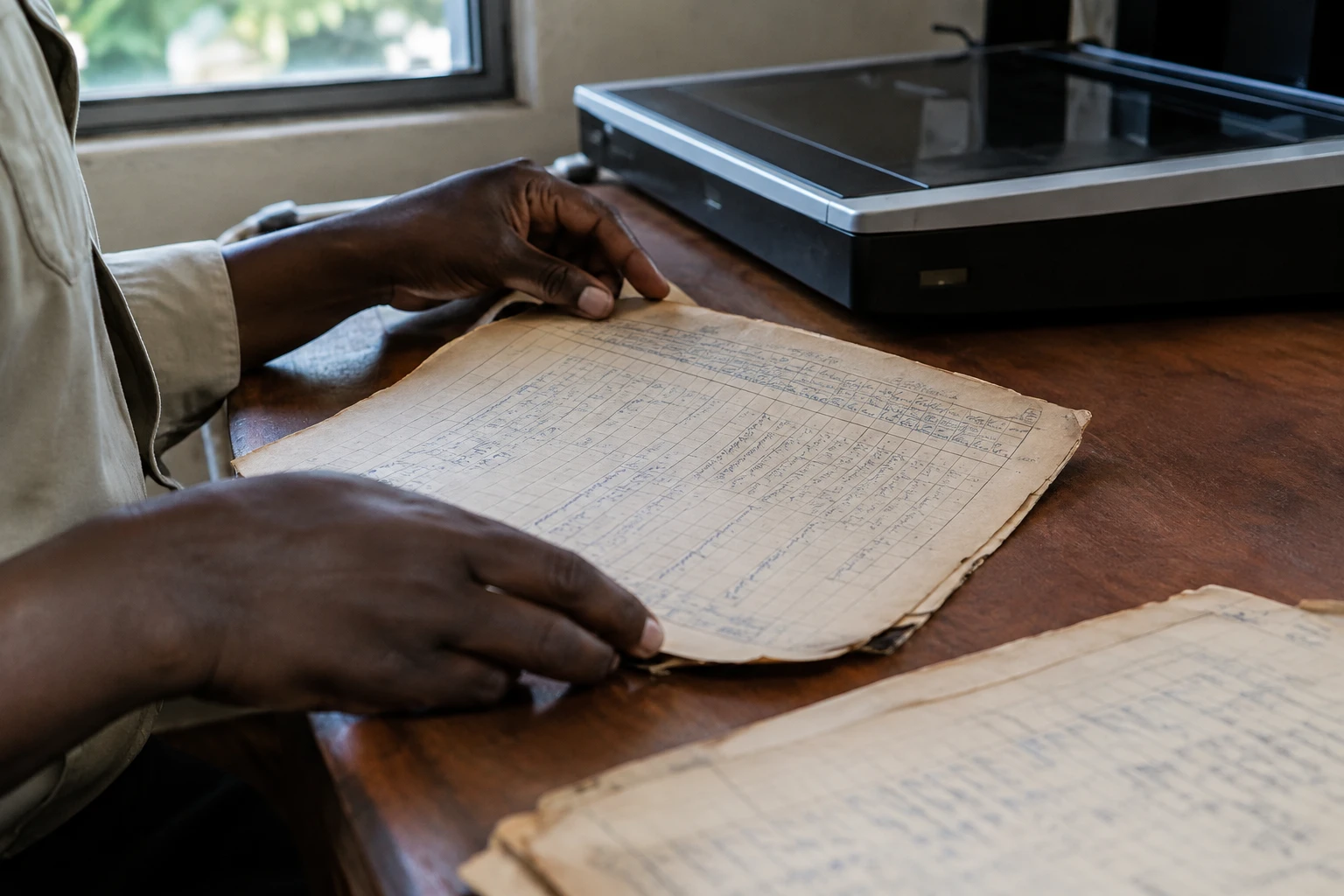
A rise in temperature may seem modest on paper. In the Congo Basin, however, it affects seasons, harvests and forecasts on which millions of people depend. To measure this change more accurately, researchers have brought back into use records long kept on paper in the Democratic Republic of the Congo (DR Congo).
Weather station records brought back into use
At Yangambi, in Tshopo province, the National Institute for Agronomic Study and Research (INERA) held observation sheets from 37 weather stations. Teams photographed 9,885 handwritten sheets, then used software for transcription assisted by machine learning. The data were subsequently checked and made available in open repositories.
The work produced more than one million daily and sub-daily observations. They cover temperatures and precipitation, among other measures. The full dataset spans 1908 to 2023, but the records examined in this project mainly cover the period from the 1960s to the 1990s, with some later extensions.
Published on 12 October 2026 in the scientific journal Earth System Dynamics, the study examines temperature trends at 21 stations. For heavy rainfall, the analysis covers just three stations, whose records met the researchers’ criteria for length and quality.
The warming signal becomes clearer
Over the period 1961-1990, maximum temperatures rose by about 0.7°C at the median across the stations analysed. Minimum temperatures increased by about 0.3°C and mean temperatures by 0.5°C. The authors also note that the average number of hot days almost doubled between the first and last decades of this period.
These findings are consistent with an earlier study at Yangambi based on measurements covering 1960-2020. It also found a sustained rise in temperatures and hot spells, with an acceleration since the early 1990s. This overlap strengthens the evidence of warming, without turning data from a handful of stations into an exhaustive measure of every part of the basin.
Even greater caution is needed on precipitation. Only three stations had sufficiently long validated daily records to study heavy rainfall episodes. Two show an increased frequency of intense rainfall, but this sample does not support a conclusion about a general trend across DR Congo or the basin as a whole.
Direct implications for agriculture and forecasting
Continuous local records help to understand changes affecting communities. For farmers, the timing of rainfall and heat influences planting periods, water needs and yields. At Yangambi, research covering six decades has already linked warming and changes in the rainy seasons to effects on crops.
Ground observations are also used to verify satellite products and weather reanalyses, which combine models with available measurements. In a region with few stations, estimates may differ from local records. The new study notes discrepancies with ERA5-Land for some stations and periods in particular. The archives therefore put to the test the tools used to describe the past climate and anticipate how it will change.
The project also highlights the importance of Congolese institutions. The sheets were held in INERA’s archives at Yangambi, and access to the collection, along with knowledge of the stations, made it possible to bring them back into use. Digitisation does not erase gaps in the current observation network. It does, however, preserve fragile measurements and make them available to other teams.
Relevance beyond DR Congo’s borders
The Congo Basin extends beyond DR Congo and connects several Central African countries. Understanding temperature and rainfall variations across this vast region matters for agriculture, water management and the study of forests. Congolese findings therefore contribute to regional knowledge, but do not automatically describe conditions in every country bordering the basin.
The next challenge is to complete the historical series and maintain regular field observations. Researchers say additional data could refine analyses of extreme events and help assess regional climate models. For meteorological services and policymakers, better-verified information can improve forecasts and planning, from Kinshasa to areas far from the capital.
The archives tell more than the story of yesterday’s climate. They also demonstrate the value of scientific heritage preserved in DR Congo and the role of Congolese researchers in making it accessible. Their use provides a firmer basis for tracking future changes, provided measurements continue and a signal observed at certain stations is not mistaken for uniform certainty across the entire basin.
For more information, see the study of DR Congo’s weather archives and the long-term research conducted at Yangambi.



