
 Algeria
 Egypt
 Libya
 Morocco
 Sudan
 Tunisia
 Benin
 Burkina Faso
 Cabo Verde
 Côte d'Ivoire
 Ghana
 Guinea
 Guinea-Bissau
 Liberia
 Mali
 Mauritania
 Niger
 Nigeria
 Senegal
 Sierra Leone
 The Gambia
 Togo
 Cameroon
 Central African Republic
 Chad
 Equatorial Guinea
 Gabon
 Republic of the Congo
 São Tomé and Príncipe
 Burundi
 Comoros
 Djibouti
 Eritrea
 Ethiopia
 Kenya
 Madagascar
 Malawi
 Mauritius
 Mozambique
 Rwanda
 Seychelles
 Somalia
 South Sudan
 Tanzania
 Uganda
 Angola
 Botswana
 Eswatini
 Lesotho
 Namibia
 South Africa
 Zambia
 Zimbabwe
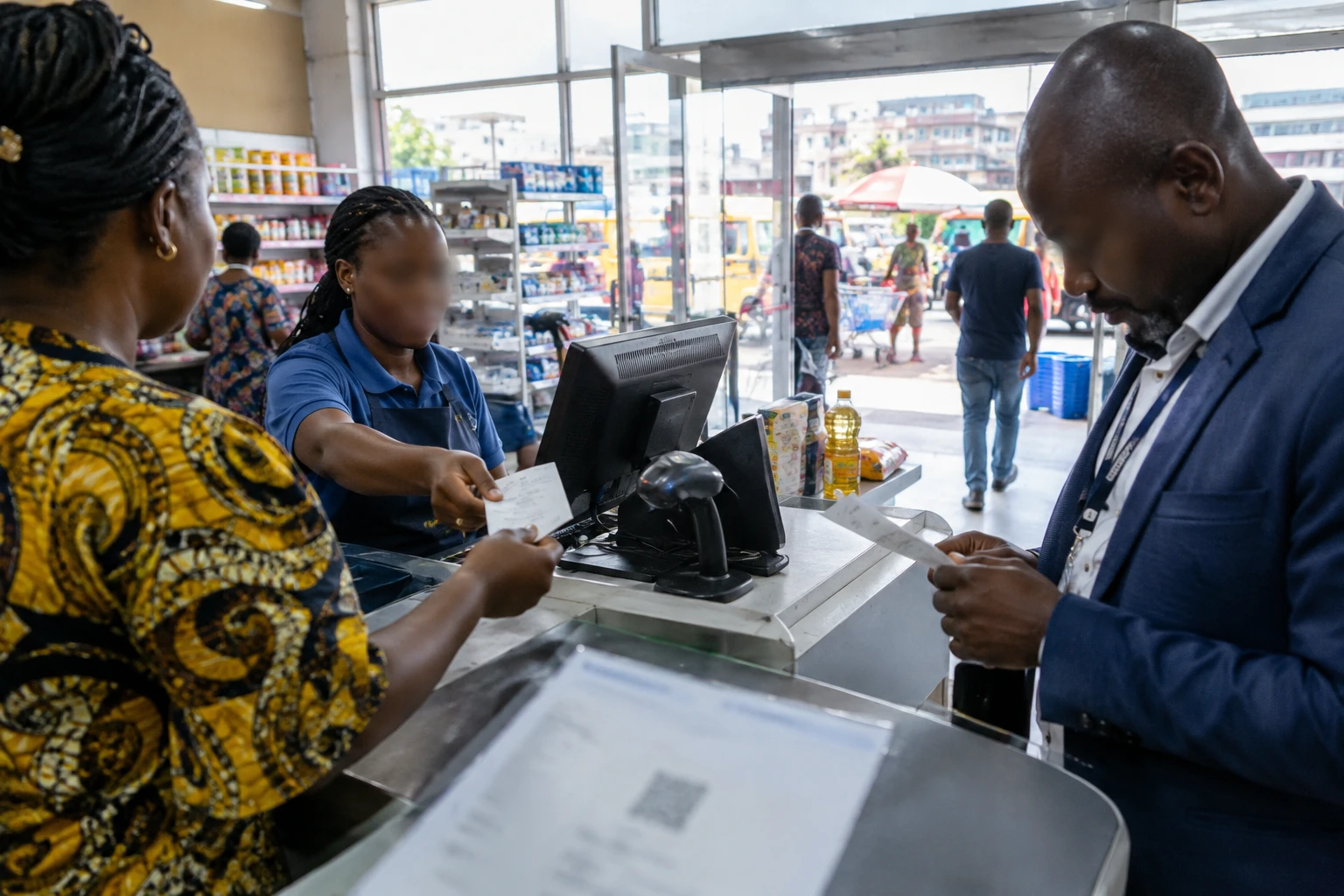
In Kinshasa, a till receipt is becoming a tool for monitoring public revenue. The Democratic Republic of the Congo (DR Congo) wants to check that value-added tax (VAT), paid by customers when they make purchases, is properly declared and remitted to the state.
The reform applies to businesses liable for VAT, from supermarkets to hotels and restaurants. It is part of a broader strategy to mobilise domestic revenue, as public financing needs remain high. In Central Africa, DR Congo is a member of the Economic Community of Central African States (ECCAS), but this reform is national: it falls under the Congolese tax authorities, not a shared regional obligation.
An obligation now in the enforcement phase
The standardised invoice is a secure sales document designed to enable the Directorate General of Taxes (DGI) to verify the authenticity and traceability of a transaction. It includes a QR code or other identification features linked to the electronic tax system. VAT, meanwhile, is a consumption tax: the business collects it from the customer, then declares it and pays it to the Treasury.
Following the launch of the reform in 2025 and several compliance stages, the obligation is now being fully enforced. The Ministry of Finance and the DGI have notably announced the end of grace periods and the start of sanctions in 2026. The Federation of Enterprises of the Congo took part in joint work with the authorities to address technical difficulties encountered by businesses.
During inspections in Kinshasa on 22 October, inspectors checked invoices given to customers at several commercial establishments. Reported irregularities included the absence of a standardised invoice, parallel systems and unrecognised QR codes. DGI director-general Barnabé Muakadi Muamba said cases of non-compliance persisted despite information campaigns. The detailed findings remain those of the inspection teams and do not, on their own, constitute a national assessment of tax fraud.
Managers at some establishments acknowledged delays in becoming compliant or said that steps were under way. In some cases, inspectors disputed these explanations, saying that applications had been rejected or were incomplete. These cases point to a practical challenge: understanding the rules is not enough if billing systems are not approved or administrative procedures are not completed.
Traceability: public revenue and business constraints
For the state, the system is intended to make sales more verifiable and reduce discrepancies between transactions carried out, VAT declared and sums actually remitted. It is also intended to improve the quality of data available for tax inspections. The authorities therefore present the standardised invoice as a monitoring tool, not merely a formality imposed on traders.
The reform also adds to the costs and compliance procedures businesses must manage: equipment, software, connectivity and changes to till procedures. Discussions between the Ministry of Finance, the DGI and the Federation of Enterprises of the Congo show that technical questions had to be examined. Larger companies may find these investments easier to absorb than smaller operators. The practical implementation of the rules and support for businesses will therefore affect how effective the system is.
The inspections also highlight the role of consumers. Many do not check the information on their receipts, even though QR-code authentication can help identify a non-compliant invoice. The government has urged Congolese people to ask for their invoices and announced the FACNO RDC app to verify them and report certain irregularities. This participation does not transfer primary responsibility for compliance to customers: that remains with businesses and the administration responsible for enforcement.
An issue of trust as well as revenue collection
The ability to mobilise domestic revenue matters in a country where public needs include infrastructure, health and education. But the impact of the reform will not be measured only by the number of inspections or invoices issued. It will also be necessary to assess whether VAT declarations become more reliable, whether sanctions are applied in accordance with the rules and whether businesses have accessible means to comply.
The standardised invoice is part of a wider trend towards digitising tax administrations across the continent. Arrangements differ from one country to another, so the Congolese experience cannot automatically be applied to other ECCAS or African Union member states. It nevertheless raises a shared question: how can public revenue be strengthened without making procedures impracticable for businesses or placing on consumers a monitoring role they cannot fulfil alone?
In Kinshasa, what happens next will depend on the regularity of checks, the clarity of the rules and how the difficulties reported by businesses are addressed. Trust in the reform will depend on these factors as much as on whether a receipt carries a QR code.



