Algeria
 Egypt
 Libya
 Morocco
 Sudan
 Tunisia
 Benin
 Burkina Faso
 Cabo Verde
 Côte d'Ivoire
 Ghana
 Guinea
 Guinea-Bissau
 Liberia
 Mali
 Mauritania
 Niger
 Nigeria
 Senegal
 Sierra Leone
 The Gambia
 Togo
 Cameroon
 Central African Republic
 Chad
 Equatorial Guinea
 Gabon
 Republic of the Congo
 São Tomé and Príncipe
 Burundi
 Comoros
 Djibouti
 Eritrea
 Ethiopia
 Kenya
 Madagascar
 Malawi
 Mauritius
 Mozambique
 Rwanda
 Seychelles
 Somalia
 South Sudan
 Tanzania
 Uganda
 Angola
 Botswana
 Eswatini
 Lesotho
 Namibia
 South Africa
 Zambia
 Zimbabwe
In areas far from Kinshasa, installing solar panels is not enough. Batteries must also be maintained, networks managed, and households, schools, health centres and businesses connected. At this decisive stage, the Democratic Republic of the Congo (DR Congo) wants to involve private operators in 28 power plants already financed with public funds.
Public infrastructure that must operate sustainably
The National Agency for Electrification and Energy Services in Rural and Peri-Urban Areas (ANSER) published, on 28 October 2026, a notice inviting companies interested in managing, operating and maintaining these facilities to come forward. The deadline to register interest is 26 November 2026.
The notice does not yet launch a tender. It is intended to identify operators and gather their feedback, particularly on grouping the power plants into lots. ANSER says that taking part at this stage will not be a requirement for participating in the subsequent selection process.
The 28 installations have a combined solar capacity of 5,615 kilowatt-peak (kWp), or 5.615 megawatt-peak (MWp). They also have 9,750 kilowatt-hours of storage and backup generators with a combined capacity of 2,475 kilovolt-amperes. These hybrid systems are intended, in particular, to supply electricity when solar output falls.
The power plants are divided into eight lots, whose scope could change before the selection process. Bas-Uélé brings together two sites with a capacity of 1,030 kWp. In Équateur and Mongala, two installations total 1,000 kWp. Kasaï has five power plants with a capacity of 900 kWp, compared with six plants and 670 kWp in Sankuru. In Lualaba, the smallest lot comprises one 175 kWp plant.
Several facilities are still undergoing technical commissioning, with household connections being tested. The notice does not say how many power plants have been fully completed or how many customers are already being served. Nor does it specify future tariffs or construction costs.
A service challenge, not just a question of generation
The issue goes beyond installed capacity. A power plant can generate electricity, but its usefulness also depends on the reliability of the local network, equipment maintenance and the ability to connect customers. In sparsely populated and remote areas, these operations can be costly, while expected revenues vary with demand.
The choice of contract will therefore affect how risks and responsibilities are shared. ANSER is considering four models: concession, affermage, interested management and management contract. The arrangement selected for each lot will be specified in the selection documents. A one-year probationary period is also planned for future contracts.
The assignments could involve more than routine operations. The agency cites new connections, network extensions, battery or converter replacements, and increases in generation and storage capacity. Equipment designed for productive uses could also be developed. But these investments are not yet fixed obligations: their scale and financing will depend on future contracts.
This caution matters to residents. Tariffs, connection fees and continuity of service will determine whether the infrastructure actually benefits households and small businesses. For operators, viability will depend in particular on the number of customers who can be connected and the distance between installations. The selection process will need to make these factors clear.
One stage in a wider programme
The 28 power plants are part of ANSER’s Priority Investment Programme, which covers projects in about 49 rural and peri-urban areas. The agency’s 2024 annual report already describes completed projects operating provisionally on a trial basis while awaiting a management framework. It also notes funding constraints and implementation delays. This precedent underscores the importance of planning for operation from the construction stage.
Decentralised solar power is one possible response to long distances and scattered settlements. It does not, on its own, replace major grids or other energy sources. However, well-maintained mini-grids can power essential services and support economic activity where extending the national grid remains difficult.
The initiative is taking place in a sector where the state is seeking to attract capital without relinquishing control of infrastructure financed from public resources. Congolese and foreign companies, individually or in consortia, may register their interest. ANSER invites foreign players to specify the local partnerships they envisage. No timetable has yet been announced for the final selection.
A signal to watch across the region
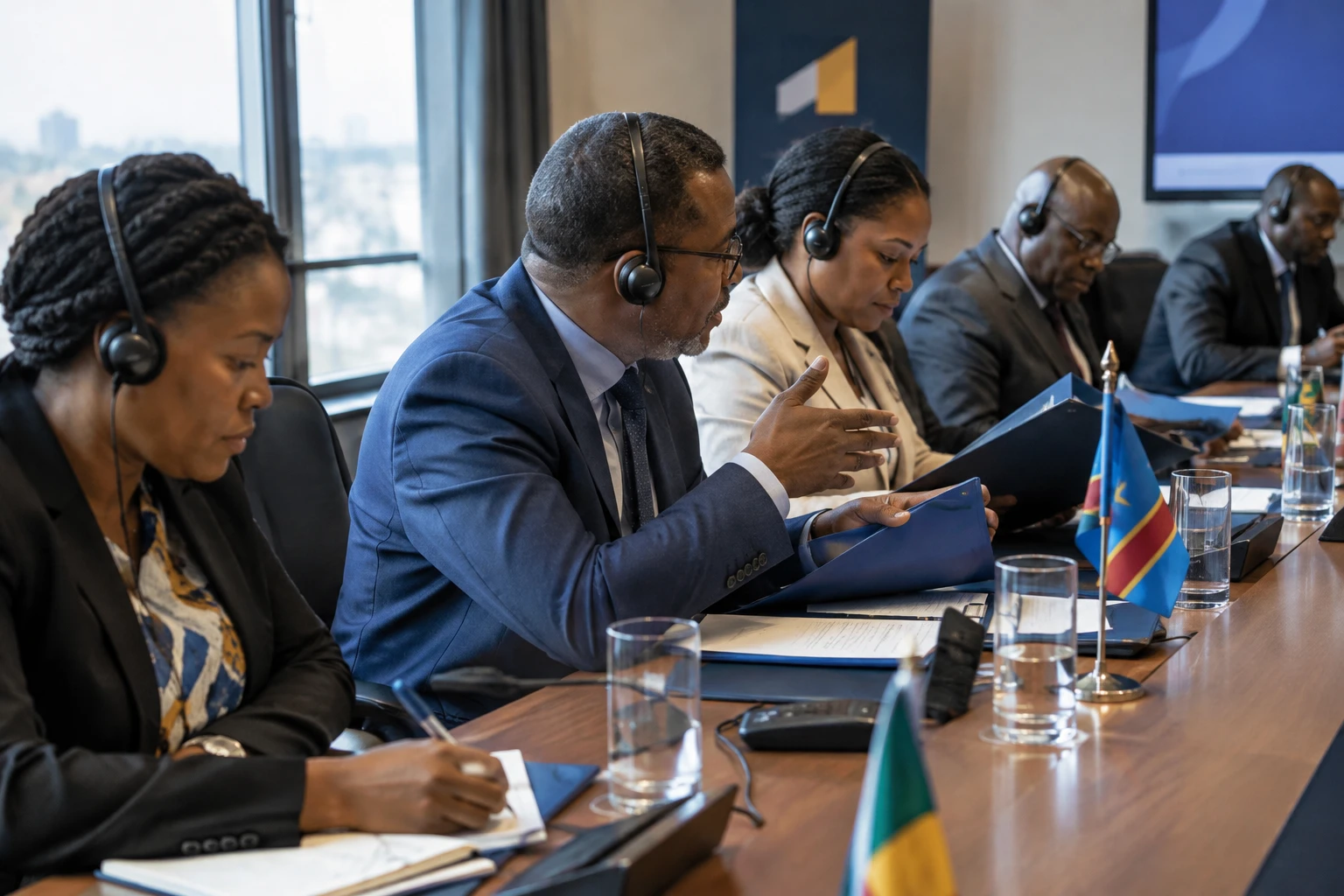
DR Congo is a member of the Southern African Development Community (SADC), which brings together regional states for economic cooperation. The experience of these delegations may be of interest to other countries facing a similar challenge: turning public investment into sustainable electricity services, particularly outside major urban centres.
In Kinshasa, the challenge will be to turn a consultation phase into transparent contracts and measurable results. In the provinces, the tangible indicators will be the number of power plants actually operating, connections completed, service quality and the cost borne by users. The next step will be publication of the selection conditions. Only then will it be possible to assess the balance between private management, additional financing and equitable access to electricity.
Details of the notice inviting operators to register interest in the 28 power plants are reported by Bankable. The programme’s context is also documented in ANSER’s 2024 annual report. SADC’s regional remit is set out by the regional organisation.