
 Algeria
 Egypt
 Libya
 Morocco
 Sudan
 Tunisia
 Benin
 Burkina Faso
 Cabo Verde
 Côte d'Ivoire
 Ghana
 Guinea
 Guinea-Bissau
 Liberia
 Mali
 Mauritania
 Niger
 Nigeria
 Senegal
 Sierra Leone
 The Gambia
 Togo
 Cameroon
 Central African Republic
 Chad
 Equatorial Guinea
 Gabon
 Republic of the Congo
 São Tomé and Príncipe
 Burundi
 Comoros
 Djibouti
 Eritrea
 Ethiopia
 Kenya
 Madagascar
 Malawi
 Mauritius
 Mozambique
 Rwanda
 Seychelles
 Somalia
 South Sudan
 Tanzania
 Uganda
 Angola
 Botswana
 Eswatini
 Lesotho
 Namibia
 South Africa
 Zambia
 Zimbabwe
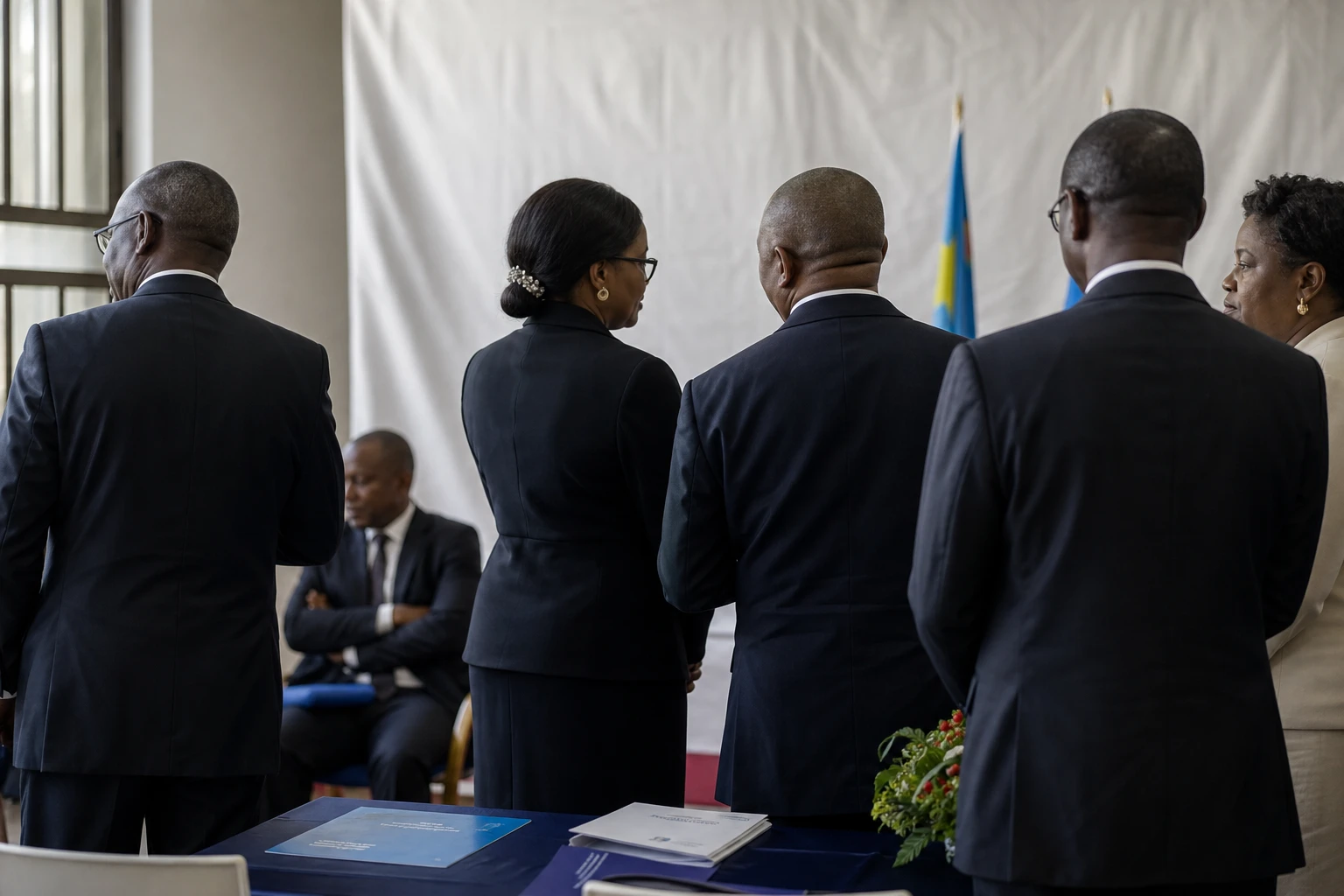
In Kinshasa, a legal debate that goes beyond procedure
In the Democratic Republic of the Congo, major political battles are not fought only in the streets. They are also fought through texts, deadlines and the institutions that validate them. That is what gives the referendum law a significance far greater than that of a simple parliamentary timetable: it touches on the balance of power, the interpretation of the Constitution and, by implication, the question of what happens after 2028.
The issue is particularly sensitive in DR Congo, where the 2006 Constitution, revised in 2011, prohibits any revision of the number and length of presidential terms. It also provides that certain revisions cannot be adopted without a referendum. In this context, recourse to the Constitutional Court becomes unavoidable whenever a text affects the rules of the institutional game.
What the law says, and what it could allow
The referendum bill was adopted by Parliament in June 2026, after being considered by the National Assembly and the Senate. On 15 June, the two chambers finally agreed on the conditions for organising a referendum, before sending the bill to the head of state for promulgation. A few days later, the Constitutional Court ruled the bill consistent with the Constitution, while reserving its position on certain wording, notably provisions allowing a referendum on any question deemed to be of «fundamental» importance.
Under the Congolese Constitution, a revision may be put to the people in a referendum unless Congress adopts it by a qualified majority. But Article 220 locks down several unalterable provisions, including the number and length of the president’s terms. This is precisely where the controversy is centred: the opposition fears that a new institutional framework, built around a constituent assembly followed by a popular vote, could be used to circumvent this prohibition.
Félix Tshisekedi, in power since 2019, has himself fuelled the ambiguity. On 6 May 2026, he said no issue of national interest should be «withheld» and that any discussion of institutions should be conducted methodically. Then, at the 30 June press conference, he said that if the people wanted a third term, he would accept it. The remark carried considerable weight because it shifted the debate from legal technicalities alone to the political interpretation of the moment.
The balance of power within the country
The government has a clear numerical advantage. The presidential majority controls a large share of Parliament, enabling the bill’s adoption despite opposition lawmakers’ withdrawal from several stages of the debate. By contrast, rival parties, weakened by the landslide re-election in 2023, have found common ground in defending the Constitution and rebuilding their political voice. The anti-reform front, centred on the C64 coalition, has denounced institutional drift, while voices in favour of change argue for a more flexible legal framework.
On the streets, protests have already crossed a symbolic threshold. Demonstrations against the reform have been held in Kinshasa, and the opposition postponed another rally after the announcement of a national dialogue. The postponement makes one thing clear: the balance of power is not confined to institutions. It also depends on the actors’ ability to hold the streets, avoid escalation and retain a credible social base in a capital where politics is reflected as much in statements as in traffic, churches and markets.
The government, for its part, insists that discussion about the country’s institutional future should not be blocked altogether. But in a country where memories of unfinished transitions remain vivid, the question is not simply whether a referendum is legal. It is also what it would actually be used for, who would set its terms, and what place would be left for provinces, local elected officials and intermediary bodies. On this point, the Constitution also protects the powers of provinces and decentralised territorial entities.
An issue set against a wider regional backdrop
DR Congo is not debating its constitutional future in a vacuum. In the Great Lakes region, security crises and political solutions often advance together, or become bogged down together. In the east, war remains a defining factor in national life. The UN, the African Union, Qatar, the United States and several regional mechanisms are still following discussions on the M23 and the stabilisation of eastern Congo. In February 2026, the AU again welcomed progress under a ceasefire mechanism between Kinshasa and the AFC/M23.
This backdrop matters. When a central government discusses a possible overhaul of its institutions while part of its territory remains vulnerable to armed conflict, the question of legitimacy becomes even more pressing. Regional organisations such as SADC, the EAC and ECCAS, alongside the African Union, have also stepped up calls for de-escalation and coordinated mediation. Kinshasa faces a dual challenge: restoring state authority in the east while preventing the constitutional debate from further fracturing the country’s political centre.
There is also the public health emergency. In May 2026, the WHO confirmed a new Ebola outbreak in DR Congo’s Ituri province and classified it as a public health emergency of international concern. The country therefore has to manage an epidemic, a war of varying intensity depending on the area, and an institutional confrontation over the rules governing power—all at the same time. This accumulation helps explain why the referendum debate is not seen by the public as abstract: it overlaps with very concrete concerns about security, mobility, health and trust in the state.
For Central Africa, the stakes go beyond DR Congo. How Kinshasa handles this issue will shape regional perceptions of constitutional transitions, which are already being watched cautiously elsewhere on the continent. It will also affect relations between African institutions and national capitals, at a time when the African Union is advancing its own mediation and stability mechanisms. In DR Congo, the next political milestone is therefore not simply a distant election date. It is the way the country chooses—or declines—to lock down its institutions while responding to its immediate emergencies.



