
 Algeria
 Egypt
 Libya
 Morocco
 Sudan
 Tunisia
 Benin
 Burkina Faso
 Cabo Verde
 Côte d'Ivoire
 Ghana
 Guinea
 Guinea-Bissau
 Liberia
 Mali
 Mauritania
 Niger
 Nigeria
 Senegal
 Sierra Leone
 The Gambia
 Togo
 Cameroon
 Central African Republic
 Chad
 Equatorial Guinea
 Gabon
 Republic of the Congo
 São Tomé and Príncipe
 Burundi
 Comoros
 Djibouti
 Eritrea
 Ethiopia
 Kenya
 Madagascar
 Malawi
 Mauritius
 Mozambique
 Rwanda
 Seychelles
 Somalia
 South Sudan
 Tanzania
 Uganda
 Angola
 Botswana
 Eswatini
 Lesotho
 Namibia
 South Africa
 Zambia
 Zimbabwe
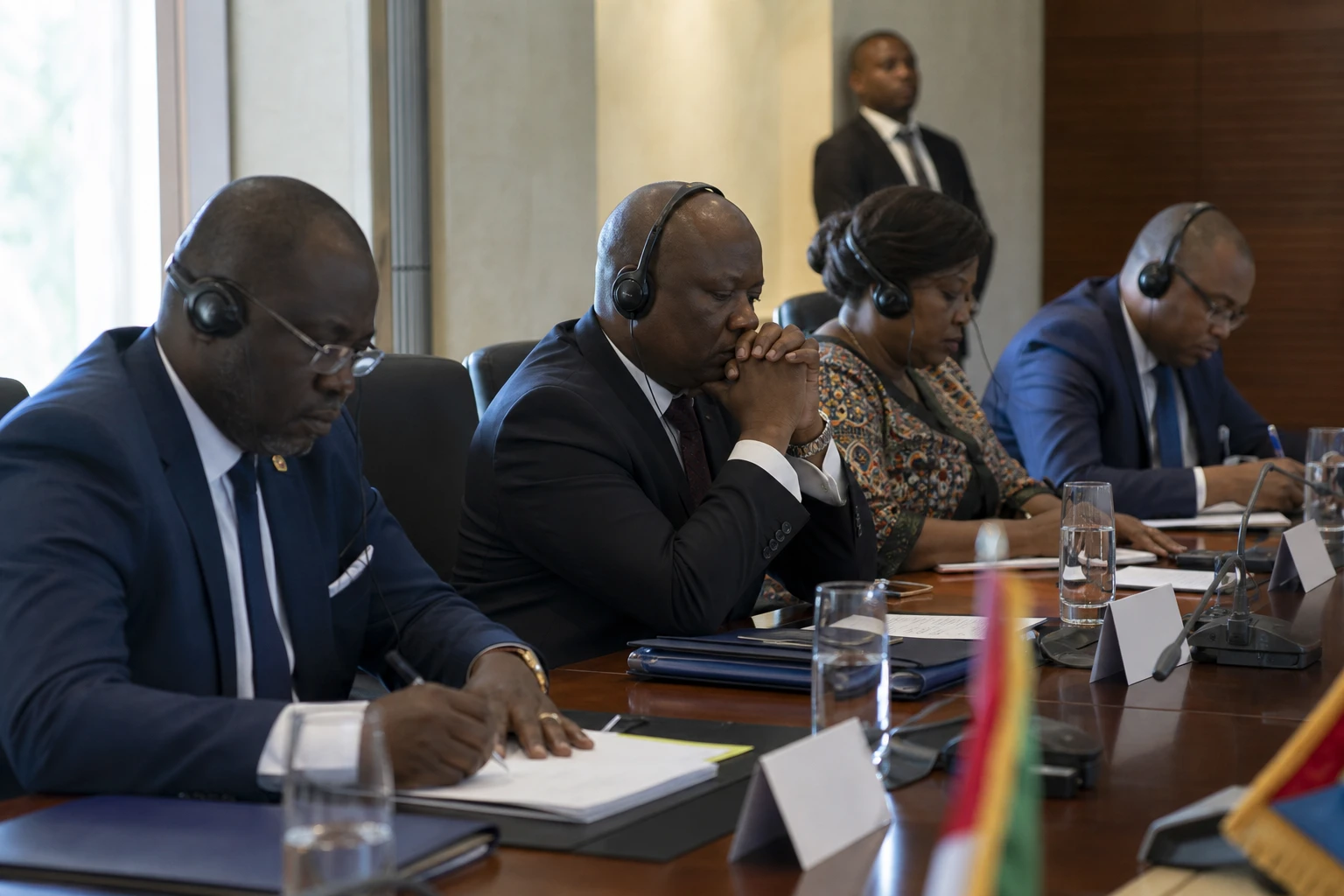
Mediation moves forward in small steps
In eastern Congo, each week of negotiations carries as much weight as a clash on the ground. In Montreux, Switzerland, the Democratic Republic of the Congo and the AFC/M23 have therefore resumed talks far from the front lines, in a diplomatic process that has become almost as strategic as the fighting itself.
The issue goes beyond the negotiating table. It affects the flow of aid, the release of detainees, the return of public services and the credibility of a process that has taken shape between Doha, Washington and several regional capitals. Qatar is leading the facilitation, with support from the United States, the African Union, Togo as the AU-designated mediator, Switzerland as host country and MONUSCO providing technical support for certain mechanisms.
Doha, Montreux and the fault lines
The political framework remains the framework agreement signed in Doha on 15 November 2025 between Kinshasa and the AFC/M23. It provides for a series of successive protocols, followed by their gradual implementation. Publicly available documents show that the provisions on humanitarian access, judicial protection, ceasefire monitoring and prisoner releases formed the basis of the Montreux discussions in April, ahead of a new round of talks this week.
This kind of format is not a minor detail. In protracted conflicts, institutional detail becomes political. Who facilitates? Who verifies? Who transports detainees? Who guarantees the safety of teams? These apparently technical questions determine the pace of dialogue in practice. The joint presence of Qatar, the African Union, Togo, the United States and Switzerland reflects this multi-layered mediation architecture, now essential to preventing the process from stalling.
What has been achieved, and what remains blocked
This latest round did not produce an additional protocol. It mainly led to the establishment of a mechanism tasked with monitoring implementation of the Doha framework agreement, according to information cross-checked with diplomatic and UN sources. No new text, however, was finalised. The parties therefore remain at the stage of organising monitoring, rather than extending the political substance of the compromise.
The main sticking point is well known. The Doha process was expected to result in eight protocols. So far, however, only two have been substantively addressed, according to information already made public about the framework. Montreux had helped advance humanitarian access, judicial protection and the ceasefire verification mechanism, but the prisoner issue remained fragile. Radio Okapi reported that, as of 30 April, no transfer had taken place despite an announced exchange of 311 detainees linked to the AFC/M23 and 166 detainees held by the government. Other reports confirmed that an initial group of 15 people was indeed released in early August, but that the match between the lists submitted by the parties and the actual releases remains incomplete.
The fighting has not stopped. Local and UN sources continue to describe a tense situation in North Kivu and South Kivu, with intermittent clashes and mutual accusations of ceasefire violations. It is precisely this disconnect between the front and diplomacy that undermines peace: commitments are formalised abroad, while security realities continue to set the agenda in eastern DR Congo.
What this means for Congolese people and the region
For civilians, the stakes are immediate. A genuinely functioning humanitarian corridor means fewer supply disruptions, shorter delays in accessing healthcare and greater safety for displaced people. The Montreux text also stresses the protection of civilians, women, children, schools, hospitals and infrastructure essential to daily life. This is not an abstract formula: in eastern DR Congo, it determines access to water, healthcare, education and local markets.
For Kinshasa, the stakes are also political. The government is seeking to preserve its authority while avoiding any reading of the dialogue as recognition of a balance of power on the ground that has become fixed. For the AFC/M23, the question is the reverse: to turn military and administrative gains into negotiating leverage without agreeing to be subsumed into a mere disarmament mechanism. In this equation, every detainee release, every verified ceasefire and every monitoring mission becomes a test of trust.
The regional significance is just as clear. The conflict in eastern Congo is no longer confined to the border between Kinshasa and an armed movement. It intersects with Great Lakes dynamics, the African Union’s concerns and attempts to coordinate among several sponsors of the mediation. Switzerland’s hosting of the talks, while Qatar retains political leadership, shows how multiple the centres of diplomatic gravity have become. Central Africa remains at the heart of the equation, with direct consequences for cross-border trade, population movements and the stability of neighbouring countries.
The next steps will therefore depend less on a grand gesture than on a series of concrete actions. Credible ceasefire verification, better-coordinated releases and a clear timetable for the remaining protocols will show whether Montreux was merely a pause or a genuine point of support. In this part of DR Congo, peace is measured first by what happens—or does not happen—to civilians.



