Algeria
 Egypt
 Libya
 Morocco
 Sudan
 Tunisia
 Benin
 Burkina Faso
 Cabo Verde
 Côte d'Ivoire
 Ghana
 Guinea
 Guinea-Bissau
 Liberia
 Mali
 Mauritania
 Niger
 Nigeria
 Senegal
 Sierra Leone
 The Gambia
 Togo
 Cameroon
 Central African Republic
 Chad
 DR Congo
 Equatorial Guinea
 Gabon
 Republic of the Congo
 São Tomé and Príncipe
 Burundi
 Comoros
 Djibouti
 Eritrea
 Ethiopia
 Kenya
 Madagascar
 Malawi
 Mauritius
 Mozambique
 Rwanda
 Seychelles
 Somalia
 South Sudan
 Tanzania
 Uganda
 Botswana
 Eswatini
 Lesotho
 Namibia
 South Africa
 Zambia
 Zimbabwe
When a railway becomes a question of economic sovereignty
In Kinshasa, rail is not just a matter of wagons and sleepers. In the south-east of the Democratic Republic of the Congo, it touches on a broader question: how can the country turn its mineral wealth into jobs, revenue and local industry, rather than letting it flow abroad too quickly? The new railway project between Dilolo and Sakania is precisely part of this effort.
The issue also extends beyond national borders. The line is intended to connect Lualaba and Haut-Katanga to the Angolan port of Lobito on the Atlantic, with Zambia as the third part of the regional arrangement. The Lobito corridor is therefore a Congolese, Angolan and Australian? No: a southern and central African issue, within the orbit of SADC, with expected effects on regional trade, customs and logistics.
What Kinshasa and Luanda signed
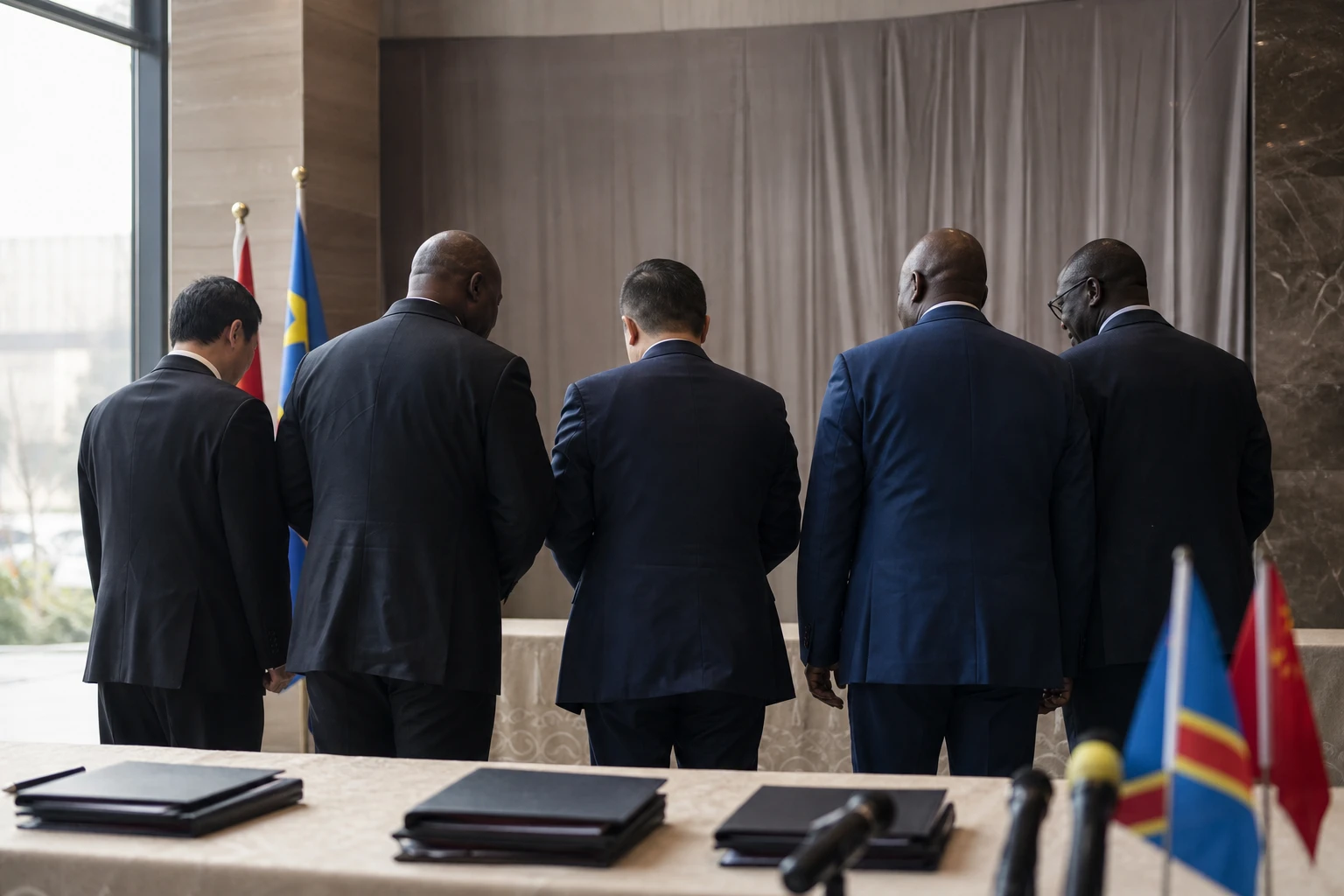
On Wednesday 26 August 2026 in Kinshasa, presidents Félix-Antoine Tshisekedi and João Manuel Gonçalves Lourenço attended the signing of the railway concession contract for the Dilolo-Sakania section, as well as a cooperation agreement relating to the Lobito corridor. The contract was concluded between the Congolese state and Mota-Engil Africa.
According to the Congolese presidency, the line in question is 1,004.5 kilometres long and serves Kolwezi, Tenke and Lubumbashi, among other places, before joining the Angolan network towards Lobito. The indicative investment is estimated at nearly US$1.258bn. The concession runs for 30 years, after which the renovated infrastructure is to revert to the Congolese state.
The financing structure is presented as more protective of DR Congo’s public finances. The concessionaire will bear the financing and traffic-related risks, with no sovereign guarantee, operating subsidy or minimum-revenue guarantee. DR Congo will retain at least 10% of the project company’s capital and receive a royalty equivalent to 7.5% of annual gross revenue.
The Congolese side also emphasises the role of SNCC, the National Railway Company of Congo. The head of state said the agreement meant neither the privatisation of SNCC nor a railway monopoly. This clarification matters because the debate over concessions often reflects a recurring concern: that the state could lose control of strategic infrastructure.
A freight corridor, but also one for production
The project is not aimed solely at minerals. The Congolese authorities want it to carry agricultural products, industrial inputs, hydrocarbons, containers, consumer goods and passengers. In short, the stated ambition is to make rail a tool for opening up the mining provinces, but also for everyday trade and the local economies that depend on markets, transport and small supply chains.
This direction aligns with the vision the Congolese government has been promoting for several months. In April 2026, Prime Minister Judith Suminwa Tuluka told an audience in Washington that the corridor should become a “genuine lever for economic transformation”, rather than simply an export route. On the same day, she called for an integrated approach combining infrastructure, reforms and private investment.
In government documents, the route is presented as a broader network of connections, with the Tenke-Kolwezi-Dilolo-Sakania axis and additional feeder lines. In the spring, the Budget Ministry referred to a corridor spanning 1,081 kilometres within Congolese territory. The difference from the 1,004.5-kilometre figure cited by the presidency shows that the technical boundaries are still described according to the perimeters used. These figures should therefore be read as working estimates, not fixed absolutes.
The political heart of the matter is this: DR Congo wants to cut logistics costs, secure its mineral exports and capture more value on its own soil. In Haut-Katanga and Lualaba, where copper and cobalt are concentrated, rail could change the equation for formal operators, subcontractors, agricultural producers and small transport businesses that depend on the smooth running of road and rail routes.
A test for regional cooperation
Beyond the work to come, the Lobito corridor remains a test of coordination between states. Kinshasa and Luanda have agreed to harmonise rail operations, tariffs and customs procedures. A joint monitoring mechanism is also to oversee maintenance, price transparency and improvements to the Dilolo-Luau border crossing. This is often where the success or failure of major cross-border projects is determined: less by the signing itself than by day-to-day implementation.
The continental significance is real. The authorities already present the corridor as part of regional integration within SADC and as a link between central Africa and the Atlantic. It is also part of broader competition between African logistics corridors, each seeking to attract mineral, agricultural and manufacturing flows towards ports, industrial hubs and international markets.
The timetable adds further pressure. The project’s success will depend on the ability of the three countries involved, their rail operators and their financial partners to align studies, financing, technical standards and customs. President Tshisekedi summed it up in his own way: the signing in Kinshasa is not an end, but the beginning of a shared responsibility. For DR Congo, the challenge is no longer to proclaim a corridor. It is to get it running, sustainably, for the people and the real economy.