Algeria
 Egypt
 Libya
 Morocco
 Sudan
 Tunisia
 Benin
 Burkina Faso
 Cabo Verde
 Côte d'Ivoire
 Ghana
 Guinea
 Guinea-Bissau
 Liberia
 Mali
 Mauritania
 Niger
 Nigeria
 Senegal
 Sierra Leone
 The Gambia
 Togo
 Cameroon
 Central African Republic
 Chad
 Equatorial Guinea
 Gabon
 Republic of the Congo
 São Tomé and Príncipe
 Burundi
 Comoros
 Djibouti
 Eritrea
 Ethiopia
 Kenya
 Madagascar
 Malawi
 Mauritius
 Mozambique
 Rwanda
 Seychelles
 Somalia
 South Sudan
 Tanzania
 Uganda
 Angola
 Botswana
 Eswatini
 Lesotho
 Namibia
 South Africa
 Zambia
 Zimbabwe
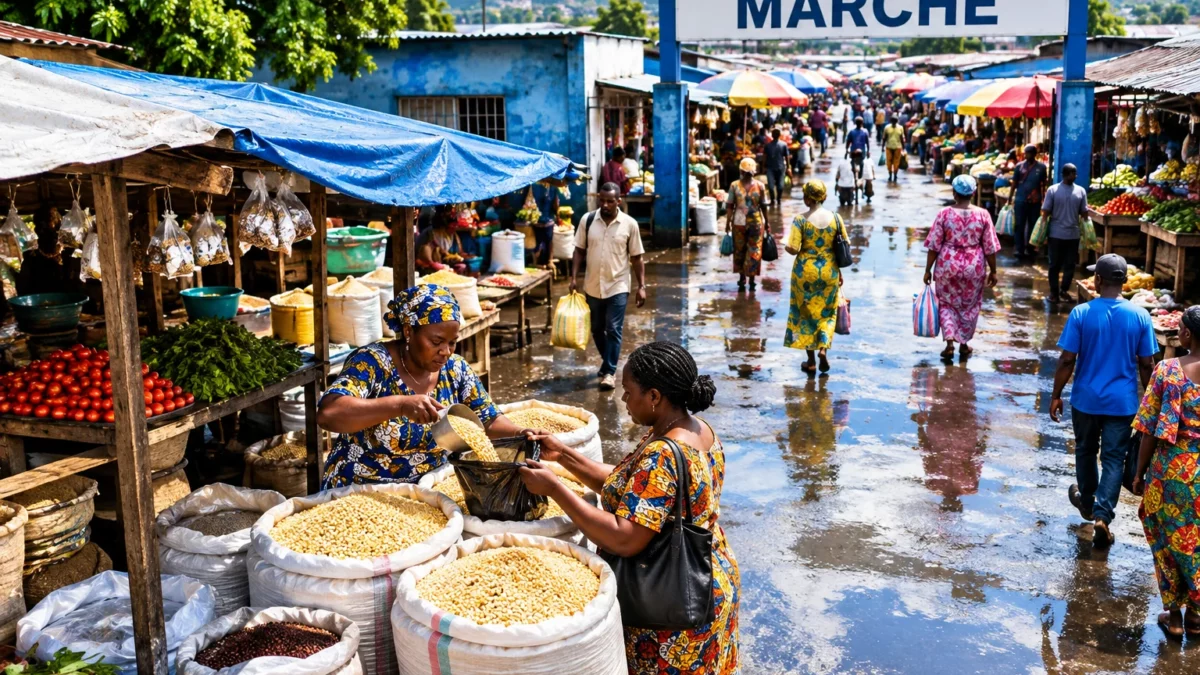
Producing more maize or fish in the Democratic Republic of the Congo is not enough: crops must also be stored, processed and transported to markets. That is the challenge addressed, on paper, by several investments recently approved by the Industrial Promotion Fund (FPI).
From fields to storage: links to strengthen
In Kinshasa, funding decisions cover activities spread across the capital, Lualaba and Kongo Central. This geography matters. In production areas, farmers need buyers and storage capacity. In cities, mills and processing plants can bring local produce closer to consumers. But these links work together only if roads, energy, procurement and distribution keep pace.
The Democratic Republic of the Congo is also a member of the Southern African Development Community (SADC), a regional organisation that works, among other things, on food systems, grain reserves and agricultural resilience. Local production therefore operates in an environment where trade and supplies extend beyond national borders.
The FPI is a public institution tasked with supporting industrialisation and local processing. Its general policy prioritises agro-industrial value chains while also targeting small and medium-sized enterprises. The Fund plans loans at 6% for entrepreneurs and 4% for certain categories of young people and women, with a maximum term of five years. These general rules do not, on their own, specify the terms set for each project.
Thirteen projects, a $79.3 million funding package
At sessions held on 13 and 14 November 2026, the FPI approved $79.3 million for 13 industrial projects. The announcement was reported on 21 November by the Congolese Press Agency, based on a statement from the Fund. The amounts and main beneficiaries were also reported by another Congolese media outlet, while the breakdown by food sector comes from a calculation published by Bankable.
According to that calculation, about 71.6% of the funding package, or nearly $56.75 million, is going to five food projects. The General Strategic Reserve (RSG), a specialised service attached to the Presidency, receives the largest allocation: $32.26 million for maize storage and processing platforms in Kinshasa and Kolwezi. The funding comprises a $22.05 million loan and a $10.2 million grant.
The statement does not make clear whether this funding covers the silo project announced in Tenke, in Lubudi territory. In August 2026, a 32,500-tonne storage project was presented there. The connection between the announcements therefore remains to be clarified, as do the construction timetable and the capacity that will actually be brought into operation.
In Lualaba, the Mbeko Shamba agro-pastoral operation is receiving $10.54 million to expand its area from 800 to 3,000 hectares. The project builds on an existing operation that includes maize cultivation, livestock farming and a mill, according to information published during an FPI visit in July 2026. In Kinshasa, Établissements Disprochim is receiving $2.08 million to establish an industrial mill. Its planned capacity has not been specified.
These three projects cover cereal production, storage and processing. However, none of the available information establishes that they are linked through purchase or supply contracts. Without these commercial connections, additional storage or milling capacity alone does not guarantee that farmers will be able to sell their harvests at a remunerative price.
Fishing and aquaculture: two investments on the coast
Food funding is not limited to maize. In Kongo Central, LAP Sarl is receiving $5.06 million to complete an aquaculture farm in Kisantu. In Boma, Société multi-industrielle de Kinshasa (SMIK) is receiving $6.81 million to strengthen its industrial fishing operations. Expected volumes and start dates have not been made public.
The other projects cover several sectors, including electrical cables, cement, packaging, pharmaceuticals, energy and applied research. This diversity is a reminder that the funding package supports an industrial portfolio, not food security alone. It also raises the question of the balance between heavily funded projects and businesses seeking more modest access to credit.
Delivery will matter more than the announcement
For producers, the effects will depend on very practical factors: the availability of equipment, a reliable electricity supply, access to inputs, transport to processing centres and payment terms. For urban consumers, increased local supply could widen choice, but it does not guarantee lower prices. These will also depend on production costs, logistics and competition with imported products.
In rural areas, the question is whether the new facilities will create accessible markets for small-scale producers or mainly rely on supplies sourced by the funded companies themselves. In cities, the focus is more on whether plants can produce consistently and distribute on a large scale. Loan terms, disbursements, production targets and expected jobs remain to be specified for each project.
The regional impact will also unfold over time. SADC encourages better co-ordination of agricultural markets and the strengthening of grain reserves. For the DRC, stronger national infrastructure could increase its capacity to meet domestic demand and participate in regional trade. But that prospect depends on projects being completed, maintained and connected to both producers and markets.
The next steps to watch are therefore contracts, disbursements and the first measurable results: hectares actually cultivated, volumes stored or processed, aquaculture output and fish landed. These indicators, rather than the approved amount alone, will show how much the funding contributes to the Congolese food supply.