
 Algeria
 Egypt
 Libya
 Morocco
 Sudan
 Tunisia
 Benin
 Burkina Faso
 Cabo Verde
 Côte d'Ivoire
 Ghana
 Guinea
 Guinea-Bissau
 Liberia
 Mali
 Mauritania
 Niger
 Nigeria
 Senegal
 Sierra Leone
 The Gambia
 Togo
 Cameroon
 Central African Republic
 Chad
 Equatorial Guinea
 Gabon
 Republic of the Congo
 São Tomé and Príncipe
 Burundi
 Comoros
 Djibouti
 Eritrea
 Ethiopia
 Kenya
 Madagascar
 Malawi
 Mauritius
 Mozambique
 Rwanda
 Seychelles
 Somalia
 South Sudan
 Tanzania
 Uganda
 Angola
 Botswana
 Eswatini
 Lesotho
 Namibia
 South Africa
 Zambia
 Zimbabwe
When a health response slows for lack of flexibility
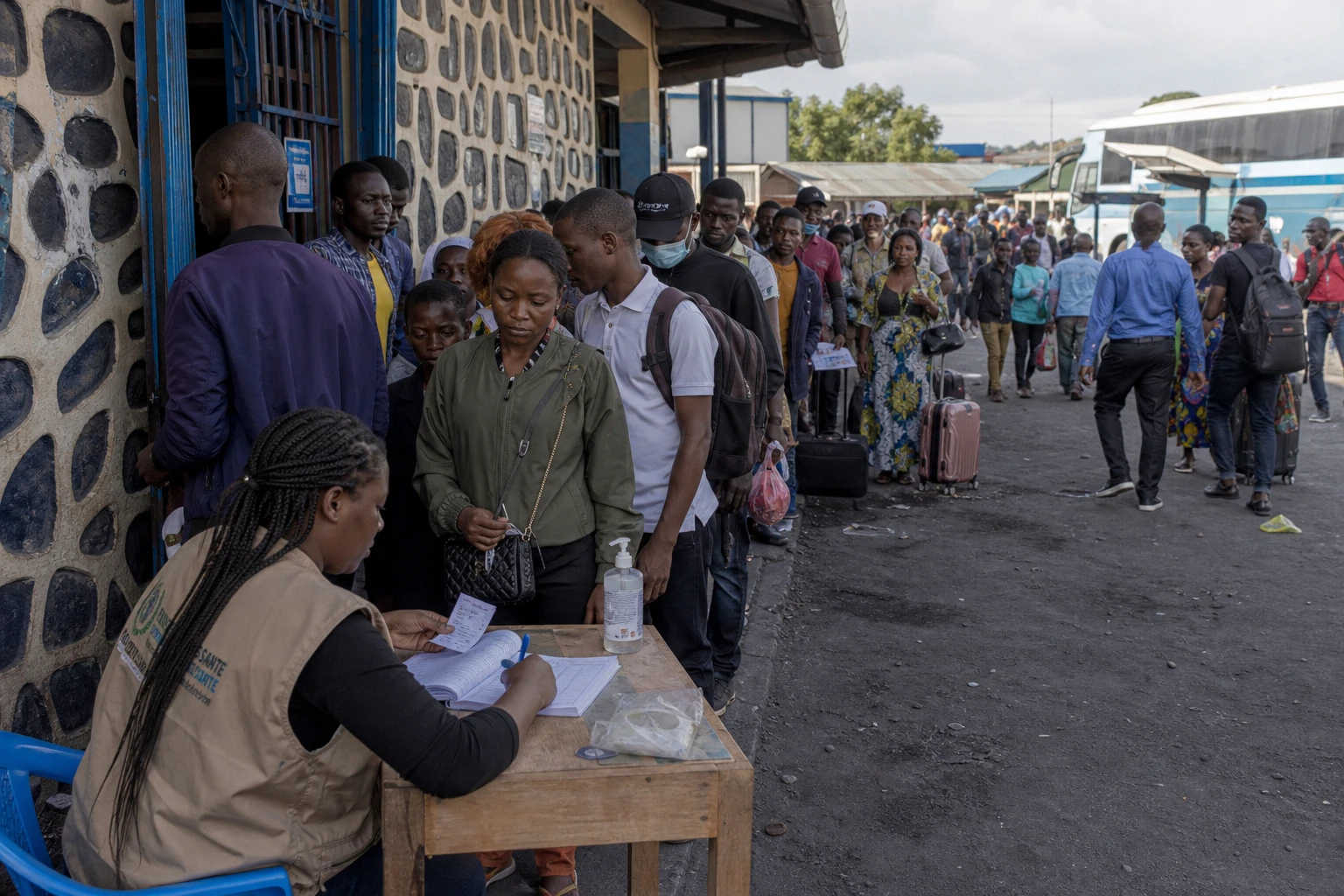
In the Democratic Republic of the Congo, the fight against Ebola is not being waged only in treatment centres. It is also being fought on roads, at borders and through the rules imposed on those who must enter or leave affected areas. When those rules are too uniform, they offer poor protection and hamper the response.
Against this backdrop, the Congolese authorities have revised their movement rules. The approach is now to distinguish between levels of exposure, rather than impose the same restrictions on everyone. The change is intended to protect public health without blocking the medical, humanitarian and technical teams whose rapid presence remains crucial.
An epidemic in a region under strain
At the time of the revision, the Ebola epidemic was affecting the east of the country, particularly North Kivu and Ituri, two provinces marked by insecurity, population displacement and extensive cross-border movement. In this part of the DRC, the health response must contend with difficult roads, recurring violence and mistrust that complicates contact tracing. The World Health Organization and its partners had already warned that travel and trade restrictions can hamper the response without stopping transmission.
This was not the DRC’s first alert. The authorities and international partners already knew that Ebola virus disease spreads through direct contact with the bodily fluids of a sick or deceased person, and that the incubation period can last up to 21 days. This is the period on which health monitoring measures are based.
What the new order changes
The health ministry has amended the measures introduced a month earlier. Exposed people are now classified according to three levels of risk. Those considered at high risk remain subject to 21 days of isolation and a travel ban, unless an exemption is granted. Those deemed at low or minimal risk may travel after an individual assessment. Journalists are explicitly included among the groups subject to more flexible monitoring in this last category.
This shift is not a minor administrative detail. It reflects an operational lesson already evident in WHO recommendations: the Ebola response must be proportionate to the actual risk, or it will cut teams off from the field. The “case-by-case” approach is therefore intended to prevent an overly broad quarantine from discouraging health workers, logisticians and aid workers from reaching the most exposed areas.
The figures show the scale of the challenge
By 19 July 2019, the Congolese response was facing an already massive outbreak: 2,423 confirmed cases, 967 deaths and 469 recoveries, according to figures cited by the United Nations in Geneva. A few days later, WHO published an even higher tally, reporting 2,522 cases, including 2,428 confirmed and 94 probable, as well as 1,698 deaths as of 16 July 2019. The discrepancies reflect how rapidly the data were changing during an active epidemic.
The case fatality rate therefore remained extremely high. WHO said at the time that transmission was continuing widely in communities, with a significant proportion of deaths occurring outside health facilities. In other words, the virus was still circulating where access to care was delayed, and where unsafe burials or fear of treatment centres could accelerate its spread.
For the DRC, a matter of public health and operational sovereignty
In Kinshasa, the decision to tailor quarantine addresses a very practical constraint: maintaining the capacity to respond in the field. In the DRC, the state must protect the population without undermining the mobility of the teams carrying out vaccinations, investigations, testing and contact tracing. In a vast, continental-sized country with uneven infrastructure, a rigid rule can have the opposite effect to the one intended.
The new framework also aligns with the International Health Regulations, which call for containing risk without imposing disproportionate barriers. The stakes are high for the local economy, already weakened by forced displacement and fears surrounding markets, as well as for provincial health systems, which are often the most exposed and least well-resourced. In the east of the country, health workers are also paying a heavy price: infections among health workers have been a marker of the severity of several Ebola outbreaks.
At regional level, this change also matters to neighbouring countries. Uganda, Rwanda, Burundi and South Sudan are closely monitoring any change in protocol in the DRC, because border crossings are numerous and human movement is constant. This is why WHO and Africa CDC have repeatedly urged countries in the region to work together rather than multiply isolated restrictions.
A lasting lesson for Central Africa
Beyond the DRC, this episode is a reminder of a rule that has become central to health crises in Africa: an effective response must be firm, mobile and adapted to local realities. WHO data show that Ebola can be contained when surveillance, ring vaccination, care and community acceptance advance together. But whenever the movement of teams slows, the virus gains ground.
For Central Africa, the message is clear. Health security does not rest solely on tighter borders. It also depends on trust, regional coordination and institutions’ ability to adapt their tools without abandoning protection. In the DRC, this revision of quarantine says one thing above all: in the fight against Ebola, the right level of response is not always the most severe, but the most precise.



