
 Algeria
 Egypt
 Libya
 Morocco
 Sudan
 Tunisia
 Benin
 Burkina Faso
 Cabo Verde
 Côte d'Ivoire
 Ghana
 Guinea
 Guinea-Bissau
 Liberia
 Mali
 Mauritania
 Niger
 Nigeria
 Senegal
 Sierra Leone
 The Gambia
 Togo
 Cameroon
 Central African Republic
 Chad
 Equatorial Guinea
 Gabon
 Republic of the Congo
 São Tomé and Príncipe
 Burundi
 Comoros
 Djibouti
 Eritrea
 Ethiopia
 Kenya
 Madagascar
 Malawi
 Mauritius
 Mozambique
 Rwanda
 Seychelles
 Somalia
 South Sudan
 Tanzania
 Uganda
 Angola
 Botswana
 Eswatini
 Lesotho
 Namibia
 South Africa
 Zambia
 Zimbabwe
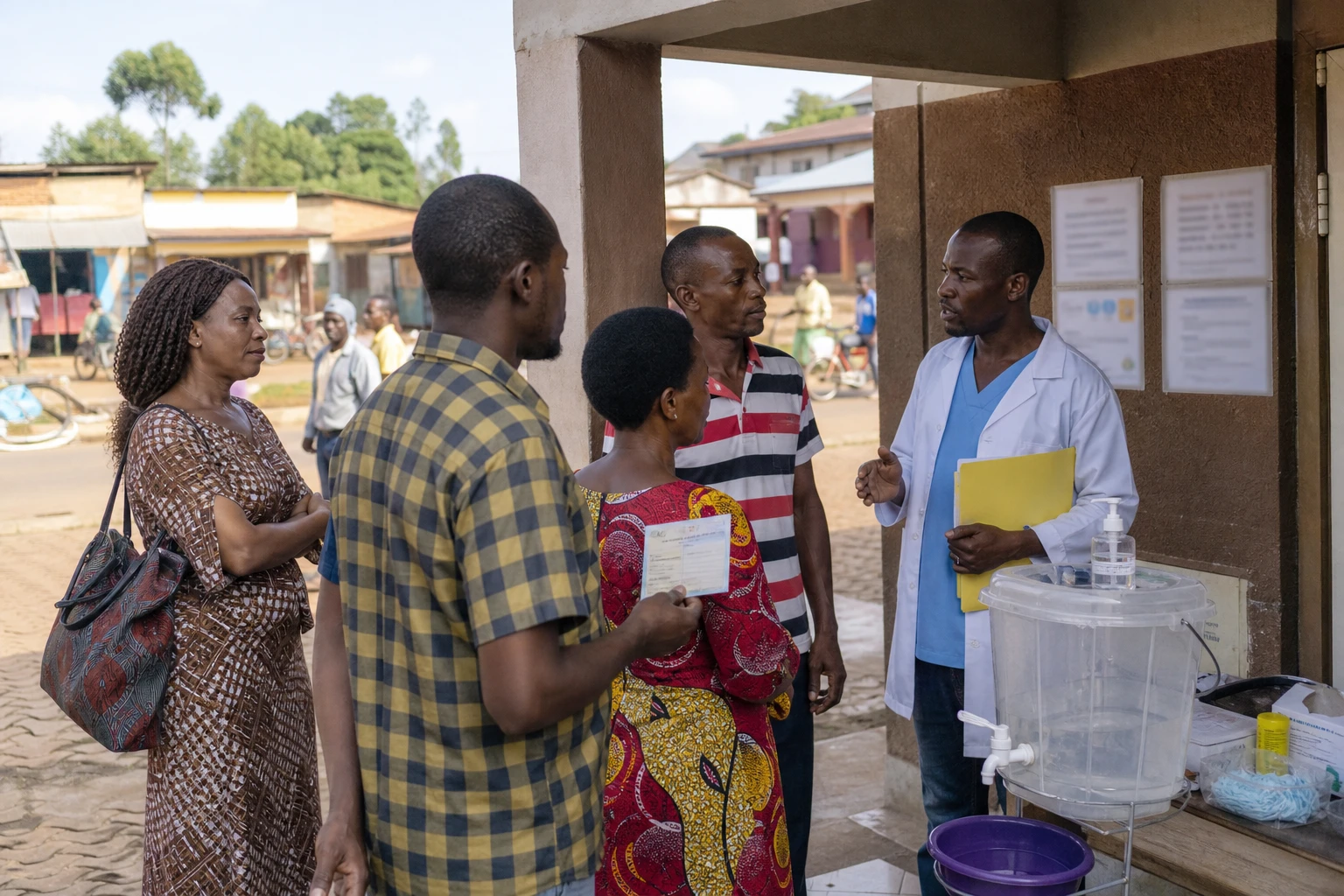
In Bunia, the Ebola response is now playing out on several fronts: treating patients, protecting teams and maintaining residents’ trust. In this city in Ituri, in the north-east of the Democratic Republic of the Congo, every delay in providing care risks extending a chain of transmission that has already spread across several provinces.
France’s Minister for Europe and Foreign Affairs, Jean-Noël Barrot, visited Bunia on Saturday 3 October 2026. The visit comes as the outbreak caused by the Bundibugyo Ebola virus has become the fastest-growing among known outbreaks in the country.
An outbreak that began in Ituri
The Democratic Republic of the Congo declared this new outbreak on 15 May 2026, after the first cases were detected in the Mongbwalu health zone in Ituri. The disease then spread to Bunia and other parts of the province.
According to the World Health Organization, the outbreak now affects 63 health zones across seven provinces: Ituri, North Kivu, South Kivu, Haut-Uélé, Bas-Uélé, South Ubangi and Tshopo.
Ituri remains the main hotspot. However, transmission is also advancing in North Kivu, a province already weakened by population displacement, insecurity and overstretched essential services. Its proximity to Uganda also heightens the regional stakes. The two countries are coordinating surveillance with support from the WHO and the Africa Centres for Disease Control and Prevention.
Care under tight safeguards at Rwampara
On the outskirts of Bunia, Jean-Noël Barrot visited the Rwampara treatment centre. The facility is run by French medical organisation Alima, which is involved in treating patients and training staff working on the response.
The centre uses a transparent medical unit, among other measures. This allows healthcare workers to examine and treat patients while reducing direct contact with bodily fluids. It therefore limits the risk of exposure, which is particularly high during close-contact care.
Rwampara also hosts clinical research activities. The EBO-PEP trial is evaluating obeldesivir, an experimental antiviral developed by Gilead Sciences, in people recently exposed to the virus but not yet showing symptoms. The aim is to determine whether the treatment can prevent the disease from developing or reduce secondary transmission.
The minister’s visit was also due to include the laboratory of the National Institute for Biomedical Research. Professor Jean-Jacques Muyembe-Tamfum, the institute’s director and a leading figure in Congolese Ebola research, has supported scientific and public health operations in the country for several decades.
A heavy toll, but figures still require caution
Figures released at the beginning of October report 8,300 confirmed cases and 4,018 deaths across seven provinces. The case fatality rate is therefore 48.4%. These figures were attributed to the Congolese health authorities and reported by several independent sources.
The epidemiological situation published by the WHO confirms the outbreak’s geographical spread, but figures change rapidly depending on laboratory results, community deaths reported late and teams’ ability to reach remote areas.
This caveat matters. The official toll does not measure only the virus’s severity. It also reflects the delay between the onset of symptoms and arrival at a treatment centre, transport difficulties, staff shortages and some people’s reluctance to report cases.
In several areas, health teams are also working in an environment marked by armed violence. Travel is sometimes disrupted. Centres have been vandalised, and staff have protested over delayed payments. A response without available, regularly paid healthcare workers quickly loses effectiveness.
Trust is central to the response
In Bunia and rural areas alike, the authorities are asking residents to report suspected symptoms promptly, accept contact tracing and follow prevention measures. But these instructions can work only if they are underpinned by trust.
Families want to know what happens to patients. They also seek explanations about safe burials, testing and the conditions for discharge from treatment centres. Communication that flows only from Kinshasa or foreign partners risks giving way to rumours.
Local outreach workers therefore play a decisive role: community health workers, religious leaders, women’s associations, teachers and frontline health staff. Their presence makes it possible to adapt messages to the realities of each neighbourhood and each area.
For Bunia’s residents, the outbreak comes on top of already severe difficulties: inflation, displacement, unreliable access to water and pressure on hospital services. In rural areas, transport costs can delay people seeking care. In cities, by contrast, the density of social interactions helps people move around and makes contact tracing more difficult.
A test for health cooperation in Central Africa
France allocated €13.4 million to the fight against Ebola between January and July 2026, according to figures provided as part of its health cooperation. Jean-Noël Barrot said he intended to argue for new humanitarian funding in the next French budget discussions.
This aid can support treatment centres, logistics, research and staff pay. It cannot, however, replace national capacity. A sustainable response will depend on coordination between the Congolese health ministry, the National Institute for Biomedical Research, the provinces, the WHO, Africa CDC and organisations working on the ground.
The stakes go beyond Ituri. The outbreak concerns border surveillance, links with Uganda and the ability of African countries to rapidly fund their own emergency responses. It is also a reminder that the response cannot be reduced to the arrival of international teams once a crisis becomes visible.
The next indicators will be decisive: trends in new cases, the proportion of deaths occurring in communities, the availability of healthcare workers, the functioning of laboratories and the ability to contain hotspots in North Kivu. In Bunia, Jean-Noël Barrot’s visit highlights a health emergency playing out in treatment centres as well as neighbourhoods, on roads and within communities.



