
 Algeria
 Egypt
 Libya
 Morocco
 Sudan
 Tunisia
 Benin
 Burkina Faso
 Cabo Verde
 Côte d'Ivoire
 Ghana
 Guinea
 Guinea-Bissau
 Liberia
 Mali
 Mauritania
 Niger
 Nigeria
 Senegal
 Sierra Leone
 The Gambia
 Togo
 Cameroon
 Central African Republic
 Chad
 Equatorial Guinea
 Gabon
 Republic of the Congo
 São Tomé and Príncipe
 Burundi
 Comoros
 Djibouti
 Eritrea
 Ethiopia
 Kenya
 Madagascar
 Malawi
 Mauritius
 Mozambique
 Rwanda
 Seychelles
 Somalia
 South Sudan
 Tanzania
 Uganda
 Angola
 Botswana
 Eswatini
 Lesotho
 Namibia
 South Africa
 Zambia
 Zimbabwe
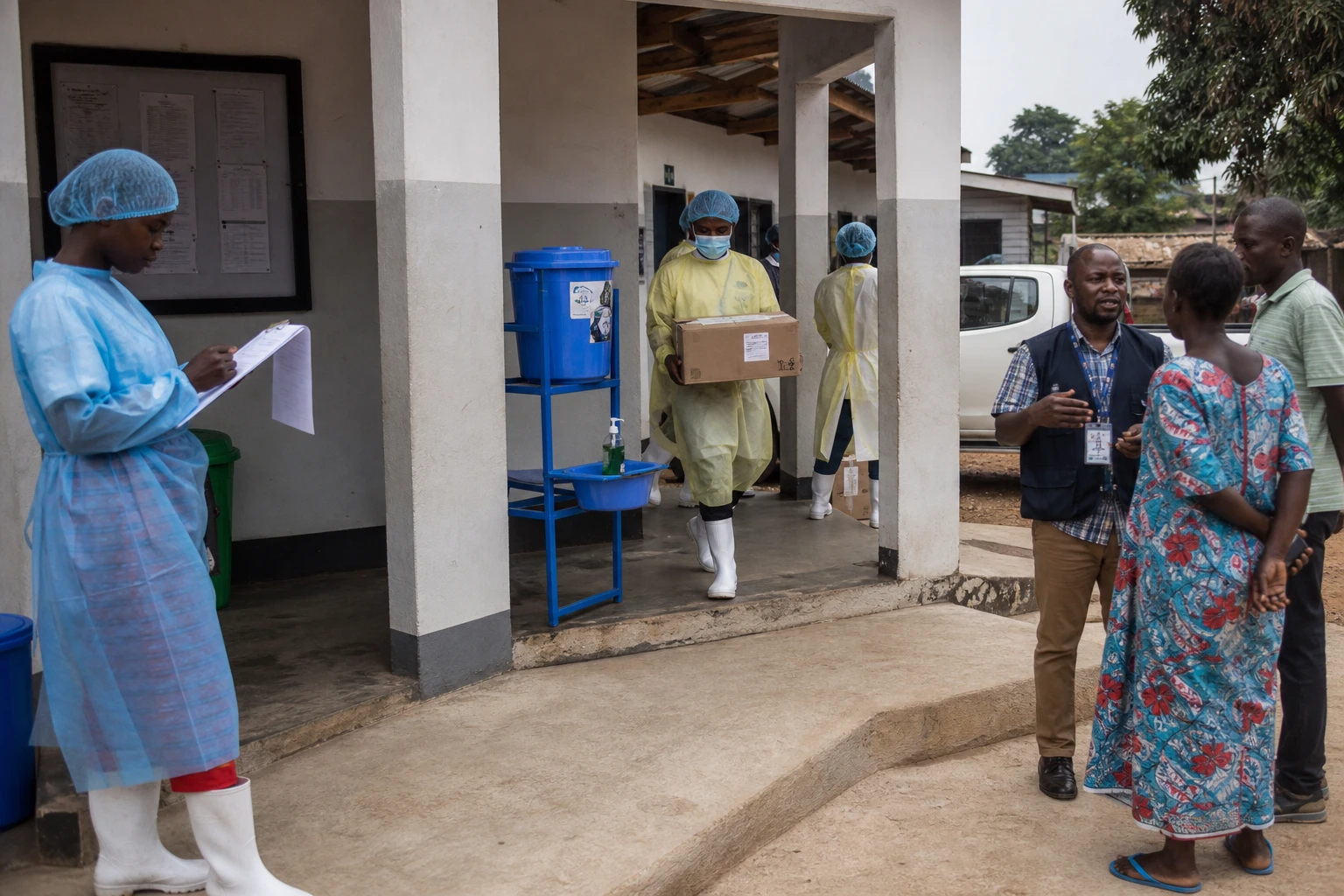
A response struggling to keep pace with movement and mistrust
In the Democratic Republic of the Congo, the emergency is no longer measured in figures alone. It is also visible in the spread of outbreaks, the exhaustion of teams and the difficulty of staying in contact with patients as the epidemic advances faster than the resources deployed. In Kinshasa, the government and its partners launched a revised 180-day plan on 4 September in an effort to regain the upper hand against Ebola, in a country where the epidemic is now circulating far beyond its point of origin.
The regional context matters as much as the health geography. The epidemic is concentrated in the east of the country, an area marked for years by population displacement, insecurity and overstretched health systems. In early August, the WHO and Africa CDC called for a response led more by communities, drawing on Uganda’s experience, where local transmission was contained more quickly. This comparison is no minor point: it shows that a response centred on villages, community health workers and local surveillance can change the course of an outbreak.
Figures for 5 September confirm an unprecedented outbreak
As of 5 September 2026, the DRC had recorded 6,604 confirmed cases and 3,175 deaths, according to figures shared by health authorities and reported by international partners. The same tracking showed 82 new infections and 41 new deaths in a single day. Ituri and North Kivu provinces remain the hardest hit, but the epidemic has already spread to six provinces and 61 health zones, complicating surveillance, patient transport and care.
On 4 September, the WHO had already reported 6,342 cases and 3,072 deaths as of 2 September, across 60 health zones in six provinces. The increase over just a few days confirms the speed of the spread. The WHO also says the Bundibugyo virus outbreak is, at this stage, the fastest-moving observed in the country and the second-largest ever recorded in the DRC. One further benchmark is even more striking: confirmed cases alone now exceed the total number of cases reported across the country’s 16 previous outbreaks.
Bundibugyo is not an abstract strain. It is a form of the Ebola virus for which protective tools remain limited, and the WHO notes that no vaccine has been licensed specifically for this strain. This means teams must rely on early detection, rapid isolation, protection for health workers and the trust of communities. The disease is also continuing to hit health centres themselves: health workers are among those infected, a sign that the chain of protection remains fragile.
The real bottleneck: people, beds, money and trust
The core problem is not medical alone. It is logistical, human and financial. An WHO technical official said that about 1,400 beds had already been set up in 59 treatment centres, but a further 1,600 would be needed to reach capacity of about 3,000 places. On that basis, the organisation estimates that around 9,000 health workers would be needed in total, requiring nearly 5,000 additional recruits and trainees. The same assessment points to another constraint: the limited number of organisations able to run Ebola centres, amid cuts to global humanitarian funding.
The pressure is all the greater because the response must reach neighbourhoods and villages. In Bunia, Africa CDC and the WHO identified obstacles slowing the response: late detection, inadequate access to care, resistance to some response activities, shortages of essential supplies and insufficient support for frontline teams. The message is clear: without trusted community networks, patients reach centres too late, and deaths at home continue to fuel transmission.
The Congolese government has also revised its 180-day response plan. The document, supported by the WHO, the United Nations, Africa CDC and other partners, is valued at US$1.3 billion. That figure reflects the scale of the challenge. Funding is needed for centres, transport, laboratories, safe and dignified burials, staff pay and community outreach. Without it, the decentralisation strategy will remain theoretical.
What this crisis says about the DRC and the continent
This Ebola outbreak is not confined to Ituri or North Kivu. It is testing the DRC’s ability, as a pivotal country in Central Africa, to protect its population while securing its health borders with Uganda, Rwanda, South Sudan and other neighbours. The WHO’s warning about regional risk is therefore no mere hypothetical. An epidemic spreading through the eastern provinces can quickly affect transport corridors, markets, routine healthcare and cross-border movement.
Across the continent, the outbreak also underlines a point that is often underestimated: African health security depends on sustainable local capacity, not one-off interventions. The joint Africa CDC-WHO plan launched in June 2026 to strengthen preparedness for Ebola across the continent reflects this shift. Early-warning systems, trained teams, reliable laboratories and communities involved in decision-making are needed. It is this network, more than the announcement of new resources alone, that will show whether the DRC can slow the epidemic before it redraws the region’s health map once again.



