
 Algeria
 Egypt
 Libya
 Morocco
 Sudan
 Tunisia
 Benin
 Burkina Faso
 Cabo Verde
 Côte d'Ivoire
 Ghana
 Guinea
 Guinea-Bissau
 Liberia
 Mali
 Mauritania
 Niger
 Nigeria
 Senegal
 Sierra Leone
 The Gambia
 Togo
 Cameroon
 Central African Republic
 Chad
 Equatorial Guinea
 Gabon
 Republic of the Congo
 São Tomé and Príncipe
 Burundi
 Comoros
 Djibouti
 Eritrea
 Ethiopia
 Kenya
 Madagascar
 Malawi
 Mauritius
 Mozambique
 Rwanda
 Seychelles
 Somalia
 South Sudan
 Tanzania
 Uganda
 Angola
 Botswana
 Eswatini
 Lesotho
 Namibia
 South Africa
 Zambia
 Zimbabwe
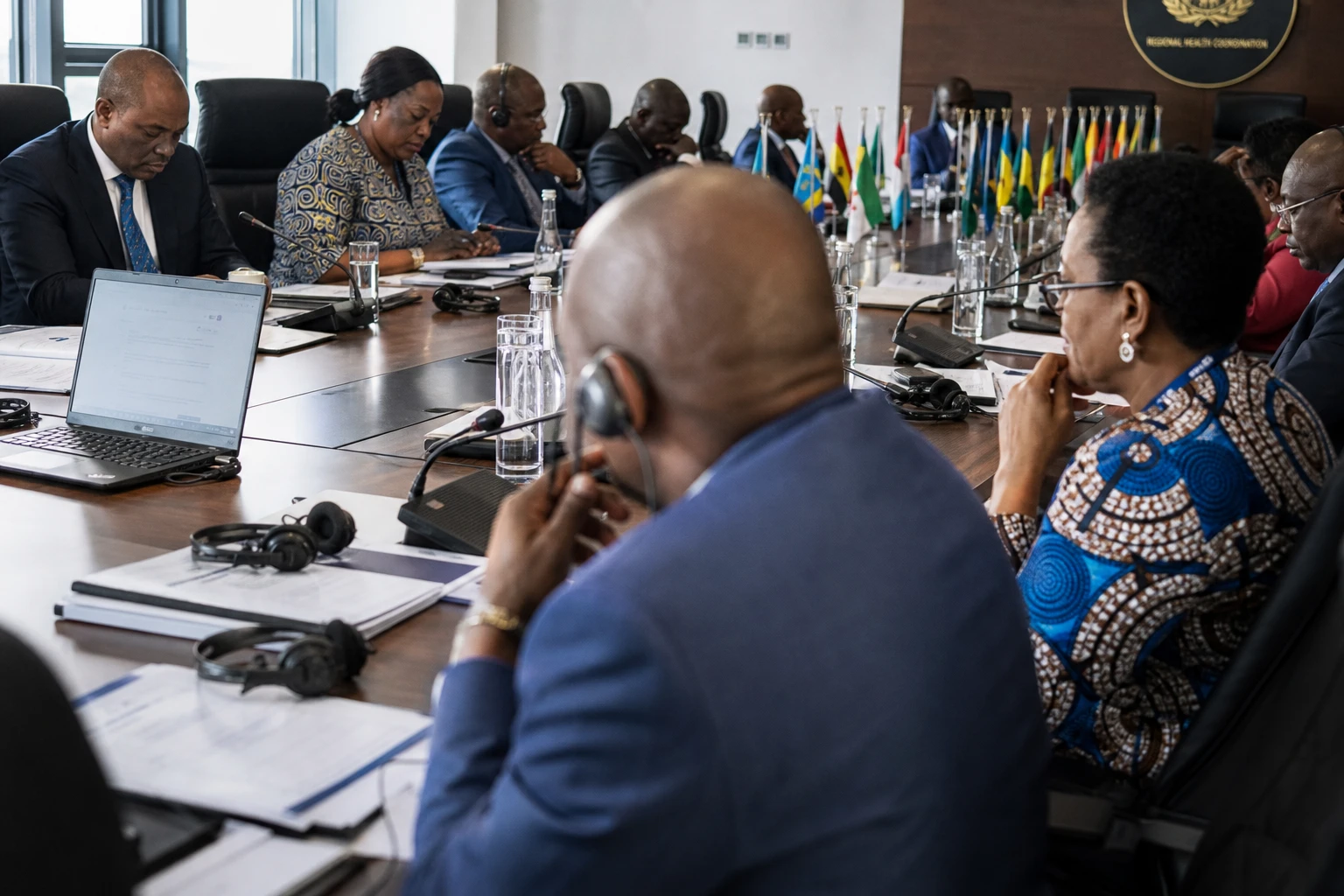
A falling curve is not enough to lift the alert
In the Democratic Republic of the Congo, an outbreak can slow without disappearing. That is the crux of the debate over Ebola: on one side, Congolese authorities say they believe the peak is behind them; on the other, Africa CDC says the available data are not yet sufficient to confirm this turning point. This caution is no technical detail. It determines the pace of field teams, the monitoring of contacts and the protection of areas still at risk.
The point of tension emerged as the response entered a longer phase than expected. On 4 September 2026, in Kinshasa, the Congolese government, WHO, the United Nations, Africa CDC and several partners launched a revised 180-day plan to strengthen the response to the country’s 17th Ebola outbreak. The plan says much about the situation: even when indicators improve in some hotspots, transmission may remain active in others.
A historic outbreak, but a cautious assessment
The current outbreak has affected the DRC since May 2026. It is linked to the Bundibugyo strain, which is different from the Zaire strain that had dominated other outbreaks in the country. On 18 May 2026, Africa CDC classified the outbreak as a public health emergency of continental security, highlighting the risk of regional spread because of population movements, insecurity and the proximity of several borders.
As the weeks passed, the toll rose. As of 26 August 2026, WHO was still reporting a cumulative total of 5,815 confirmed cases across the entire area being monitored, including 5,794 in the DRC, 20 in Uganda and one in France. A more recent update, published on 7 September 2026, reported a cumulative total of 6,778 confirmed cases, including 6,757 in the DRC. Congolese authorities, for their part, announced on 11 September that the 7,000-case mark had been passed and that they considered the peak to have been reached in mid-August.
This is precisely the point on which Africa CDC remains more cautious. Its assessment of 17 September notes encouraging signs in some hotspots, particularly in Ituri, but also says that active transmission and increases in some health zones, especially in North Kivu, mean it is not yet possible to conclude that the peak has been sustainably passed. In other words, a local decline does not mean the outbreak has stopped.
What the disagreement between Kinshasa and Africa CDC means
In an Ebola response, declaring victory too soon can be costly. If the peak is announced before it is confirmed, there is a strong temptation to ease surveillance, disperse teams and reduce the intensity of contact tracing. Conversely, maintaining a high level of alert makes it possible to tackle residual hotspots where the virus is still circulating at low levels. That is the logic behind the revised 180-day plan: moving from an emergency response to a prolonged, coordinated and multisectoral mobilisation.
The situation in the DRC also has a social dimension. In affected areas, families are living with schools making adjustments, markets subject to health rules, more closely monitored travel and more tightly regulated funerals. On 27 August 2026, parents and teachers in the outbreak’s epicentre called for the reopening of schools to be postponed, a sign that the disease extends beyond the medical sphere and disrupts daily life. In a country as vast as the DRC, where health infrastructure remains uneven between Kinshasa, eastern cities and rural areas, every new area of transmission makes the task more difficult.
The use of the Ervebo vaccine, designed so far for the Zaire strain, adds a further layer of operational uncertainty. Authorities and partners are counting on possible cross-protection, but WHO stresses that effectiveness must be assessed in the specific context of the Bundibugyo strain in circulation. This matters for health workers, border areas and neighbouring countries that share trade, family and mining links with eastern Congo.
A Congolese issue, but an alert for all of Central Africa
The DRC is facing more than a national crisis. It is also a regional test. Africa CDC has explicitly raised the risk of spread to neighbouring countries, while WHO has distinguished between the risk to countries sharing a land border with the DRC and the risk to the rest of the African region. For Central Africa, the question is straightforward: how can a disease be contained when it spreads along routes where administrative borders matter less than trade routes, markets and movements driven by survival?
This episode also highlights the importance of African institutions in assessing emergencies. Africa CDC did more than relay the data; the African Union’s health agency organised an independent scientific assessment, then called for the response to be maintained where signals remained unstable. In this kind of crisis, the African voice does not come afterwards. It helps shape decisions, make adjustments and set priorities, alongside ministries, national public health institutes and technical partners.
The continental significance is therefore twofold. First, it concerns health security: the DRC remains a hotspot capable of affecting several countries in Central and East Africa. Second, it concerns the approach: emerging from the crisis does not depend on a single announcement, but on sustained convergence between field data, community surveillance, vaccination, contact monitoring and regional coordination. Until these elements align, the word “peak” remains a working hypothesis, not a definitive finding.



