Algeria
 Egypt
 Libya
 Morocco
 Sudan
 Tunisia
 Benin
 Burkina Faso
 Cabo Verde
 Côte d'Ivoire
 Ghana
 Guinea
 Guinea-Bissau
 Liberia
 Mali
 Mauritania
 Niger
 Nigeria
 Senegal
 Sierra Leone
 The Gambia
 Togo
 Cameroon
 Central African Republic
 Chad
 Equatorial Guinea
 Gabon
 Republic of the Congo
 São Tomé and Príncipe
 Burundi
 Comoros
 Djibouti
 Eritrea
 Ethiopia
 Kenya
 Madagascar
 Malawi
 Mauritius
 Mozambique
 Rwanda
 Seychelles
 Somalia
 South Sudan
 Tanzania
 Uganda
 Angola
 Botswana
 Eswatini
 Lesotho
 Namibia
 South Africa
 Zambia
 Zimbabwe
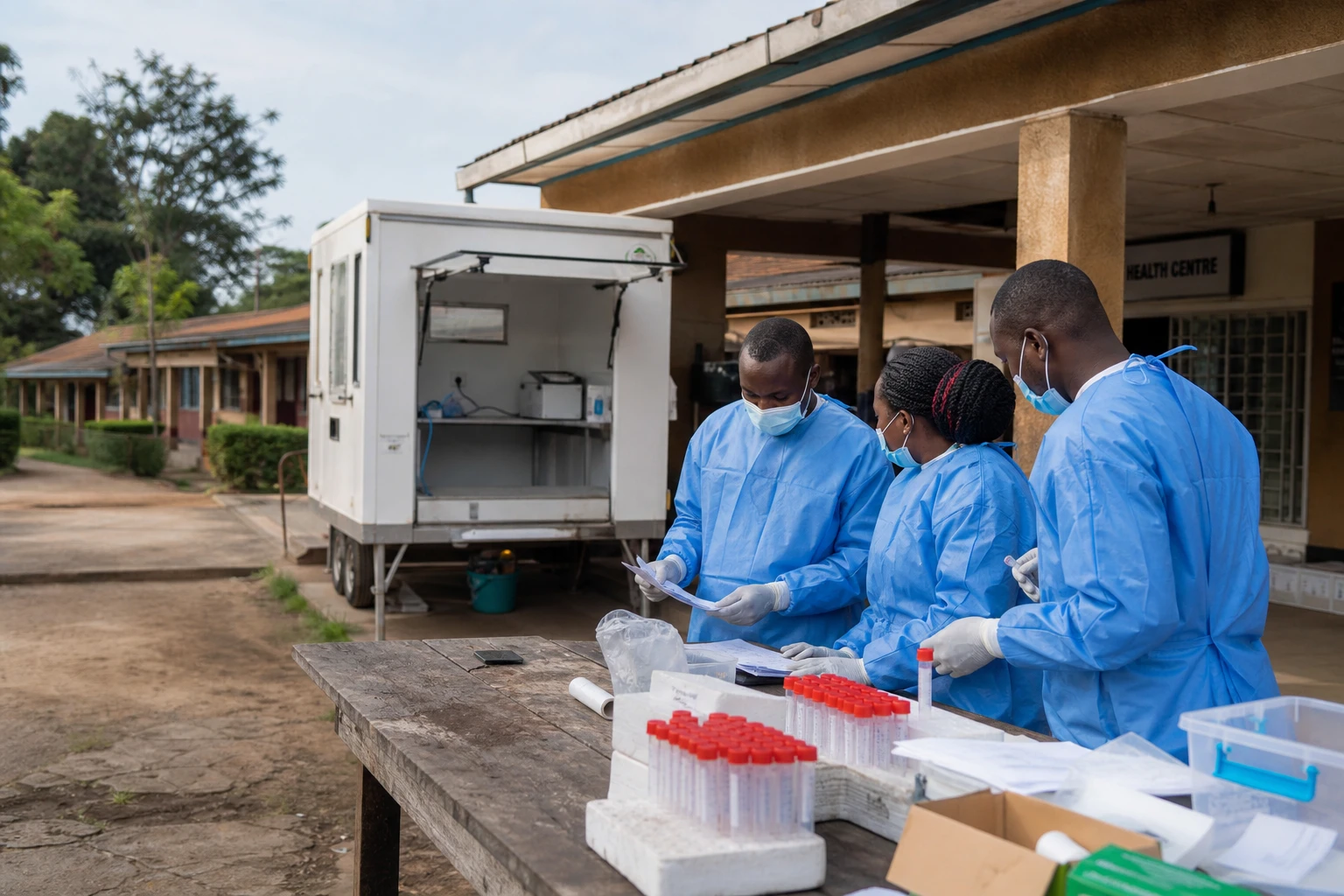
In Bunia, in the east of the Democratic Republic of the Congo, the response to Ebola now depends as much on laboratories as on treatment centres. Every hour saved in obtaining a test result can help isolate a patient and break a chain of transmission.
The 17th Ebola outbreak recorded in the DRC since 1976 is unfolding in an especially challenging environment. Ituri, North Kivu and other neighbouring provinces remain affected by population displacement, insecurity and high levels of mobility linked to trade and mining. The proximity of Uganda adds a cross-border dimension to health surveillance.
Laboratories closer to affected areas
Mobile laboratories have been set up in Butembo, in North Kivu, to reduce the time between sample collection and diagnosis. The arrangement is intended to deliver results in less than 24 hours, compared with longer delays when samples have to travel several hundred kilometres.
The system addresses a practical challenge. In rural or isolated areas, a suspected patient may have to wait before being referred to a specialist centre. In the meantime, relatives and healthcare workers accompanying them may be exposed. Rapid diagnosis therefore facilitates treatment, contact tracing and the protection of medical teams.
Congolese doctor Lota Kalubi, quoted in connection with the ITAV Ebola treatment centre in Butembo, has also highlighted the role of cooperation between the DRC and Uganda in improving screening. Population movements between the two countries require the authorities to share alerts and maintain surveillance at crossing points.
This expansion builds on experience accumulated during previous outbreaks. It does not, however, eliminate logistical difficulties. Access to some communities still depends on the security situation, road conditions and staff availability.
An outbreak rapidly spreading beyond its initial focus
The current outbreak is caused by the Bundibugyo strain of the Ebola virus. The Democratic Republic of the Congo officially declared it in May 2026. The World Health Organization subsequently classified the situation as a public health emergency of international concern, a mechanism that strengthens coordination between the countries concerned and health partners.
According to data published by the WHO on 14 August 2026, 4,665 confirmed cases and 2,184 deaths had been reported in the DRC at that point. The outbreak had affected 54 health zones across six provinces. These figures should be treated with caution, as increased testing and data reconciliation may bring previously unrecorded cases into published totals.
Government data reported in September subsequently indicated more than 6,800 cases and more than 3,300 deaths. The spread is therefore no longer limited to Ituri, the initial epicentre. North Kivu and Haut-Uélé are also among the areas where transmission has intensified.
The type of virus involved complicates the response. At this stage, there is no approved vaccine or widely available specific treatment for Bundibugyo. Care relies mainly on early intervention, rehydration, treatment of symptoms and the prevention of infections in healthcare facilities.
Community trust remains crucial
The battle is not being fought with medical equipment alone. Teams must also persuade families to report symptoms promptly and agree to referral to treatment centres. In several areas of eastern Congo, mistrust of the authorities and outside organisations continues to be fuelled by years of violence, displacement and unfulfilled health promises.
The WHO has recorded 12 attacks on health services since the international emergency was declared on 17 May 2026. These incidents disrupt surveillance, delay evacuations and may deter patients from going to specialist facilities.
Protecting healthcare workers is therefore a central concern. Congolese teams are working in areas where access to routine care is already fragile. Any interruption to services may affect not only the Ebola response, but also care for pregnant women, children, injured people and those with chronic illnesses.
Staff members’ social conditions are also weighing on the response. Health workers have reported delayed pay and difficult working conditions. At treatment centres, fatigue and tensions can lead to strike action at a time when continuity of care is essential.
French visit amid regional sensitivities
France’s Minister for Europe and Foreign Affairs, Jean-Noël Barrot, is expected in the Democratic Republic of the Congo on 2 and 3 October 2026. He is due to visit Bunia, in Ituri, where the outbreak is particularly active. Paris has presented the trip as a show of support for the Congolese authorities and humanitarian organisations.
The visit comes a few days before a humanitarian conference announced in Paris for 6 October. It lends a diplomatic dimension to a crisis that remains, first and foremost, a public health emergency in the DRC. The challenge is to mobilise resources without sidelining national institutions, local teams and community representatives.
For Kinshasa, the stakes go beyond bringing the outbreak under control. Unchecked circulation of the virus could further disrupt trade in the east of the country and complicate relations with Uganda. The health response must therefore work alongside border surveillance systems and local authorities on both sides.
A test for African health cooperation
The outbreak is testing the ability of the DRC, Uganda, the WHO and the Africa Centres for Disease Control and Prevention to coordinate their interventions. It also underscores that regional health security depends on trust in the actors working on the ground.
In the coming days, changes in case numbers in North Kivu, Haut-Uélé and Ituri will be closely monitored. The authorities will also need to clarify the resources allocated to mobile laboratories, healthcare worker protection and staff pay.
The Ebola response will not be measured solely by the number of tests carried out. It will also depend on the ability to maintain routine care, secure facilities and involve Congolese communities in decision-making. Only then can international support strengthen, rather than replace, the DRC’s public health capacity.