
 Algeria
 Egypt
 Libya
 Morocco
 Sudan
 Tunisia
 Benin
 Burkina Faso
 Cabo Verde
 Côte d'Ivoire
 Ghana
 Guinea
 Guinea-Bissau
 Liberia
 Mali
 Mauritania
 Niger
 Nigeria
 Senegal
 Sierra Leone
 The Gambia
 Togo
 Cameroon
 Central African Republic
 Chad
 Equatorial Guinea
 Gabon
 Republic of the Congo
 São Tomé and Príncipe
 Burundi
 Comoros
 Djibouti
 Eritrea
 Ethiopia
 Kenya
 Madagascar
 Malawi
 Mauritius
 Mozambique
 Rwanda
 Seychelles
 Somalia
 South Sudan
 Tanzania
 Uganda
 Angola
 Botswana
 Eswatini
 Lesotho
 Namibia
 South Africa
 Zambia
 Zimbabwe
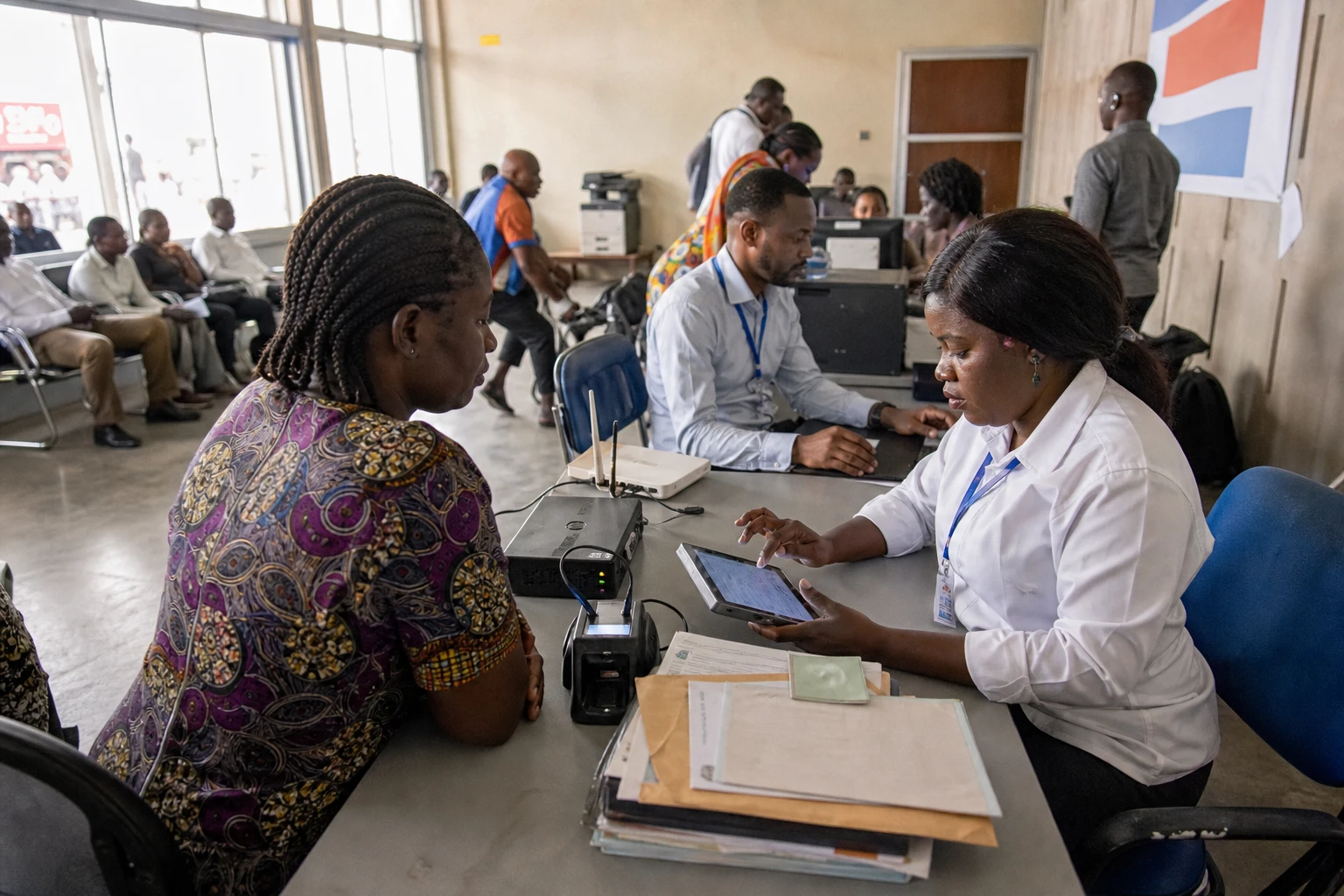
In Kinshasa, the digital transformation is gradually moving from announcements to concrete measures. But whether it is digital identity, an artificial intelligence strategy or a cybersecurity agency, the central challenge remains the same: making these tools useful to a population in which a large share still lacks stable and affordable internet access.
A digital architecture takes shape
On 28 September 2026, the Congolese Minister of Digital Economy, Augustin Kibassa Maliba, presented the main projects undertaken since the formation of the government led by Prime Minister Judith Suminwa on national broadcaster Radio-Télévision nationale congolaise.
The progress report highlights several projects intended to modernise the administration, secure electronic exchanges and better regulate the use of data. The most visible is RDC-PASS, a digital identification system designed to make it easier for Congolese people to access public services and certain financial and social services.
Launched on 13 June 2026 by President Félix-Antoine Tshisekedi Tshilombo, RDC-PASS is intended to give each citizen a personal digital identifier. The system does not, however, replace the national identity card or official documents provided for by law. Rather, it aims to create a common access key for online procedures.
An initial operational phase began in September with the training of 50 registration agents. This phase is intended to test procedures, build skills and prepare for a gradual expansion of the programme. The ministry also emphasises confidentiality, the traceability of operations and restrictions on access to data.
For households and businesses, the implications will be tangible. A reliable digital identity can reduce travel, shorten some procedures and limit repeated administrative checks. Its effectiveness will nevertheless depend on the state’s ability to maintain access points in the provinces, including when internet connections or electricity are unavailable.
Artificial intelligence and Congolese data
The ministry also highlighted the approval of the Digital Economy Sector Policy and the National Artificial Intelligence Strategy. These two documents are intended to provide a framework for investment, infrastructure, training, innovation and data governance.
The artificial intelligence strategy notably aims to take better account of the country’s linguistic realities. A project to collect data in Lingala is cited as a way to help develop tools capable of understanding and producing content in a language widely used in the Democratic Republic of the Congo.
This approach addresses a frequently underestimated problem. Artificial intelligence systems generally perform better in languages with large digital datasets. For African languages, a shortage of corpora, language resources and specialist expertise can limit the quality of tools offered to administrations, schools, businesses and the media.
The issue is therefore not simply a matter of importing solutions designed elsewhere. It also concerns the Democratic Republic of the Congo’s ability to produce its own data, protect its infrastructure and define acceptable uses of artificial intelligence. Training engineers, researchers and public servants will be crucial.
Institutions to support the shift online
The reform also provides for the creation of bodies to support online services. Decrees establishing the Digital One-Stop Shop and the National Electronic Certification Agency were signed by Prime Minister Judith Suminwa.
The Digital One-Stop Shop is intended to make it easier to access administrative procedures online. The National Electronic Certification Agency, in turn, is intended to help establish the legal and technical validity of digital exchanges. Electronic certification can, in particular, verify the identity of a signatory and the integrity of a document sent remotely.
This is complemented by a National Cybersecurity Agency, established by presidential ordinance. Its stated mission is to protect Congolese cyberspace, prevent incidents and strengthen the resilience of digital systems.
This institutional framework is becoming increasingly important as public services go online. An outage, data leak or attack on an essential operator can directly affect citizens, banks, businesses and government bodies. Cybersecurity is therefore no longer an issue reserved for specialists. It is becoming a condition for trust in the shift to digital services.
The Digital Code, adopted in 2023, also needs to become better known. The ministry is continuing to raise awareness of it among government bodies, the private sector, young people and users. The law regulates several digital activities, including electronic services, data and the responsibilities of stakeholders.
Access remains the main obstacle
This institutional architecture is being built in a country where access to digital services remains highly unequal. In a report published on 18 September 2025, the GSMA estimated that 45% of the population was covered by a mobile network providing internet access.
The same study estimated that a further 9.7 million people could be connected by 2029 if targeted reforms were implemented. It also estimated that digital transformation could add 9,800 billion Congolese francs to gross domestic product, or about $4.24 billion according to the data cited.
These projections remain conditional. They assume investment in networks, a clearer tax system, better management of the radio spectrum and a more reliable electricity supply. They also depend on the price of smartphones and data plans, which continues to limit the uptake of digital services.
The divide is also geographical. Kinshasa and major urban centres generally have more operators, service points and technical expertise. In rural or remote areas, difficulties with coverage, transport and electricity can slow access to the same tools.
Workers in the informal economy are also affected. Online government services can make it easier to obtain a document or make a payment, but they can also exclude people who have neither a recent smartphone nor a digital account. The reforms will therefore require assistance desks, training and solutions that are accessible offline.
A challenge for Central Africa
The Congolese trajectory extends beyond the national context. Given its population, resources and position in Central Africa, the Democratic Republic of the Congo could become a major market for digital services and a testing ground for public digital infrastructure.
This ambition will nevertheless need to be aligned with regional developments within the Economic Community of Central African States, an organisation tasked with promoting cooperation and economic integration among its members. Issues such as cross-border payments, data protection, combating cybercrime and recognition of electronic signatures do not stop at national borders.
The next test will be implementation. RDC-PASS will have to prove that it genuinely simplifies procedures. National strategies will need to be translated into budgets, measurable targets and available services. Finally, cybersecurity will need to protect users without becoming an obstacle to innovation.
For Kinshasa, digital technology could therefore become a lever for modernising the state and diversifying the economy. But this promise will not be measured by the number of strategies adopted. It will be tested in the provinces, government offices and businesses, and in the daily lives of Congolese people.



