Algeria
 Egypt
 Libya
 Morocco
 Sudan
 Tunisia
 Benin
 Burkina Faso
 Cabo Verde
 Côte d'Ivoire
 Ghana
 Guinea
 Guinea-Bissau
 Liberia
 Mali
 Mauritania
 Niger
 Nigeria
 Senegal
 Sierra Leone
 The Gambia
 Togo
 Cameroon
 Central African Republic
 Chad
 Equatorial Guinea
 Gabon
 Republic of the Congo
 São Tomé and Príncipe
 Burundi
 Comoros
 Djibouti
 Eritrea
 Ethiopia
 Kenya
 Madagascar
 Malawi
 Mauritius
 Mozambique
 Rwanda
 Seychelles
 Somalia
 South Sudan
 Tanzania
 Uganda
 Angola
 Botswana
 Eswatini
 Lesotho
 Namibia
 South Africa
 Zambia
 Zimbabwe
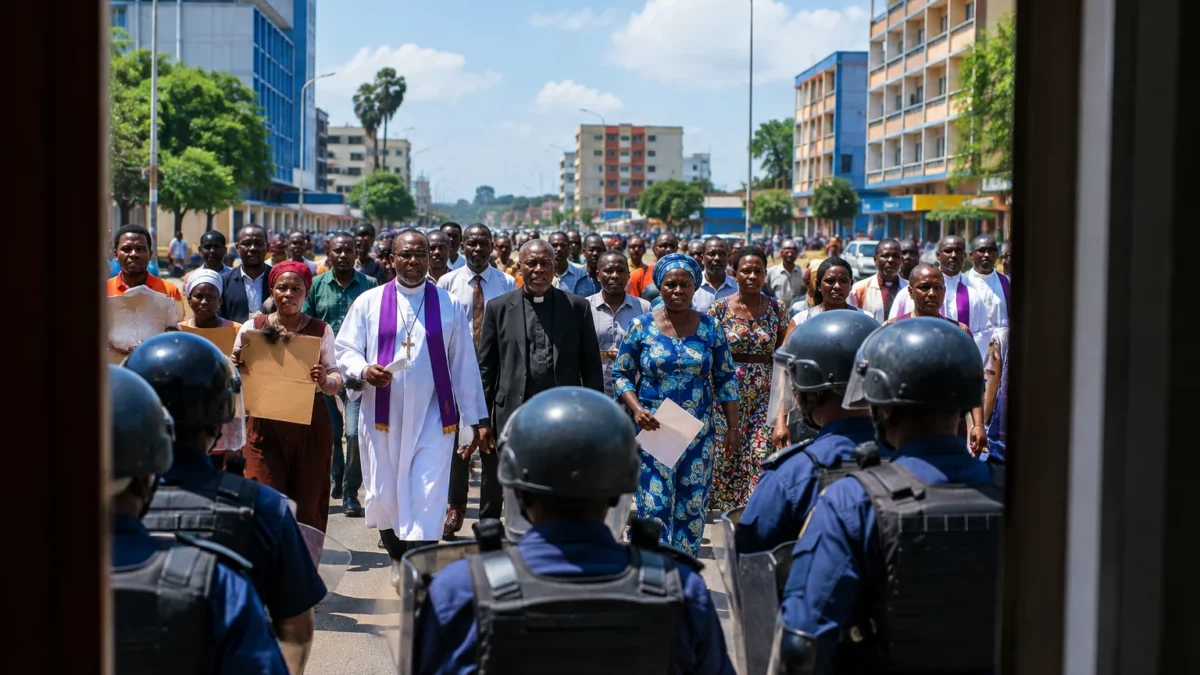
In Kinshasa, Lubumbashi and within the ruling majority, three recent episodes raise the same question: how far can Congolese institutions turn their commitments into action? Religious freedom, scrutiny of public spending and relations with Kampala are testing the government on different fronts, linked by the issue of trust.
Two cities, one debate on religious freedom
The first test centred on Catholic gatherings. In Kinshasa, the Diocesan Youth Day scheduled for Sunday 22 November at Tata Raphaël Stadium could not be held there. The National Episcopal Conference of Congo (CENCO), which brings together the country’s Catholic bishops, denounced an infringement of religious freedom. Congolese media also reported that the young people and religious leaders eventually met at Saint-Raphaël College. Actualité.cd reported CENCO’s announcement, while DayNews RDC covered the alternative gathering.
In Lubumbashi, on Monday 23 November, a march linked to the land dispute involving the Grand Séminaire Saint-Paul was prevented from taking place. Local media reported that tear gas was used against demonstrators. The Church is calling for court rulings concerning the property to be enforced. The claim therefore concerns both the right to demonstrate and the implementation of a judgement. The precise circumstances and the authorities’ accounts should be distinguished from the accusations made by the organisers. Congo Inter reported on the dispersal; the Fides agency had documented the land dispute and the Church’s efforts.
These two cases do not, on their own, prove a general policy against the Church. They do, however, make public clarification more pressing: what rules informed the decisions taken in Kinshasa and Lubumbashi, and how do the authorities intend to guarantee religious freedom as well as the right to assemble? For worshippers, associations and residents of the two cities, the answer will be measured by access to venues, the safety of gatherings and the handling of the court case.
The ruling majority faces questions over the books
Another sign has come from the Union for the Congolese Nation (UNC), the party of Vital Kamerhe and a member of the presidential majority. After remarks on 20 November about military strategy in the east and the use of resources allocated to the war effort, party officials distanced themselves from him. Their statement of 25 November objected in particular to the lack of prior consultation. The UNC leadership subsequently called for calm, without announcing any immediate sanctions. MediaCongo Press reported the statement by the dissenters; Actualité.cd detailed the party’s response.
The number of signatories varies across published accounts: some count eleven, others ten, followed by one additional supporter. What is firmly established is the internal challenge, not a consistent tally. The stakes go beyond a party dispute. In a country where security spending is tied to a war directly affecting the eastern provinces, asking for explanations of its effectiveness is also a matter of political scrutiny. This does not prejudge either how the funds have been used or the military results.
The episode recalls tensions previously reported around Modeste Bahati Lukwebo and his remarks on a possible constitutional revision. But it would be premature to conclude that the majority has been fully reshaped. Disagreement over party discipline, allies’ freedom to speak and spending transparency remains unresolved. For residents of areas affected by fighting, as for taxpayers in urban centres, the practical question is accountability: what resources are being mobilised, according to which priorities, and with what verifiable results?
With Kampala, military co-operation and political trust
The third issue concerns relations with Uganda. The Congolese foreign ministry summoned Uganda’s head of diplomatic mission following posts by General Muhoozi Kainerugaba, the country’s army chief. Kinshasa objects in particular to messages of support for the Front for the Refoundation of the Nation (FRN), a movement associated with Joseph Kabila in the material provided. Congolese media reported the summons; the content and interpretation of the posts should remain attributed to the authorities denouncing them. Actualité.cd reported on the diplomatic move.
The relationship is particularly sensitive because the two countries co-operate militarily against the Allied Democratic Forces (ADF), an armed group active in eastern DR Congo. This co-operation, carried out under Operation Shujaa, does not erase diplomatic differences or Congolese concerns about the public messages of a senior military official. An investigation by Le Monde into the recent security situation notes the presence of Ugandan forces in Ituri alongside the Congolese army. The coexistence of the operation and the diplomatic crisis points to a relationship based on co-operation, but not necessarily unreserved trust.
For people in the east, everyday security remains the priority, while the governments must preserve channels of communication capable of preventing a public dispute from undermining co-ordination against armed groups. DR Congo is part of the wider dynamics of Central Africa and the Great Lakes, where security crises spill across borders and involve several regional frameworks, including the East African Community and the Southern African Development Community.
From statements to verifiable decisions
These three issues have different origins and involve different actors. Their common thread is more limited: each requires the authorities to explain their decisions and make their effects visible. In Kinshasa and Lubumbashi, restrictions on gatherings and the handling of the land dispute need clarification. Within the UNC and the majority, political loyalty must be distinguished from debate over public funds. With Kampala, co-operation against the ADF must be maintained while disagreements are addressed through diplomatic channels.
In the coming days, the signs to watch will be concrete: an official position on the events affecting religious gatherings, effective mediation within the UNC and clarification between Kinshasa and Kampala. Trust is not restored by the language of calm alone. It will depend on decisions that are understandable, procedures that are respected and accounts that are accessible to Congolese citizens.