Algeria
 Egypt
 Libya
 Morocco
 Sudan
 Tunisia
 Benin
 Burkina Faso
 Cabo Verde
 Côte d'Ivoire
 Ghana
 Guinea
 Guinea-Bissau
 Liberia
 Mali
 Mauritania
 Niger
 Nigeria
 Senegal
 Sierra Leone
 The Gambia
 Togo
 Cameroon
 Central African Republic
 Chad
 Equatorial Guinea
 Gabon
 Republic of the Congo
 São Tomé and Príncipe
 Burundi
 Comoros
 Djibouti
 Eritrea
 Ethiopia
 Kenya
 Madagascar
 Malawi
 Mauritius
 Mozambique
 Rwanda
 Seychelles
 Somalia
 South Sudan
 Tanzania
 Uganda
 Angola
 Botswana
 Eswatini
 Lesotho
 Namibia
 South Africa
 Zambia
 Zimbabwe
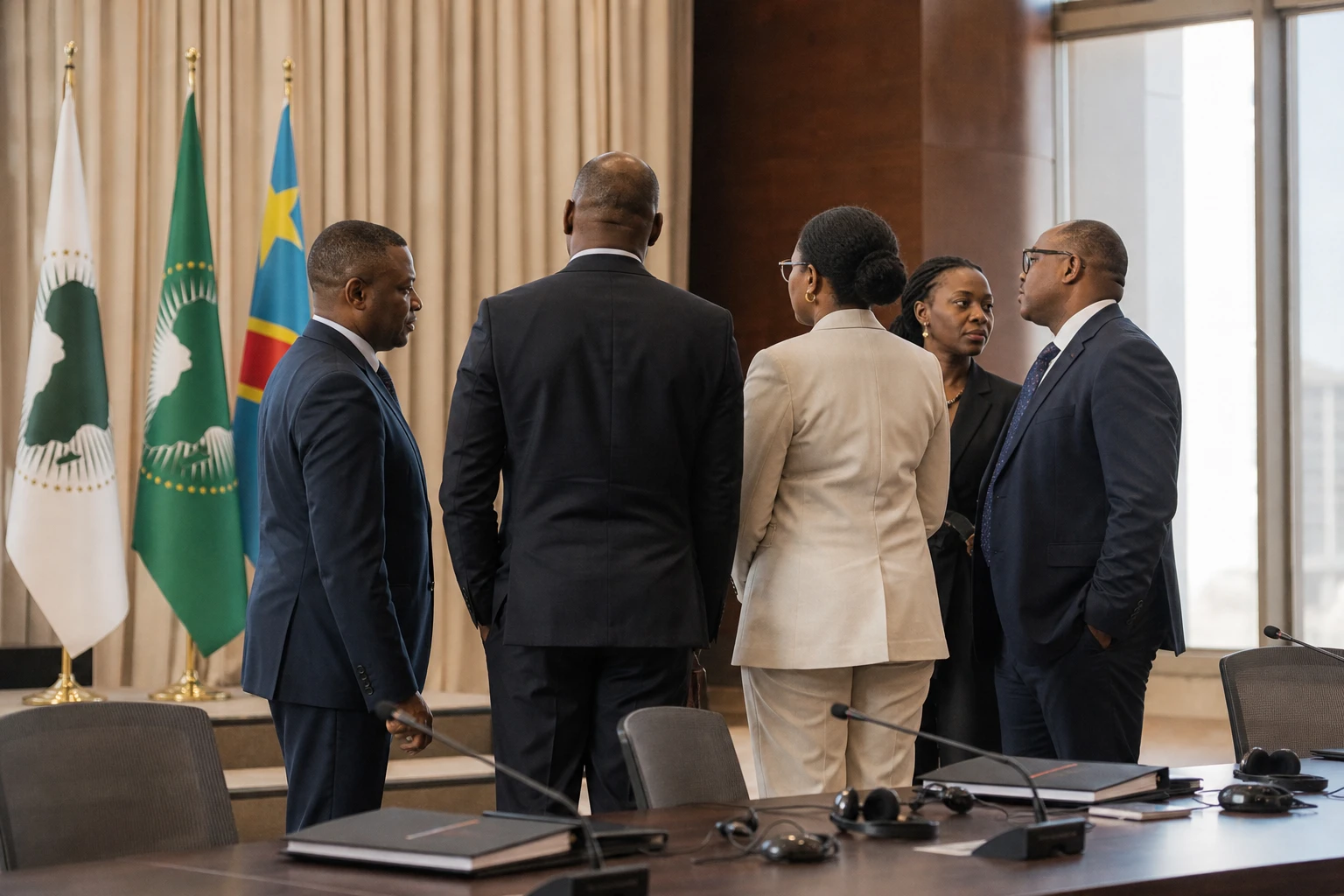
In Kinshasa, the stakes go beyond securing new funding. By seeking a place among the founding members of the African Energy Bank, the Democratic Republic of the Congo also aims to influence the rules of an institution designed to support African energy projects.
An initiative born of a funding shortfall
The bank project is backed by the African Petroleum Producers’ Organization (APPO) and Afreximbank, the pan-African bank specialising in trade finance. The two institutions signed the agreement establishing the future bank and its charter in June 2024, after two years of negotiations.
The creation of the institution addresses a challenge that has become central for African hydrocarbon-producing countries. Several international banks are reducing their exposure to oil and gas projects, notably because of policies relating to the energy transition and climate change. For APPO and Afreximbank, this trend risks limiting investment in infrastructure essential to access to electricity and industrialisation.
The project therefore promotes an African approach to energy finance. Its purpose is not simply to support oil or gas exploration. The bank should also be able to back infrastructure, the processing of resources and, more broadly, projects linked to the continent’s energy security.
Kinshasa seeks to secure a place in governance
On 24 September 2026 in Kinshasa, Acacia Bandubola Mbongo, Minister of State for Hydrocarbons, received an APPO delegation led by the organisation’s Executive Council president, Karrol Kadiata. Talks focused on the DRC’s involvement in launching the bank and a possible partnership between the African Energy Investment Corporation, or AEICORP, and the Société nationale des hydrocarbures du Congo, SONAHYDROC.
Congolese participation is not yet guaranteed. To become a founding member, Kinshasa must ratify the treaty establishing the bank and pay its capital contribution. In other words, the political announcement must still be followed by legal and financial action.
The future institution was designed with an announced initial capital of $5 billion. This figure corresponds to the authorised capital set out in the founding documents. It does not mean that this amount is already available as cash to finance projects immediately.
The bank’s actual capacity will depend on states paying in their contributions, the mobilisation of investors and its ability to attract financial partners. Projects it supports will also have to meet the investment criteria and repayment terms set by the institution.
Direct interest for Congolese projects
The DRC has significant energy potential, but its resources remain difficult to turn into industrial activity and sustainable revenue. The country has oil and gas reserves, vast hydroelectric potential and considerable needs for infrastructure to generate, transmit and distribute electricity.
In this context, a specialised African bank could give Kinshasa another point of contact. It could help structure projects, seek investors and reduce dependence on external financing, which is often costly or difficult to secure.
The proposed cooperation between AEICORP and SONAHYDROC fits this approach. It could cover project preparation and financing, as well as the search for partners. For the Congolese state-owned company, the challenge will be to turn identified resources into bankable projects—that is, projects documented, profitable and regulated well enough to persuade investors.
The expected benefits will therefore not be automatic. Access to a new bank does not replace technical studies, contractual transparency or legal safeguards for investments. It will also be necessary to show that projects can generate revenue while meeting the needs of people and businesses.
The challenge of access to energy
For the Congolese authorities, developing hydrocarbons is part of a broader strategy to mobilise resources. But that strategy must contend with a domestic reality: much of the country remains inadequately served by electricity, and energy networks are very unevenly distributed.
Projects intended for urban areas, particularly around Kinshasa, do not always address the constraints facing remote provinces. The needs of households, small businesses and mining operations differ. An effective energy policy will therefore have to combine major projects, decentralised solutions and investment in networks.
The informal sector could also be affected by financing choices. More reliable energy can reduce costs for workshops, shops and local services. Conversely, investment focused on extraction or exports would have a more limited impact on day-to-day activity if it were not accompanied by local processing.
Environmental considerations will remain equally important. The bank project was created in response to the withdrawal of some international financiers, but it will also have to take account of African commitments on the energy transition. Financing hydrocarbons therefore cannot be separated from the search for lower-carbon solutions and wider access to electricity.
A diplomatic moment for the DRC
The move comes as Acacia Bandubola Mbongo holds the APPO vice-presidency and could seek the organisation’s presidency at its ordinary session of the Council of Ministers scheduled for 17 November 2026. If confirmed and backed by member states, her candidacy would raise Kinshasa’s profile in African energy discussions.
This sequence therefore goes beyond the bank’s capital alone. It concerns the DRC’s position in African institutions linked to hydrocarbons, the negotiation of partnerships and the promotion of a continental approach to energy finance.
The DRC is also operating in a complex regional environment. It is a member of the Economic Community of Central African States, ECCAS, and the Southern African Development Community, SADC. These two regional blocs have their own priorities for infrastructure, electricity and economic corridors. The African Energy Bank could thus become an additional instrument for projects that cross national borders.
The next test will be delivery
For Kinshasa, the priority is now to complete ratification of the treaty and settle the terms of its contribution. The government will then have to put forward projects capable of meeting the bank’s requirements and delivering measurable benefits.
The success of this strategy will be judged less by the number of announcements than by the ability to finance operational infrastructure. Key things to watch will include the bank’s effective establishment, the composition of its capital, its first loans and the place given to DRC projects.
At continental level, the question will be whether the institution can genuinely reduce Africa’s energy financing gap. For the DRC, it represents a strategic opportunity. But that opportunity will become a development lever only if it is backed by strong governance, well-prepared projects and a visible distribution of benefits.