Algeria
 Egypt
 Libya
 Morocco
 Sudan
 Tunisia
 Benin
 Burkina Faso
 Cabo Verde
 Ghana
 Guinea
 Guinea-Bissau
 Liberia
 Mali
 Mauritania
 Niger
 Nigeria
 Senegal
 Sierra Leone
 The Gambia
 Togo
 Cameroon
 Central African Republic
 Chad
 DR Congo
 Equatorial Guinea
 Gabon
 Republic of the Congo
 São Tomé and Príncipe
 Burundi
 Comoros
 Djibouti
 Eritrea
 Ethiopia
 Kenya
 Madagascar
 Malawi
 Mauritius
 Mozambique
 Rwanda
 Seychelles
 Somalia
 South Sudan
 Tanzania
 Uganda
 Angola
 Botswana
 Eswatini
 Lesotho
 Namibia
 South Africa
 Zambia
 Zimbabwe
Another plant, but above all a battle for raw materials
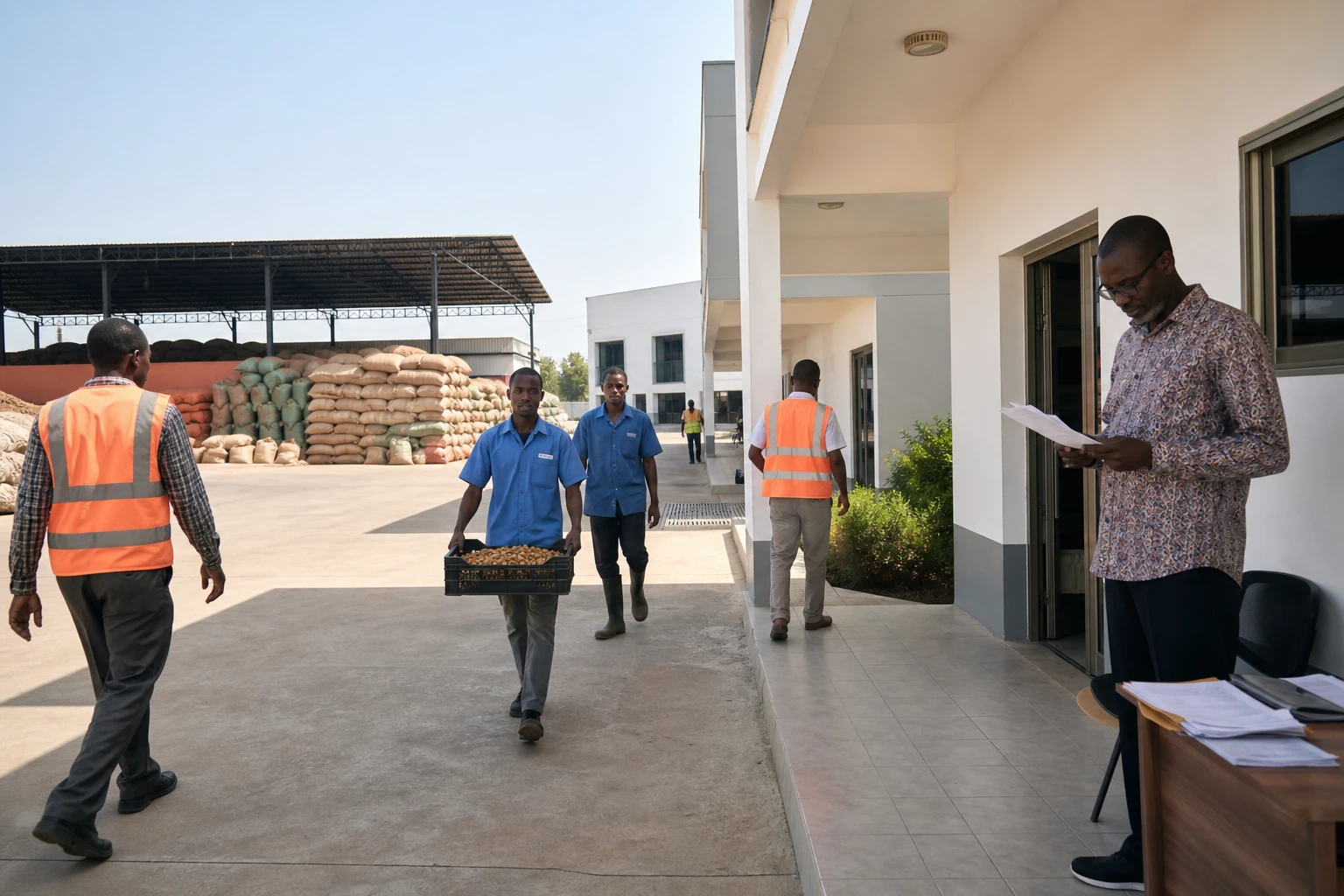
In Yamoussoukro, the growth of the cashew industry is no longer just about machinery. It now depends on the ability to attract, store and trace raw nuts, in a country seeking to retain more value at home. The new project backed by Dorado is part of this approach: processing closer to the farms, creating local jobs and securing volumes in a sector that has become strategic for Côte d’Ivoire.
The national context is clear. Côte d’Ivoire remains the world’s leading producer of raw cashew nuts, with more than 1.5 million tonnes in 2025, according to the government. Local processing is also growing, but remains below the potential suggested by the national harvest. Abidjan is now aiming to raise the processing rate above 50% by 2030, from around 43% in 2025. In line with ECOWAS priorities, moving up the value chain matters for jobs, the trade balance and industrial sovereignty.
What Dorado is planning in Yamoussoukro
The project concerns Dorado FZCO, a holding company registered in the United Arab Emirates and 90% controlled by Venkatesan Rajkumar and 10% by Vigneshwar Rajkumar. Its Ivorian subsidiary, Bluejay Nuts SARL, is to develop the new plant in Yamoussoukro. The proposal submitted to the IFC provides for a total investment of $18 million, including $15 million in loans and $3 million in equity. The project was officially disclosed on 30 July 2026 and remained “pending approval” in the update of 31 July 2026.
The planned facility is to be built in Côte d’Ivoire’s political capital, on a 5.43-hectare site. Its stated capacity is 50,000 tonnes a year. The project also includes a 30,000-tonne warehouse and a 2.5 MW rooftop solar installation. The announced schedule targets commissioning in the first quarter of 2027. For the IFC, the project involves more than financing alone: the institution also plans to provide technical support on the supply chain and traceability.
The choice of location is no accident. Yamoussoukro is already part of Côte d’Ivoire’s agro-industrial processing map. The government inaugurated the Cashew Innovation and Technology Centre there in 2020. The state has also encouraged plants to be set up in Toumodi, Oussou and other production areas. The idea is simple: bring industrial facilities closer to agricultural regions to reduce logistics costs and capture a larger share of the value added.
Supply, jobs and shifting power dynamics
The real test, however, is not construction. It is keeping production lines supplied on a regular basis. Dorado already says it processes substantial volumes in Toumodi, where its plant, inaugurated in 2022, was announced as having an annual capacity of 60,000 tonnes before the IFC raised that figure to 120,000 tonnes. With the new facility, the group claims a combined capacity of at least 170,000 tonnes in Côte d’Ivoire. This puts the purchase of nuts at the heart of its business model.
The country offers favourable conditions, but competition is intense. National production reached 1,225,935 tonnes in 2023, according to open government data, and exceeded 1.5 million tonnes in 2025, according to the executive. At the same time, the amount destined for local processing rose to 659,579 tonnes in 2025, from 344,026 tonnes in 2024. In other words, plants are multiplying faster than ever, but they are competing for a raw material that remains seasonal, dispersed and highly sensitive to the prices offered to producers.
This pressure explains the contracts signed upstream with co-operatives and aggregators, as well as the proliferation of warehouses in Bondoukou, Bouaké and Toumodi. For processors, the challenge is no longer just industrial. It is becoming commercial and territorial. They must persuade producers, secure supply flows and prevent raw nuts from going to other channels that are faster or offer better prices. For co-operatives, however, this competition could strengthen their bargaining power, provided traceability does not remain merely theoretical.
The project also has a social dimension. In Côte d’Ivoire, cashew plants create jobs for women and young people in inland areas, far from Abidjan. The government claims there are nearly 20,000 direct jobs in the sector, with women making up a large share of the workforce. The Yamoussoukro project is therefore part of a more balanced economic geography, in which inland cities are seeking to attract more formal economic activity. This is a tangible issue for rural households, transporters, collectors and the small co-operative organisations that sustain the supply chain.
An Ivorian industry already carrying weight across the continent
Beyond Côte d’Ivoire, the project says something about the trajectory of Africa’s cashew industry. The continent still exports large quantities of raw nuts, but the biggest margins remain in processing, sorting, kernels and industrial by-products such as CNSL, an oil extracted from the shells. Dorado says it already has a facility in Toumodi capable of processing these shells, and plans to add a biomass unit by 2028. This vertical integration is the approach increasingly sought by African governments: export less raw material, sell more semi-processed products and create industrial jobs locally.
The regional implications are clear. If processing capacity in Côte d’Ivoire continues to grow, competition for harvests could intensify with neighbouring producer countries, while traceability standards become more demanding. ECOWAS and continental trade frameworks will then have to reckon with a simple fact: value will shift towards areas able to process, finance and certify. For Yamoussoukro, the Dorado project is therefore not just another plant. It is another signal of the reshaping of a West African industry seeking to retain more wealth close to producers.