Algeria
 Egypt
 Libya
 Morocco
 Sudan
 Tunisia
 Benin
 Burkina Faso
 Cabo Verde
 Côte d'Ivoire
 Ghana
 Guinea
 Guinea-Bissau
 Liberia
 Mali
 Mauritania
 Niger
 Nigeria
 Sierra Leone
 The Gambia
 Togo
 Cameroon
 Central African Republic
 Chad
 DR Congo
 Equatorial Guinea
 Gabon
 Republic of the Congo
 São Tomé and Príncipe
 Burundi
 Comoros
 Djibouti
 Eritrea
 Ethiopia
 Kenya
 Madagascar
 Malawi
 Mauritius
 Mozambique
 Rwanda
 Seychelles
 Somalia
 South Sudan
 Tanzania
 Uganda
 Angola
 Botswana
 Eswatini
 Lesotho
 Namibia
 South Africa
 Zambia
 Zimbabwe
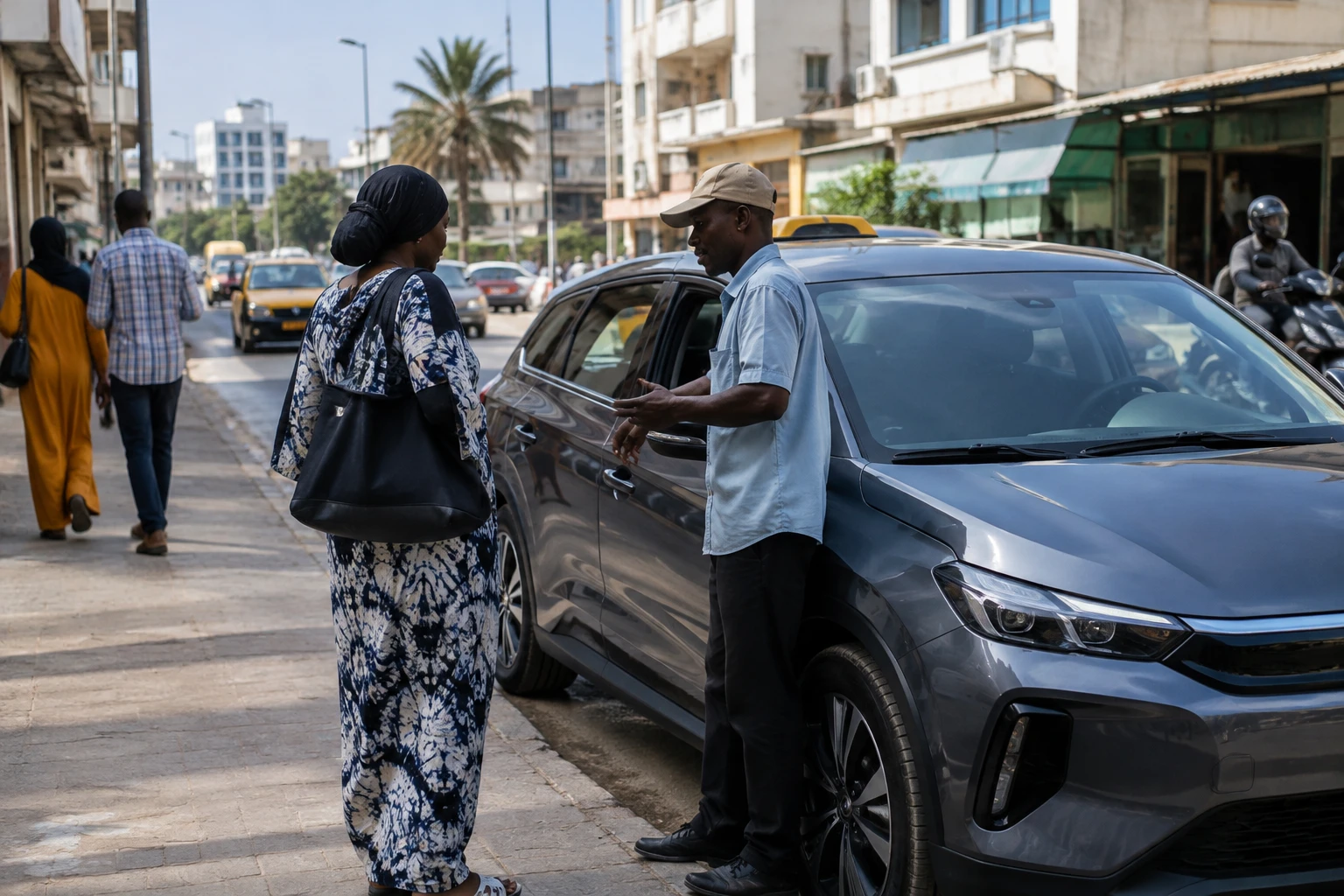
In Dakar, converting a taxi to all-electric power involves more than replacing the engine. The vehicle must also be financed, charging organised and drivers guaranteed a viable income. Senegal has just launched its first large-scale test: 100 cars in a programme that ultimately aims to provide 1,000 taxis.
First batch to renew the taxi fleet
On 24 September 2026, the Land Transport Development Fund (FDTT) and the Bank for Trade and Industry (BCI) received 100 electric taxis in Dakar. The batch launches a programme for 1,000 vehicles intended for transport professionals, according to the Senegalese Press Agency and the FDTT.
The announced timetable has changed since the project was first presented. At the handover, the FDTT said it aimed to provide 1,000 taxis before the end of 2027. The BCI, for its part, referred to 700 vehicles before the end of 2026, followed by a further 300 no later than 31 December 2027. The broader target of 10,000 electric taxis features among the programme’s ambitions, but is not the immediate next step.
The FDTT plans to provide CFA francs 13 billion in financing for the 1,000 vehicles. Its guarantee scheme is intended to reassure banks and make it easier for operators to access credit. The fund is therefore not a substitute for bank financing: it aims to reduce the risk for lenders.
The rollout builds on a transformation already under way in the capital. Dakar has the Regional Express Train and an electric bus rapid transit system, the BRT. But taxis remain essential to daily journeys, particularly on routes not directly served by public transport networks.
Promised savings, financing yet to be tested
For drivers, the immediate selling point is the cost of running the vehicle. Famara Daffé, a spokesperson for the beneficiaries, told the APS that covering 450 kilometres in a new vehicle would cost no more than CFA francs 5,000. He compared this with the roughly CFA francs 30,000 in fuel a conventional taxi can consume in a day. These figures are statements by officials and operators, not yet an independent assessment of actual costs.
The claimed difference could boost drivers’ earnings, provided the taxis are driven enough and electricity is available when needed. Maintenance, insurance, financing costs and potential downtime must also be factored in. Savings on energy alone therefore do not guarantee higher net income.
The project combines fleet renewal with the formalisation of the profession. Drivers are to gain access to vehicles through regulated professional and financial arrangements. In the scheme’s initial version, employment contracts, social protection and savings were mentioned. The handover of the 100 taxis does not yet show how many drivers will actually receive these guarantees, or on what terms.
Price remains a central issue. High monthly repayments could exclude drivers with little collateral or those working in the informal economy. Conversely, the guarantee scheme announced by the FDTT could give operators access to credit when they would otherwise have been unable to finance a new vehicle on their own. The precise repayment terms and allocation of risks will be decisive.
Charging points and maintenance: prerequisites for scaling up
An electric fleet is useful only if it can recharge without drivers losing hours of work. Early announcements about the project referred to eight fast-charging points in Dakar. The handover of the cars alone does not confirm that they are operational, or that they can meet the needs of a fleet set to grow. The FDTT and BCI will need to clarify the timetable, locations and contingency plans in the event of breakdowns.
Dependence on spare parts, trained technicians and after-sales services is just as important. Choosing Chinese models provides access to vehicles available in a market where the electric vehicle industry has grown rapidly. But the local benefits will depend on the ability to carry out repairs in Senegal, train mechanics and minimise downtime.
The country is not starting from scratch. A fact sheet from the public agency Invest in Senegal had already outlined an electromobility project combining charging, solar panels, vehicles and assembly. This earlier initiative shows that the challenge goes beyond importing taxis: it involves building infrastructure and potentially developing local maintenance and production activities.
Urban and regional stakes
The effects will not be the same for everyone in Dakar. Passengers could benefit from more comfortable, quieter vehicles, while drivers will bear the costs and constraints of credit and charging. Residents of neighbourhoods near busy roads could see a reduction in tailpipe emissions, but the scale of that effect will depend on the number of taxis replaced and the source of the electricity.
The shift to electric vehicles will not solve traffic congestion, route planning or access to transport in outlying neighbourhoods. Nor will it, on its own, meet the needs of secondary cities. Mobility policy will therefore need to integrate taxis, buses, the BRT and rail, while taking account of workers and operators already in the sector.
Across West Africa, Senegal’s experience will be watched for answers to very practical questions: can drivers repay the cost of the vehicles, do the charging points work day to day, and are the promised savings borne out over several months? The next step is less about the figure of 10,000 taxis than about publishing verifiable results on operating costs, access to finance and service quality. That is the scale at which Senegal will be able to judge whether Dakar’s pilot can serve as a model for other urban networks in the region.