
 Algeria
 Egypt
 Libya
 Morocco
 Sudan
 Tunisia
 Benin
 Burkina Faso
 Cabo Verde
 Côte d'Ivoire
 Ghana
 Guinea
 Guinea-Bissau
 Liberia
 Mali
 Mauritania
 Niger
 Nigeria
 Sierra Leone
 The Gambia
 Togo
 Cameroon
 Central African Republic
 Chad
 DR Congo
 Equatorial Guinea
 Gabon
 Republic of the Congo
 São Tomé and Príncipe
 Burundi
 Comoros
 Djibouti
 Eritrea
 Ethiopia
 Kenya
 Madagascar
 Malawi
 Mauritius
 Mozambique
 Rwanda
 Seychelles
 Somalia
 South Sudan
 Tanzania
 Uganda
 Angola
 Botswana
 Eswatini
 Lesotho
 Namibia
 South Africa
 Zambia
 Zimbabwe
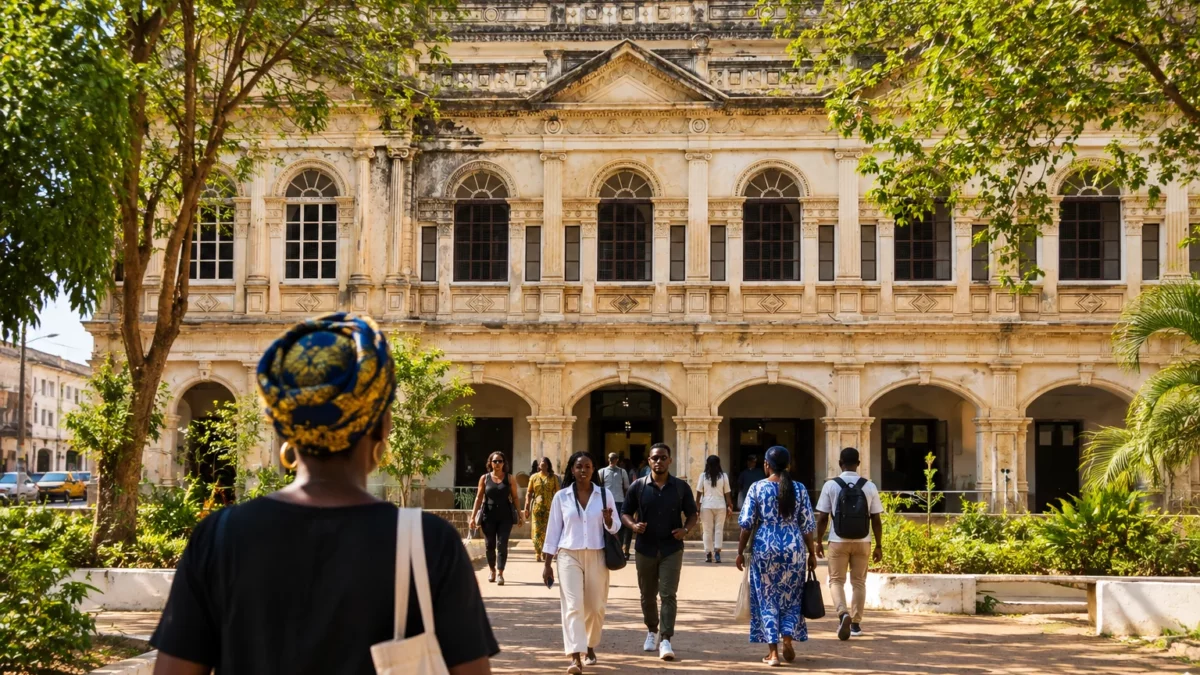
In Dakar, an artwork can repair a memory, circulate knowledge or raise a question that official discourse leaves aside. Until 19 December, the 16th edition of the Contemporary African Art Biennale puts these gestures at the heart of an event connecting artists, audiences and diasporas.
A Senegalese event with continental reach
Since 19 November, Dakar has hosted the Biennale under the theme “(Anti)fragility: Arts of Repair and Strategies of Resistance”. Organised by Senegal, the event runs until 19 December. It is being held in venues including the former Palace of Justice and the National Gallery of Art, while exhibitions in the OFF programme are taking place in several cities across the country. This network of events outside the official selection also gives a platform to initiatives held beyond the major exhibition venues.
Here, “(anti)fragility” refers to the ability to turn a difficult situation into a starting point for creation, rather than simply a condition to endure. Artistic director Morad Montazami develops the idea around the power of fragility, care and repair, as well as collective responses to crises. The aim is not to erase wounds, but to examine the forms of memory, solidarity and invention that can emerge from them.
This approach is part of a Senegalese cultural trajectory in which Dak’Art has for several decades served as a meeting platform for contemporary art from the continent and its diasporas. The 2026 calendar also places the Biennale after the Youth Olympic Games held in Dakar in October and November. For Senegal, the stakes go beyond the capital’s profile: they also concern the circulation of artworks, professional opportunities and public access to cultural life.
Artworks that offer new readings of history
The international selection brings together 54 artists. The Design section features 22, and the official programme also includes two special invitations, a “Grand Witness” and a carte blanche. The Democratic Republic of the Congo, the guest of honour, presents “Fourth Time: Time as Living Matter”, curated by Steve Bandoma.
The Congolese project invites a confrontation with history and collective responsibility. Steve Bandoma describes this “fourth time” as an immaterial moment of reassessment: a mirror in which to look at what has been done to humanity, Africa and the DRC. This approach gives memory an active role. It invites an examination of legacies and their effects on the present, without reducing a country or a continent to its wounds.
Another approach gives form to Africa’s democratic trajectories. Ghanaian artist Whitney Chinonye Ernest is part of a collective of women artists using data art to make visible the efforts and complexities of political journeys. Her work is a reminder that democratic progress is neither linear nor identical from one country to another. Representing it also allows audiences to grasp its stages and tensions.
These proposals respond to one another without telling a single story. Congolese memory, democratic experiences and the approaches of other artists each retain their own grounding. Their encounter in Dakar opens up a space for comparison and dialogue, without claiming to sum up the diversity of African societies.
Beyond the official venues
The OFF programme extends the Biennale’s reach. About 450 projects are planned in Dakar and other cities in Senegal, running until 19 December. This figure refers to projects, not necessarily to the same number of separate exhibitions. Their spread can bring artworks closer to audiences who do not usually visit art institutions. However, visibility and the conditions for welcoming visitors depend on the venues, available resources and visitors’ ability to travel.
For artists, a Biennale can offer an audience, professional exchanges and an opportunity to showcase practices beyond their own country. For visitors, it turns several spaces in Dakar into places of discovery and discussion. But the scale of a programme does not, on its own, guarantee that all audiences can benefit from it in the same way. Access — in the capital as well as in the other cities involved — therefore remains as important as the number of artworks on show.
The event also takes place within a West African landscape where the movement of artists and ideas does not stop at national borders. Senegal is a member of ECOWAS, the Economic Community of West African States. The Biennale is not an event organised by that body, but its regional and diasporic openness is a reminder of the role cultural exchanges play in building ties between societies. It also showcases practices that engage with the rest of the continent without being conflated with it.
An impact that will be measured over time
The theme of repair takes on its full meaning when artworks leave the galleries and continue to circulate in conversations, collections or artists’ projects. It remains to be seen which professional ties will endure after the closing, which works will find new audiences and what place will be given to local art scenes beyond the Biennale’s main event.
On a pan-African scale, Dak’Art thus offers a platform for visibility and debate rather than an imposed shared narrative. The programme places different histories, forms and experiences side by side. Its contribution will lie as much in this plurality as in its ability to sustain exchanges between Dakar, Senegal’s regions, the continent and the diasporas.



