Algeria
 Egypt
 Libya
 Morocco
 Sudan
 Tunisia
 Benin
 Burkina Faso
 Cabo Verde
 Côte d'Ivoire
 Ghana
 Guinea
 Guinea-Bissau
 Liberia
 Mali
 Mauritania
 Niger
 Nigeria
 Sierra Leone
 The Gambia
 Togo
 Cameroon
 Central African Republic
 Chad
 DR Congo
 Equatorial Guinea
 Gabon
 Republic of the Congo
 São Tomé and Príncipe
 Burundi
 Comoros
 Djibouti
 Eritrea
 Ethiopia
 Kenya
 Madagascar
 Malawi
 Mauritius
 Mozambique
 Rwanda
 Seychelles
 Somalia
 South Sudan
 Tanzania
 Uganda
 Angola
 Botswana
 Eswatini
 Lesotho
 Namibia
 South Africa
 Zambia
 Zimbabwe
A relay that goes beyond sport
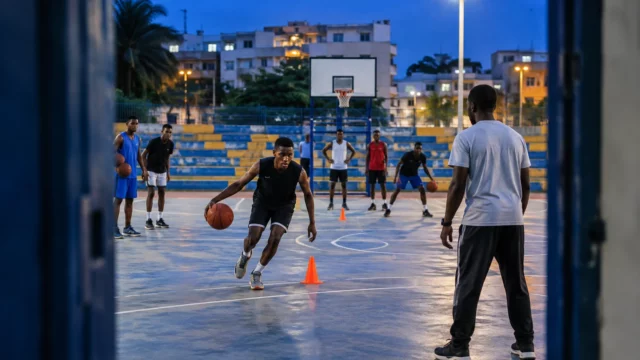
In Dakar, the Youth Olympic Games flame did more than cross a square or mark a ceremony. Above all, it served as a political and symbolic signal: Senegal is entering the final stretch before an event that will make Dakar, Diamniadio and Saly the three settings for an unprecedented occasion for the continent. In 2026, Africa will host an Olympic event for the first time, and its significance extends far beyond the competition itself. It speaks to the country’s image, the mobilisation of its young people and the ability of Senegalese institutions to meet a tight schedule.
This context also matters at regional level. Senegal, a member of ECOWAS, wants the Dakar 2026 Youth Olympic Games to showcase expertise in a sub-region often viewed through the lens of political instability or security crises. The challenge here is different: to show that a West African country can host a global event, with refurbished infrastructure, logistics routes linking the capital with the hubs of Diamniadio and Saly, and a mobilisation bringing together institutions, local authorities and the sporting community. Senegalese officials have also presented the Games as a driver of transformation and a lasting legacy, not merely a showcase lasting a few days.
From the Panathenaic Stadium to Dakar’s streets
The flame’s journey began in Athens, at the Panathenaic Stadium, on 10 September 2026, before it arrived in Dakar on 12 September. The International Olympic Committee confirmed that the torch would travel to Senegal after the handover ceremony, and the Senegalese presidency announced at the cabinet meeting on 10 September that the head of state would preside over the official handover of the flame on 12 September. In Dakar, the welcome ceremony brought together music, a parade, young athletes and popular pageantry, deliberately combining a civic celebration with a sporting one.
The national relay that follows is no mere ritual. It is due to run from 14 September to 30 October 2026, pass through Senegal’s 14 regions and involve more than 400 torchbearers, according to Senegalese Radio and Television, while the Senegalese public press reports a route of more than 3,650 kilometres. Dates vary slightly between planning documents, but the principle remains the same: the flame is to return to Dakar on the eve of the Games’ opening, scheduled for 31 October to 13 November 2026. Several official and media sources have confirmed this timetable, making its broad outline reliable.
The choice of Dakar-Plateau as the starting point is no accident. This administrative and historic centre is home to the state, government services, major commercial thoroughfares and powerful symbols. By launching the tour in the heart of the capital, organisers wanted to show that the Games are not just about the new infrastructure in the suburbs or the competition venues, but also the old city, its daily flows and its popular life. The flame’s passage through Sandaga, Petersen and the Presidential Palace places it in the reality of urban life, where traders, pupils, public servants, supporters and residents cross paths. It is a way of saying that the event does not belong to an isolated sporting elite.
A test of organisation and public support
In practical terms, the relay is a full-scale test. Senegal still has to demonstrate that it can keep a national operation moving without interruption in a country where the distances between Dakar, Casamance, Fouta and the east require careful logistics. The challenge is tangible for local authorities, security forces, schools, sports associations and cultural groups involved at each stop. It also matters to people in the regions, who will not simply watch a symbol pass by: they will be called on as hosts, spectators, volunteers and ambassadors. The ceremony is therefore no mere ornament. It gauges popular support for a state project intended to be national, but one that must be experienced locally.
The choice of torchbearers reflects this desire for inclusion. Organisers have highlighted figures from Senegalese sport, youth representatives, cultural figures and people recognised beyond the country’s borders. Senegalese media have also noted the participation of champions and familiar faces from across Africa, reinforcing the relay’s intergenerational dimension. The message is clear: the Dakar 2026 Youth Olympic Games must not remain an event reserved for the Olympic circle. They aim to speak to young Senegalese people, as well as young people across Africa, who will see the Games as a stage where their continent is no longer merely a spectator in global sport.
What Dakar 2026 says to Africa
Across the continent, Dakar 2026 carries particular weight. The official slogan, “Africa welcomes, Dakar celebrates”, captures the balance being sought: to make Senegal’s capital a continental gateway without diminishing Senegal’s role in a broader African story. The IOC stresses the historic nature of this edition, the first Olympic event to be held in Africa, while Senegalese sources emphasise the ambition to leave a lasting legacy in infrastructure, participation in sport and the country’s international image. The continent will therefore be watching not just a tournament, but a demonstration of organisational capability.
The next steps will unfold very soon. The national relay is due to end in Dakar on 30 October, followed by the opening ceremony and the Games, running from 31 October to 13 November 2026. Around 2,700 young athletes are expected to compete, according to media reports and Olympic documents, in about 20 sports, at venues spread across Dakar, Diamniadio and Saly. If the schedule is met, Senegal will do more than host the flame. It will put a simple but significant idea back into the language of global sport: Africa can organise, pass on and celebrate at the same level as the established Olympic centres. That is the event the national tour is preparing for, far beyond the symbolic flame.