Algeria
 Egypt
 Libya
 Morocco
 Sudan
 Tunisia
 Benin
 Burkina Faso
 Cabo Verde
 Côte d'Ivoire
 Ghana
 Guinea
 Guinea-Bissau
 Liberia
 Mali
 Mauritania
 Niger
 Nigeria
 Senegal
 Sierra Leone
 The Gambia
 Togo
 Cameroon
 Central African Republic
 Chad
 DR Congo
 Equatorial Guinea
 Gabon
 Republic of the Congo
 São Tomé and Príncipe
 Burundi
 Comoros
 Djibouti
 Eritrea
 Ethiopia
 Kenya
 Madagascar
 Malawi
 Mauritius
 Mozambique
 Rwanda
 Seychelles
 Somalia
 South Sudan
 Tanzania
 Uganda
 Angola
 Botswana
 Eswatini
 Lesotho
 Namibia
 South Africa
 Zambia
 Zimbabwe
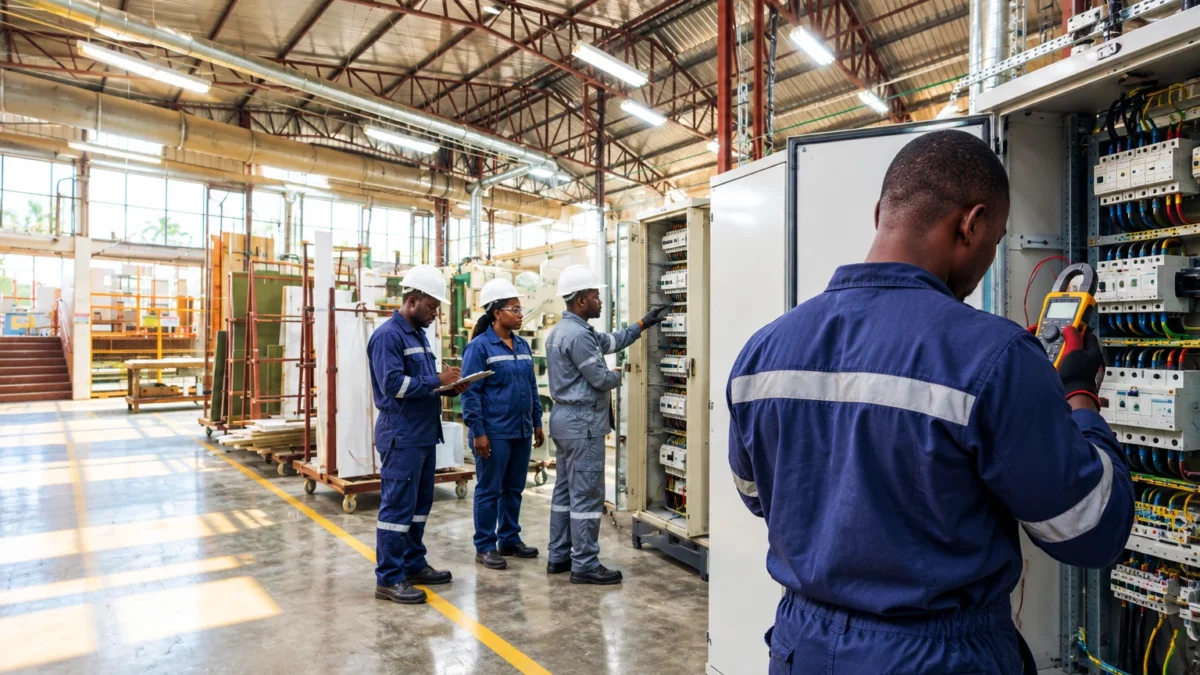
For a factory, hotel or mining site, energy is more than a bill to be paid. It is a production cost, a factor in continuity and, at times, a constraint that delays investment. In Côte d’Ivoire, energy audits and on-site solar power are therefore playing a growing role in corporate decisions, provided the expected savings can be demonstrated.
Measure before investing
This issue extends beyond Côte d’Ivoire’s borders. Côte d’Ivoire is a member of ECOWAS, the Economic Community of West African States, and its electricity trade forms part of a regional network. In this context, making better use of available electricity can be as important as developing new capacity, particularly for businesses seeking to stabilise costs and operations.
The Ivorian framework requires periodic energy audits for certain large consumers. Since the scheme was revised in April 2024, the threshold has covered, in particular, industrial sites consuming at least 2 gigawatt-hours a year and commercial and public service establishments consuming at least 1 gigawatt-hour. An audit examines uses and equipment to identify opportunities for improvement. On its own, it does not guarantee a lower bill.
Smart Energy, a subsidiary of Compagnie Ivoirienne d’Électricité (CIE), itself a member of the Eranove group, offers these assessments and related support. The Ivorian Directorate-General for Energy lists it among accredited auditors. The official list of accredited energy auditors in Côte d’Ivoire confirms this status.
Potential savings, not a certainty
According to data provided by the company, Smart Energy carried out 102 audits between 2023 and 2025. The studies are said to have identified more than CFA 18 billion in potential savings at the sites examined. This figure represents estimated potential, not sums already saved by clients. Verifying it would require tracking completed work and then comparing consumption with a baseline.
The distinction is essential. An audit may recommend adjusting motors, improving industrial refrigeration, better managing air conditioning or correcting power quality issues. Each option requires a different investment. Its value depends on the site’s profile, equipment costs, financing and savings actually measured after installation.
International trends support the case for such initiatives, but do not amount to a promise of local returns. In a survey published by the International Energy Agency in 2025, covering 1,000 industrial establishments in 14 countries, about 70% of respondents reported returns on investment of more than 10% for efficiency measures implemented in the previous five years. The agency also reports average savings of 11% over the first three years for companies that adopted ISO 50001, an energy management system. These averages do not predict results at an Ivorian site.
Company size also matters. Large groups often have greater investment capacity and specialist staff. For SMEs, the upfront cost can deter projects that would be profitable in the long term. Solutions that include financing, equipment and maintenance can ease this barrier, but must be assessed in light of their costs and contractual commitments.
Solar power, an option to size carefully
Solar photovoltaics can supplement grid supply, particularly at sites whose consumption patterns coincide with daytime generation. However, an average generation cost observed at large power plants is not the same as the price of a rooftop installation. Sizing depends in particular on available space, consumption patterns, financing and integration with existing equipment.
The International Renewable Energy Agency (IRENA) estimates that the average levelised cost of electricity from new large-scale solar power plants in Africa fell from $0.225 per kilowatt-hour in 2015 to $0.074 in 2024. This measure accounts for a project’s costs over its lifetime; it is neither a sale tariff nor a direct estimate of the cost of an installation for an Ivorian business. IRENA’s report on renewable power generation costs in 2024 sets out these figures.
Smart Energy says it favours a two-stage approach: first reduce avoidable consumption, then assess solar self-generation according to the client’s needs. The company also offers financing that, subject to technical and financial feasibility, can cover up to 100% of the initial investment. Repayment terms and expected net savings remain crucial in assessing the value of each project.
An issue for West African industry
The debate will form part of a wider regional agenda at the International Exhibition of Extractive Resources and Energy, to be held in Abidjan from 18 to 22 November 2026. The event brings together stakeholders from the mining, oil and energy sectors. Smart Energy plans to present its so-called “energy as a service” approach, which can combine assessment, equipment, financing, monitoring and maintenance.
For industrial and mining operators, the issue is not limited to choosing between the grid and solar panels. It is about determining which improvements can be financed without straining cash flow, and how to verify the results afterwards. For policymakers, audits can inform demand management, while regional electricity cooperation remains linked to availability and cross-border exchanges.
The next step is therefore practical: turn recommendations into monitored investments, and distinguish announced savings from those actually achieved. It is through this site-by-site measurement that the contribution of energy efficiency to the competitiveness of Ivorian businesses and, gradually, other West African markets will be judged.