Algeria
 Egypt
 Libya
 Morocco
 Sudan
 Tunisia
 Benin
 Burkina Faso
 Cabo Verde
 Côte d'Ivoire
 Ghana
 Guinea
 Guinea-Bissau
 Liberia
 Mali
 Mauritania
 Niger
 Nigeria
 Senegal
 Sierra Leone
 The Gambia
 Togo
 Cameroon
 Central African Republic
 Chad
 DR Congo
 Equatorial Guinea
 Gabon
 São Tomé and Príncipe
 Burundi
 Comoros
 Djibouti
 Eritrea
 Ethiopia
 Kenya
 Madagascar
 Malawi
 Mauritius
 Mozambique
 Rwanda
 Seychelles
 Somalia
 South Sudan
 Tanzania
 Uganda
 Angola
 Botswana
 Eswatini
 Lesotho
 Namibia
 South Africa
 Zambia
 Zimbabwe
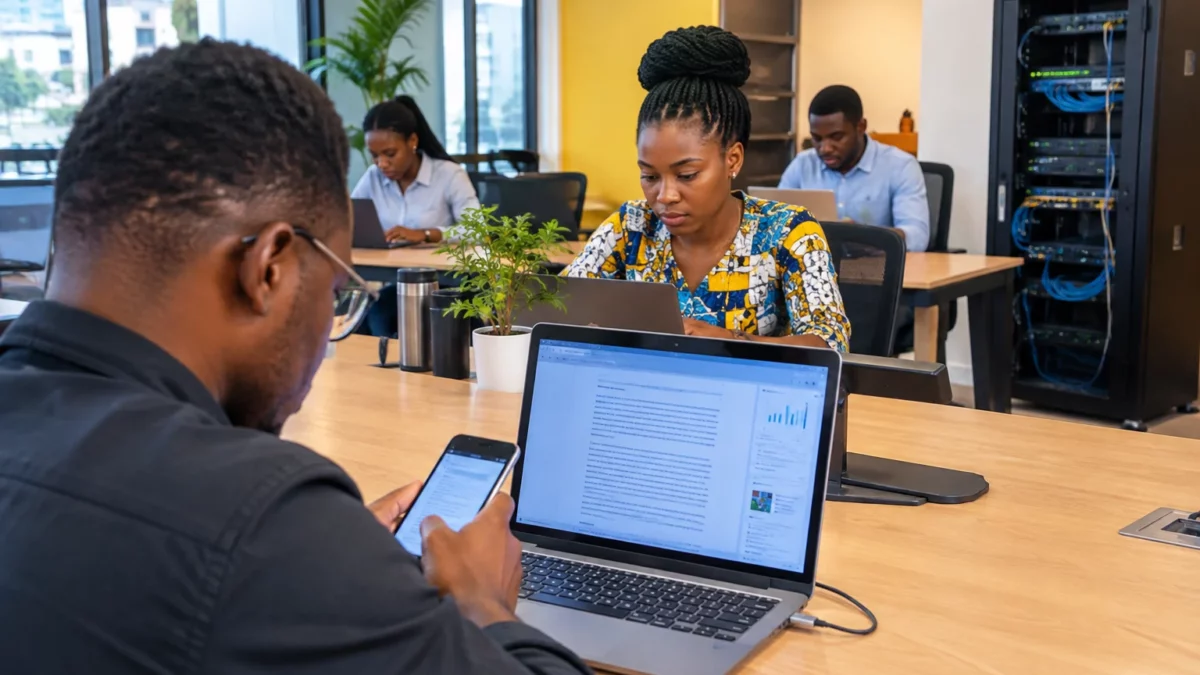
An international connection can fail without cutting off the internet altogether. But keeping the network online does not always mean maintaining the same speeds or connection quality. The repair of the WACS cable, announced on 16 November 2026, brings this distinction back to the fore in the digital sector in the Congo.
A backup route put to use
The Congo, whose capital is Brazzaville, relies on terrestrial and subsea connections to exchange data with the rest of the world. WACS, short for West Africa Cable System, is a fibre-optic cable laid on the floor of the Atlantic Ocean. It links South Africa to Europe and serves several coastal countries, including the Congo.
The country belongs to the Economic Community of Central African States (ECCAS), a regional cooperation organisation. Connections with neighbouring countries also matter for its telecommunications: the WACS cable links the Matombi stations in the Congo and Muanda in the Democratic Republic of the Congo, among others. These two neighbouring countries should not be confused: Brazzaville is the capital of the Congo, and Kinshasa is the capital of the DRC.
According to Congo Telecom, its teams detected an interruption on 29 October affecting circuits carried by WACS on the segment between the two countries. The company says its redundancy mechanisms automatically rerouted traffic over backup links. It says this enabled it to maintain internet capacity for the affected customers without manual intervention.
The operator announced that the cable had been restored to service on Monday 16 November, two days ahead of the 18 November deadline previously communicated. The restoration date and the operation of the redundancy system are reported by the company. The public information consulted provides no independent measurement of speeds or latency during the incident.
Continuity does not necessarily mean unchanged quality
Rerouting means sending data along another path when the usual route becomes unavailable. It prevents a single break from necessarily causing a total outage. But the other links must be available and have enough capacity to absorb the diverted traffic.
A backup route can therefore preserve access while slowing some activities. If it is heavily used, pages may load more slowly, video calls may deteriorate or latency may increase. Congo Telecom’s statement that service continued does not, by itself, establish that subscribers enjoyed their usual connection quality.
The local context makes the situation harder to assess. On 30 October, the Regulatory Agency for Posts and Electronic Communications (ARPCE) reported disruptions affecting electronic communications networks and services, linked to difficulties in securing energy supplies. The alert, published the day after the reported date on which the WACS incident was detected, describes another factor that could affect services.
Energy constraints do not affect all users in the same way. Businesses, public administrations and individuals depend on network stability for their day-to-day activities. Perceived quality may also vary between Brazzaville, Pointe-Noire and less well-served localities, depending on local equipment and available power solutions.
A shared challenge along Africa’s coasts
Incidents in 2024 showed that several cables damaged at the same time can extend disruption far beyond a single country. In March, breaks in cables off West Africa affected numerous states. The Internet Society documented the consequences of these failures and rerouting efforts, while operators reported seeking alternative routes.
This precedent does not make it possible to compare the impact of those incidents directly with that of WACS in the Congo. It does, however, highlight a shared vulnerability: subsea cables carry a significant share of international data exchanges. Route diversity, interconnections between operators and available capacity in the event of an outage determine whether interruptions can be limited.
In a separate incident in September 2026, a Congo Telecom executive had mentioned using additional capacity on the 2Africa cable to reroute traffic. This provides information about the tools the company may have deployed during that other outage. It does not, however, confirm that 2Africa was used in the same way, or to the same extent, during the October incident.
Data needed to measure resilience
To fully assess the outcome, it would be necessary to know the volume of traffic diverted, the backup routes used and their available capacity. Measurements of speed, latency and availability during the outage would also help distinguish an absence of disconnection from the effective maintenance of service quality. These data do not appear in the public communications consulted.
Resilience is therefore measured not only by the cable’s restoration or the existence of a backup link. It also depends on the link’s performance under pressure, the power supply to equipment and operators’ transparency about the effects observed.
For the Congo and its neighbours in Central Africa, the next steps lie in diversifying routes and technical cooperation between landing stations, operators and regulators. The restoration of WACS concludes one stage of repairs. The next question is more concrete for subscribers: what level of service can networks guarantee when their main international route becomes unavailable?
Sources consulted: Congo Telecom statement on the restoration of WACS, ARPCE alert on disruptions linked to energy supply, Internet Society analysis of subsea cable resilience and independent coverage of cable disruptions in Africa in March 2024.