Algeria
 Egypt
 Libya
 Morocco
 Sudan
 Tunisia
 Benin
 Burkina Faso
 Cabo Verde
 Côte d'Ivoire
 Ghana
 Guinea
 Guinea-Bissau
 Liberia
 Mali
 Mauritania
 Niger
 Nigeria
 Senegal
 Sierra Leone
 The Gambia
 Togo
 Cameroon
 Central African Republic
 Chad
 DR Congo
 Equatorial Guinea
 Gabon
 Republic of the Congo
 São Tomé and Príncipe
 Burundi
 Comoros
 Djibouti
 Eritrea
 Ethiopia
 Madagascar
 Malawi
 Mauritius
 Mozambique
 Rwanda
 Seychelles
 Somalia
 South Sudan
 Tanzania
 Uganda
 Angola
 Botswana
 Eswatini
 Lesotho
 Namibia
 South Africa
 Zambia
 Zimbabwe
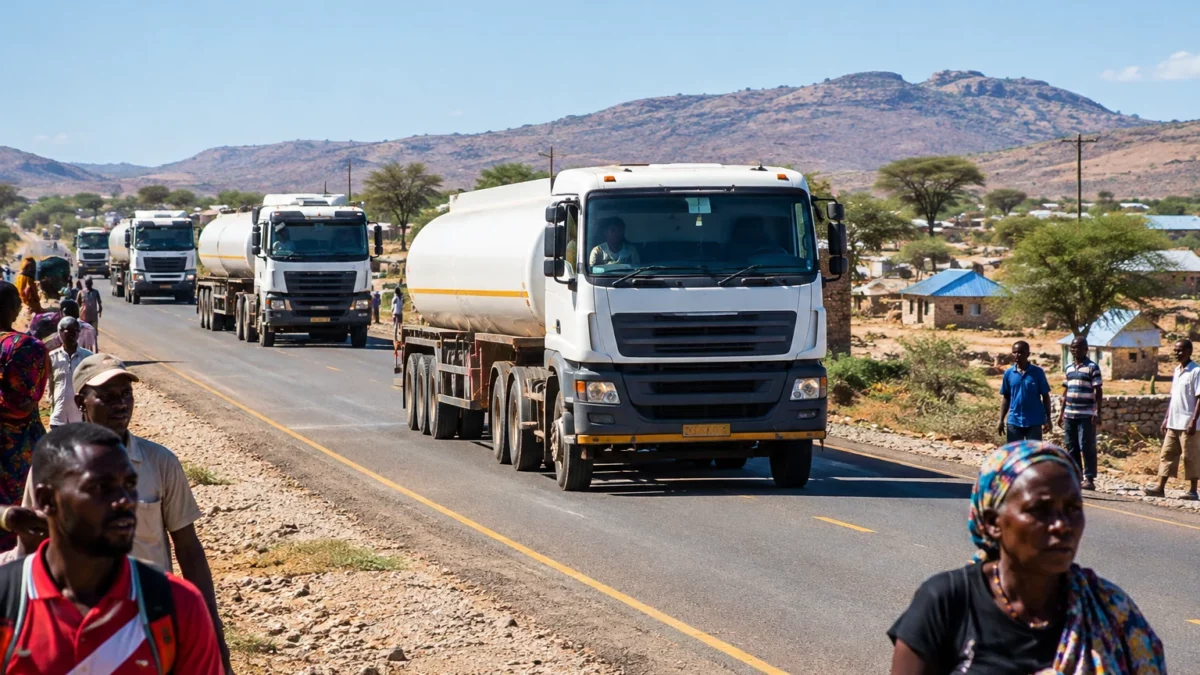
For residents of Turkana County, oil from South Lokichar represents the promise of jobs and public revenue. But getting it to market also depends on a very practical challenge: transporting the crude to the coast without the benefits bypassing the regions where it is extracted.
Kenya, whose capital is Nairobi, is preparing to become a commercial oil producer after more than a decade of delayed development. The announced timetable marks an important milestone. It does not, however, resolve questions about transport, revenue-sharing and oversight of local impacts.
Production to begin in stages
The South Lokichar basin is in Turkana County, in north-west Kenya. The first oil discoveries date back to 2012. The project covers blocks T6 and T7 and operates under production-sharing agreements between the state and the operator.
On Friday 20 November 2026, Gulf Energy began drilling the Amosing 1 well. The company is targeting the start of production on 1 December, at a rate of 20,000 barrels a day. Kenya’s Ministry of Petroleum and Energy also presents this date as the target for the first phase. This is a forecast, not production that has already taken place.
This phase is to cover the Ngamia and Amosing fields. The approved plan provides for 48 wells: 24 producers and 24 injectors, the latter used to maintain pressure in the reservoirs. Development is then to expand to other fields, including Twiga, Ekales, Agete and Etom. Gulf Energy is considering eventual production of 50,000 barrels a day in this expanded phase.
Ownership of the project has changed hands. Tullow Oil sold its Kenyan assets to Auron Energy E&P, a company affiliated with Gulf Energy. The transaction, finalised on 25 September 2025 according to Tullow’s documents, provided for minimum consideration of $120 million, subject to adjustments. In February 2026, Gulf Energy announced an investment programme worth several billion dollars. The development plan reviewed by Parliament puts upstream capital expenditure at about $5.7 billion.
Road transport comes before a pipeline
The oil will not initially be transported by pipeline. In the first phase, crude is to be carried from Turkana to the facilities of Kenya Petroleum Refineries Limited in Mombasa. The plan provides for about 100 loads a day and a fleet of around 600 lorries, required for a six-day round trip. The first exports are expected in March 2027, according to Kenyan officials and Gulf Energy.
This option allows production to begin without waiting for a pipeline to the coast to be built. It does, however, make logistics dependent on long roads and heavy-goods traffic. In February, government officials told Parliament that safety audits had been conducted on some routes. The parliamentary committee also noted that a full assessment of road risks was still needed. The distinction matters: announced transport capacity alone does not guarantee road-user safety or the quality of road maintenance.
Road transport is described as a temporary measure. In the longer term, the authorities are considering a link between the fields and the port of Lamu. The timetable and funding for this infrastructure will therefore determine the project’s next steps. Until then, lorries will pass through the communities along the route, while oil-related revenues and activities will be shared among several public and private actors.
Local benefits remain to be assessed
For the state, the start of production could open a new source of revenue and strengthen Kenya’s position in the regional energy sector. For Turkana residents, the stakes also include accessible jobs, contracts awarded to local businesses, public services and lasting benefits. These gains do not automatically follow from extraction: they depend on contractual terms, public oversight and how revenues are distributed.
The risks are also unevenly distributed. Communities near the facilities and road users directly bear some of the disruption and potential dangers. The development plan and environmental approvals provide for management and monitoring measures. Their effective implementation, along with transparency over data on incidents and revenues, will be crucial to assessing the project’s record beyond production volumes.
The project is not yet a shortcut to energy independence. Kenya still imports the petroleum products needed for its domestic market, while South Lokichar crude is intended for export after storage in Mombasa. Domestic production could increase revenue and logistics activity, but it does not automatically mean that fuel consumed in the country will become cheaper.
A concern for East Africa
The project is part of a region where several countries are seeking to develop their resources and transport corridors. Kenya is a member of the East African Community, or EAC, which brings neighbouring states together around economic co-operation and infrastructure. At regional level, the question is therefore not only about extraction, but also about the ports, roads and networks able to connect resources with markets.
For Nairobi, South Lokichar will be as much a test of governance as an industrial project: the authorities will have to meet the timetable, monitor environmental obligations and make the sharing of value clear. The next milestones are the targeted start of production on 1 December 2026, followed by the first exports announced for March 2027. Any gaps between these dates, production targets and local benefits will help determine whether this new phase transforms the project for the long term — or simply shifts its difficulties on to the roads and communities concerned.