Algeria
 Egypt
 Libya
 Morocco
 Sudan
 Tunisia
 Benin
 Burkina Faso
 Cabo Verde
 Ghana
 Guinea
 Guinea-Bissau
 Liberia
 Mali
 Mauritania
 Niger
 Nigeria
 Senegal
 Sierra Leone
 The Gambia
 Togo
 Cameroon
 Central African Republic
 Chad
 DR Congo
 Equatorial Guinea
 Gabon
 Republic of the Congo
 São Tomé and Príncipe
 Burundi
 Comoros
 Djibouti
 Eritrea
 Ethiopia
 Kenya
 Madagascar
 Malawi
 Mauritius
 Mozambique
 Rwanda
 Seychelles
 Somalia
 South Sudan
 Tanzania
 Uganda
 Angola
 Botswana
 Eswatini
 Lesotho
 Namibia
 South Africa
 Zambia
 Zimbabwe
As growth holds up, the real test lies elsewhere
In Yamoussoukro, the political and administrative capital of Côte d’Ivoire, the challenge is no longer simply to generate more growth. It must now be funded, distributed and turned into visible jobs in cities and across the interior. In a regional context where West African economies are advancing at uneven rates, Abidjan is seeking to maintain its lead without increasing its fiscal vulnerability.
This tension sums up the moment for Côte d’Ivoire. The country is emerging from a cycle in which macroeconomic indicators were supported by agriculture, infrastructure and relative stability. But the new 2026-2030 National Development Plan requires a step change in scale: the task is no longer simply to maintain the pace, but to mobilise substantial capital, diversify funding sources and ensure that growth is not concentrated in just a few sectors.
The 2026-2030 development plan, backbone of the next economic five-year term
The core of the matter is now clear. The 2026-2030 National Development Plan was adopted by the National Assembly on 14 April 2026, then presented as a total package worth 114,838.5 billion CFA francs. The government says 70.2% of this effort is expected to come from the private sector, compared with 29.8% from the public sector. The plan is built around six pillars: peace and stability, agriculture and agro-industry, the private sector and industrialisation, human capital, strategic infrastructure, and good governance.
In detail, the Ivorian executive says it expects the plan to deliver average growth of 7.2% and per capita income of $4,500 by 2030. It has also set specific social ambitions: more than three million formal jobs, a poverty rate below 20% and life expectancy of 65 years. These goals give the plan a political as well as an economic dimension. They set out a measurable promise, not just a trajectory.
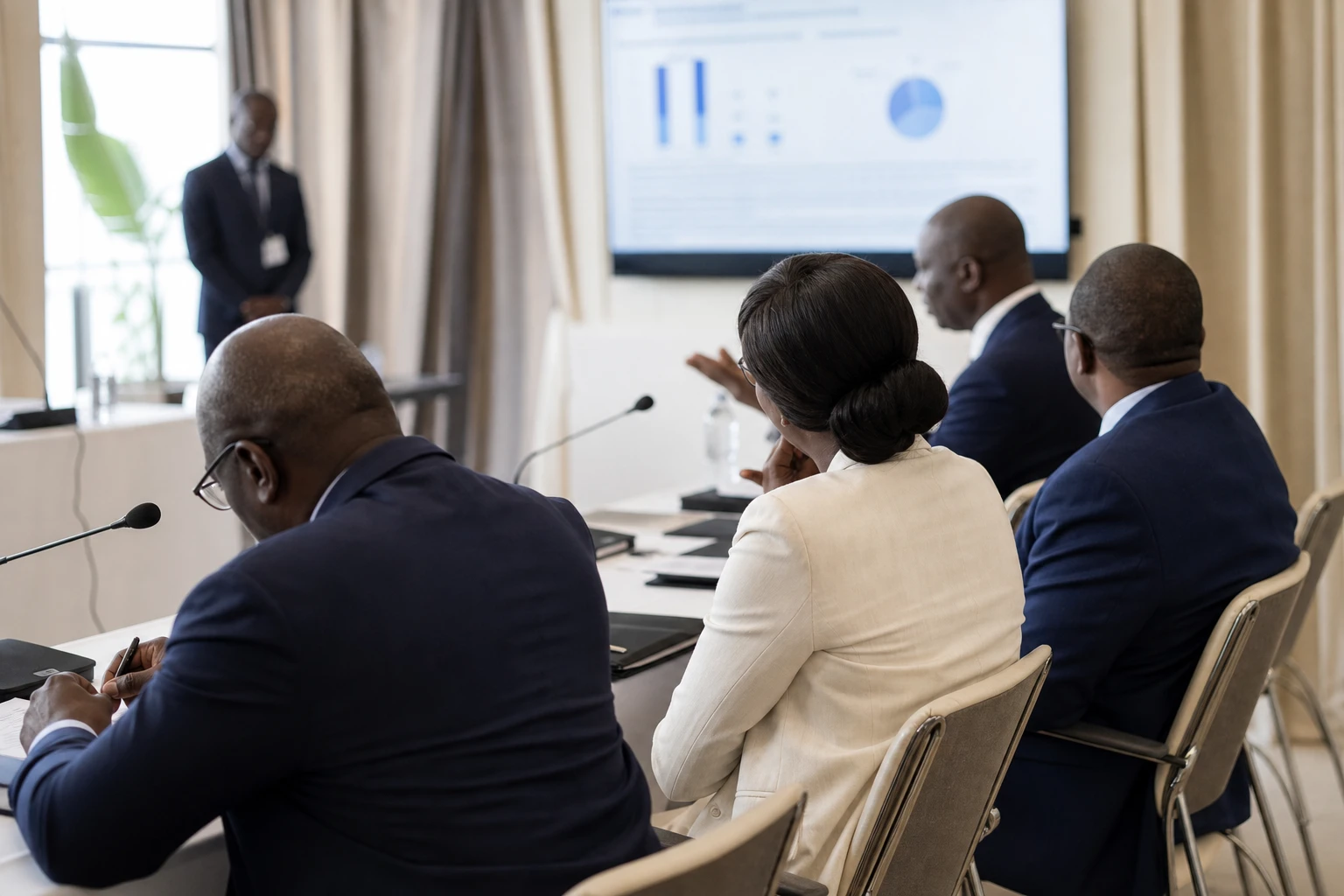
The consultative group that met on 8 and 9 July 2026 in Abidjan served as a showcase for this strategy. The government described the meeting as an opportunity to mobilise technical and financial partners, regional institutions, the private sector and civil society. Ivorian authorities said they expected about 70% of funding to come from the private sector, signalling that the state wants to share the burden with investors rather than shoulder the cost of the plan alone.
Why the AfDB is emphasising funding
The African Development Bank does not dispute Côte d’Ivoire’s momentum. It considers it strong. In its country outlook, it forecasts growth of 6% in 2025, 6.2% in 2026 and 6.5% in 2027. The institution links this growth to the expansion of the mining and oil sectors, as well as implementation of the 2026-2030 National Development Plan. It also expects inflation to remain around 3% and the risk of debt distress to remain low.
But the AfDB points to an obvious fact that good figures can sometimes obscure: growth does not automatically fund transformation. Hence its emphasis on mobilising public and private resources. Côte d’Ivoire’s plan requires domestic savings, a broader tax base, a more digital tax administration and long-term instruments capable of financing major projects. The Bank cites public-private partnerships, sovereign wealth funds, climate finance and diaspora bonds in particular.
This is central to Côte d’Ivoire. Its tax base is still considered narrow in relation to its ambitions, with a tax-to-GDP ratio below the West African Economic and Monetary Union standard. In other words, there is a gap between the level of investment envisaged and the country’s domestic capacity to finance it without relying on external capital over the long term. The credibility of the plan will be determined here.
A regional signal for West Africa
The issue extends beyond Côte d’Ivoire. The AfDB forecasts growth of 4.8% for West Africa in 2025, followed by 4.7% in 2026 and 4.5% in 2027. It highlights the role of agriculture, infrastructure investment and the expansion of mining and oil. But it also warns that this pace is not enough to reduce poverty sustainably. The message applies to several economies in the sub-region: growth is there, but the quality of funding is becoming decisive.
The context is all the more sensitive because the region’s states face a fragmented environment. Commodity-price volatility, climate impacts, geopolitical tensions and deteriorating security in the Sahel make national plans harder to assess. Against this backdrop, Côte d’Ivoire wants to be seen as an economy capable of attracting long-term capital without losing control of its fiscal trajectory. This is also a test for ECOWAS, which is watching the performance of one of its economic powerhouses.
Ultimately, the issue for Côte d’Ivoire has become continental. If the 2026-2030 National Development Plan succeeds in attracting private funding, capturing more local savings and supporting industrial transformation, it will offer a model for other African economies seeking greater room for manoeuvre. If, on the other hand, the promised funding fails to materialise, the question will not be Côte d’Ivoire’s potential, but the African model for financing development in a world where aid is dwindling and capital moves quickly.