Algeria
 Egypt
 Libya
 Morocco
 Sudan
 Tunisia
 Benin
 Burkina Faso
 Cabo Verde
 Côte d'Ivoire
 Guinea
 Guinea-Bissau
 Liberia
 Mali
 Mauritania
 Niger
 Nigeria
 Senegal
 Sierra Leone
 The Gambia
 Togo
 Cameroon
 Central African Republic
 Chad
 DR Congo
 Equatorial Guinea
 Gabon
 Republic of the Congo
 São Tomé and Príncipe
 Burundi
 Comoros
 Djibouti
 Eritrea
 Ethiopia
 Kenya
 Madagascar
 Malawi
 Mauritius
 Mozambique
 Rwanda
 Seychelles
 Somalia
 South Sudan
 Tanzania
 Uganda
 Angola
 Botswana
 Eswatini
 Lesotho
 Namibia
 South Africa
 Zambia
 Zimbabwe

Rising commodity prices do not have the same effect everywhere. For African countries that import oil and much of their food, they increase the external bill. For mining economies, by contrast, they open a window of revenue. But this windfall depends as much on prices as on governments’ ability to turn mining rents into reserves, investment and public revenue.
A favourable shock for metal producers
The latest World Bank data confirm the strength of the trend. In its monthly « Pink Sheet » series, the institution tracks movements in the main global commodity markets. Copper reached $14,474 a tonne in September 2026, up from an average of $9,947 in 2025. The metal has therefore risen by more than 45% in a year.
Gold has also moved to a new level. Its average price stood at $4,319 an ounce in September 2026. It remains well above the 2025 average of $3,442 and the 2024 average of $2,388. Aluminium and zinc are also trading at elevated levels.
This shift changes the terms of trade, meaning the relationship between the price of exports and that of imports. Countries selling copper or gold earn more for every tonne exported. However, the final outcome depends on production, mining costs, contracts and the share actually captured by the national budget.
In DR Congo, more foreign currency but mining rents to capture more effectively
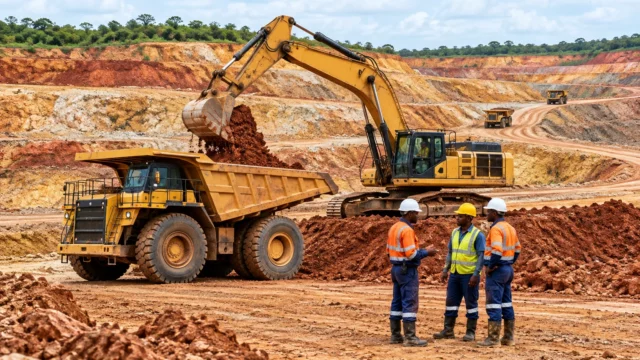
The Democratic Republic of the Congo, whose capital is Kinshasa, is at the heart of this trend. Copper and cobalt account for most of its mining exports. They also provide much of the foreign currency needed to finance imports and support the Congolese franc.
The International Monetary Fund has for several months considered mineral prices to be supporting the Congo’s external position. Its projections still assumed copper prices well below the levels seen in September 2026. The gap could therefore mechanically increase the value of exports if volumes remain stable.
This improvement gives Kinshasa more breathing room. It could strengthen international reserves, support the currency and increase tax revenue linked to the extractive sector. The IMF had already noted that the Congolese franc had been stable since the end of 2025, partly as a result of improved mining revenues.
The mechanism nevertheless has a limit. A high price does not guarantee an equivalent increase in public revenue. Mining companies deduct their operating costs. Contracts, tax regimes, reimbursements and ownership structures then determine the share that goes to the state.
DR Congo must therefore balance a rapid increase in exports against the development of a more integrated industry. The debate is no longer only about the volume extracted. It also concerns local processing, contract transparency and the ability to finance infrastructure in mining provinces.
Zambia aims to turn copper into a lasting recovery
In Lusaka, the rise in copper prices comes as the economy is still marked by its 2020 default and debt restructuring. The metal accounts for about two-thirds of Zambia’s export earnings. Price movements therefore feed through quickly to the current account, reserves and public finances.
The IMF projected a current-account surplus of about 1.7% of gross domestic product in 2026. It also estimated that a 10% fall in copper prices could be enough to turn that surplus into a deficit. The current rebound works in the opposite direction, but does not remove the vulnerability.
Zambia is targeting annual copper production of three million tonnes by 2031. To reach that goal, it needs to attract capital, secure its electricity supply and bring new capacity on stream more quickly. The IMF also highlights the importance of local processing and diversification into agro-industry, tourism and textiles.
For Zambian households, the impact of the price rise is neither immediate nor uniform. Mining regions may benefit from jobs and subcontracting contracts. In rural areas far from the Copperbelt, the gains remain more indirect. They depend on public spending, access to electricity and investment in roads.
In Ghana, gold improves the accounts but puts the budget at risk
Ghana offers another perspective on the surge in metals. In Accra, gold now accounts for more than half of exports, compared with about a fifth in 2021. Higher prices have coincided with increased production and the greater formalisation of artisanal gold mining and small-scale operations.
According to the IMF, Ghana exported about 104 tonnes of artisanal gold in 2025, worth $10.9 billion, or 9.5% of GDP. The public GoldBod scheme, set up to oversee purchases and exports, has therefore played a central role in bringing in foreign currency.
This windfall has contributed to an improvement in the current account, stronger reserves and an appreciation of the cedi. The IMF estimates that Ghana’s currency appreciated by 41% in nominal terms against the dollar in 2025. Falling inflation and improved foreign-currency liquidity have also supported macroeconomic stabilisation.
The model nevertheless comes at a cost. The public gold-buying programme has created balance-sheet risks for the Bank of Ghana. The IMF has also warned of low tax revenues from artisanal gold, smuggling and environmental damage linked to illegal mining.
The question, then, is one of governance. Centralising purchases can reduce informal outflows and improve traceability. But the scheme must disclose its costs, margins and transfers to the budget. Without such transparency, rising exports may mask limited public capture of mining rents.
The risk of a new cycle of dependence
DR Congo, Zambia and Ghana are not the only African countries benefiting from current prices. South Africa, Mali and Burkina Faso are also gaining from strong gold prices, with varying effects depending on their volumes, tax regimes and institutional stability.
The contrast is sharper with importers of oil and food products. For them, the commodity-price surge makes transport, electricity and basic goods more expensive. Central banks must then contain inflation, while governments seek to protect households without worsening their deficits.
For mining producers, the main challenge is to avoid becoming more dependent on prices they do not control. Higher prices can finance infrastructure, strengthen reserves and ease pressure on debt. They can also delay reforms if revenues appear easy to obtain.
The next stage will therefore be decisive. Investors will watch copper production in DR Congo and Zambia. Markets will track Ghana’s ability to make GoldBod sustainable. Populations, meanwhile, will judge the impact above all on jobs, prices and public services. That is the measure by which the true scale of the mining windfall will be judged.