Algeria
 Egypt
 Libya
 Morocco
 Sudan
 Tunisia
 Benin
 Burkina Faso
 Cabo Verde
 Côte d'Ivoire
 Ghana
 Guinea
 Guinea-Bissau
 Liberia
 Mali
 Mauritania
 Niger
 Nigeria
 Senegal
 Sierra Leone
 The Gambia
 Togo
 Cameroon
 Central African Republic
 Chad
 Equatorial Guinea
 Gabon
 Republic of the Congo
 São Tomé and Príncipe
 Burundi
 Comoros
 Djibouti
 Eritrea
 Ethiopia
 Kenya
 Madagascar
 Malawi
 Mauritius
 Mozambique
 Rwanda
 Seychelles
 Somalia
 South Sudan
 Tanzania
 Uganda
 Angola
 Botswana
 Eswatini
 Lesotho
 Namibia
 South Africa
 Zambia
 Zimbabwe
When return becomes a question of security
For thousands of Congolese families who have lived in Tanzania for years, return is not just a matter of distance. It is first and foremost a question of the route, their home village, security and dignity.
In the east of the Democratic Republic of the Congo, those reference points remain fragile. Fighting, forced displacement and changes in local control continue to influence refugees’ choices, well beyond diplomatic announcements.
The tripartite meeting held in Lubumbashi, in Haut-Katanga, therefore addressed a question that seems simple on the surface: how to organise voluntary returns without sending people back to areas still exposed to violence. The answer is more complex than a timetable.
As of 31 March 2026, the United Nations system counted 87,163 Congolese refugees in Tanzania. Most live in the Kigoma area, including Nyarugusu, one of the country’s main camps.
A humanitarian issue tied to the war in the Kivus
The issue of Congolese refugees in Tanzania cannot be separated from the security crisis in eastern DR Congo. Since the conflict escalated in North Kivu and South Kivu, people have continued to flee to neighbouring countries. UNHCR says the situation in the east of the country has led to new displacement and affected several countries of asylum in the region.
Human Rights Watch, for its part, documented arbitrary detentions, killings and forced recruitment by M23 and the Rwandan Defence Forces in eastern Congo in June 2026, confirming that return to some areas remains a delicate matter.
In this context, UNHCR’s caution is consistent with its usual policy: return must remain voluntary, informed and safe. The agency says repatriation is not encouraged to areas considered dangerous, including Ituri, North Kivu and South Kivu.
Tanzania, meanwhile, remains an important host country in the Great Lakes region. UNHCR data show that it still hosts a substantial refugee population, concentrated mainly in the north-west, with Nyarugusu as a focal point.
What was decided in Lubumbashi
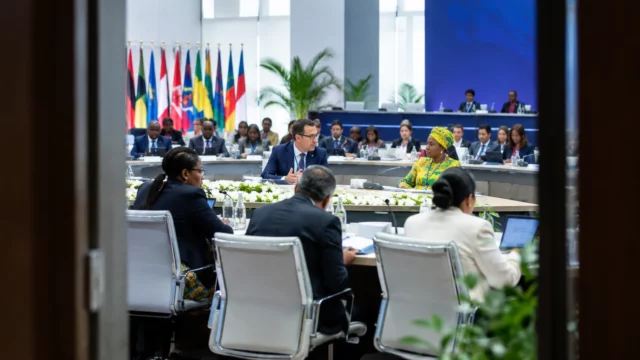
The eighth meeting of the DRC-Tanzania-UNHCR Tripartite Commission opened in Lubumbashi on 25 August 2026. It brought together experts from the three parties to establish a roadmap for the voluntary repatriation of Congolese refugees living in Tanzania.
The aim is to clarify several very practical points: possible return areas, mechanisms for informing refugees, and arrangements for transport, reception and follow-up after arrival. At this stage, no precise timetable has been announced.
The Congolese government, through the Ministry of the Interior, says it wants to work with Tanzania and UNHCR to support compatriots who wish to return. It stresses the need to find a «safe and secure» place of return, either their place of origin or another settlement site. This caution matters: it is a reminder that return is not simply an administrative move.
Tanzania, for its part, reaffirmed that it would continue to offer hospitality to those who are not ready to return. This position extends a tradition of welcoming refugees already highlighted by UNHCR, while keeping pressure on the funding needed to provide support.
What return would mean for families and the Congolese state
For refugees, the stakes are twofold. They want to rebuild a normal life, while avoiding a premature return to localities where basic services remain weak and front lines are shifting. In eastern Congo, a family’s return only makes sense if it can last.
For Kinshasa, the issue is as political as it is humanitarian. Organising voluntary returns allows the state to show that it looks after its citizens beyond its borders. But it also forces the authorities to answer the central question: when will the areas people come from actually be secure?
The Congolese authorities face a familiar balance of forces in the Great Lakes region. On one side, humanitarian pressure pushes for returns to be accelerated. On the other, realities on the ground mean repatriation must not be confused with a lasting solution. This is where coordination with UNHCR remains crucial.
Funding will also be decisive. For several months, UNHCR has stressed that needs arising from the situation in Congo extend to several countries in the region, including Tanzania, and that resources remain under pressure. Without sufficient support, the roadmap risks becoming just another working document.
A regional process to watch
This issue extends beyond the Lubumbashi-Kigoma axis. It is part of a broader round of discussions on refugees, voluntary returns and stability in the Great Lakes region. In June 2026, the DRC had already made progress on a tripartite roadmap with Rwanda and UNHCR for voluntary repatriation and reintegration. Work on returns is therefore taking shape at several levels.
This process says something broader about Central and East Africa: security crises do not stop at borders, and neither do solutions. The Tripartite Commission, the governments concerned and UNHCR will now have to turn principles into verifiable steps, with serious monitoring of return areas and reintegration.
For Congolese people in Kinshasa and in the east, the real question remains the same: can return once again become a life choice rather than a risk? As long as the answer remains uncertain, the roadmap will depend on developments on the ground in North Kivu, South Kivu and the other affected provinces.