Algeria
 Egypt
 Libya
 Morocco
 Sudan
 Tunisia
 Benin
 Burkina Faso
 Cabo Verde
 Côte d'Ivoire
 Ghana
 Guinea
 Guinea-Bissau
 Liberia
 Mali
 Mauritania
 Niger
 Nigeria
 Senegal
 Sierra Leone
 The Gambia
 Togo
 Cameroon
 Central African Republic
 Chad
 DR Congo
 Equatorial Guinea
 Gabon
 Republic of the Congo
 São Tomé and Príncipe
 Burundi
 Comoros
 Djibouti
 Eritrea
 Ethiopia
 Kenya
 Madagascar
 Malawi
 Mauritius
 Mozambique
 Rwanda
 Seychelles
 Somalia
 South Sudan
 Tanzania
 Angola
 Botswana
 Eswatini
 Lesotho
 Namibia
 South Africa
 Zambia
 Zimbabwe
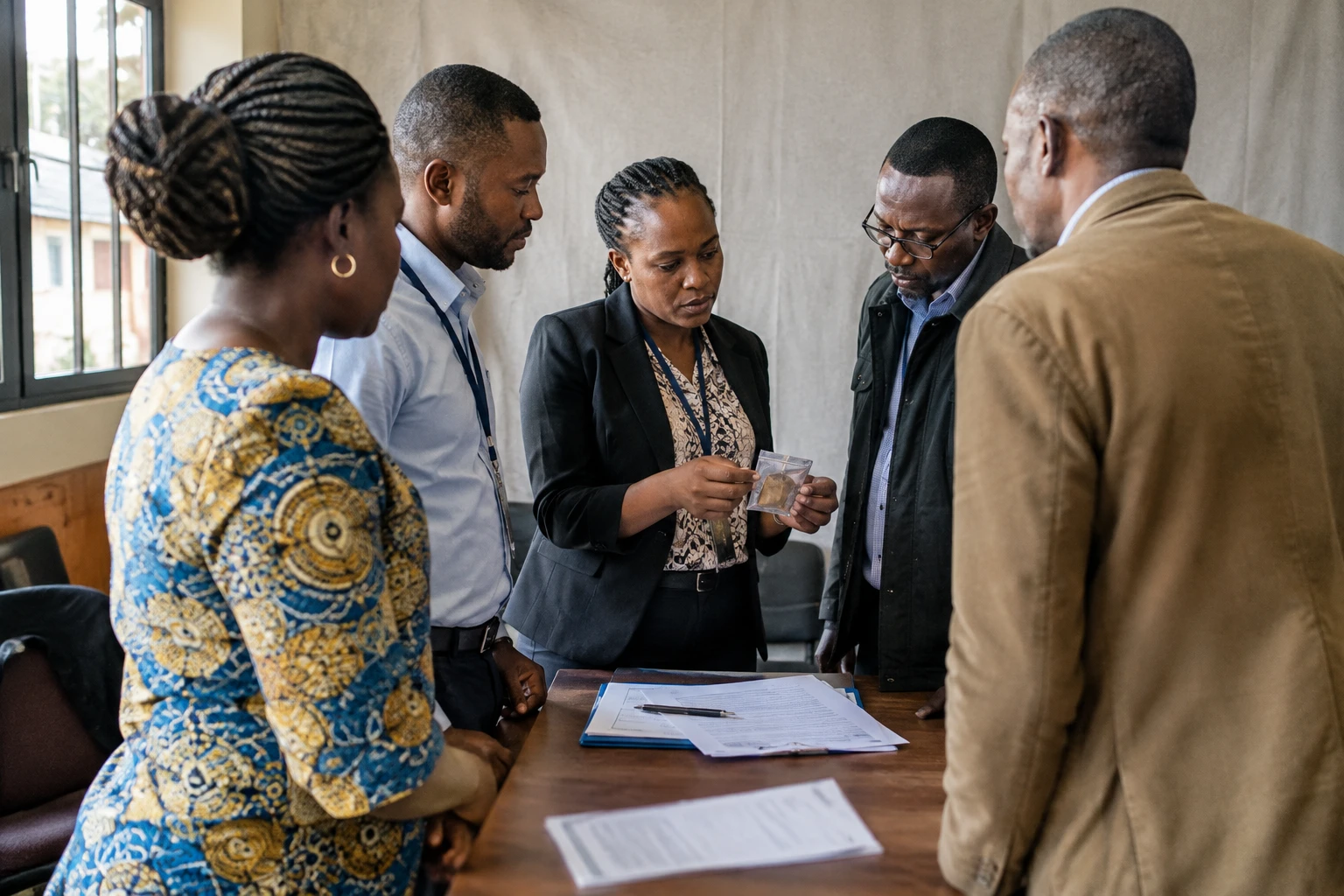
A gram of gold mined in a rural area of North Kivu can change hands several times before being refined in Uganda. At each stage, its value rises; its origin, meanwhile, can become harder to establish. For Congolese communities, the stakes go beyond trade: they concern security, local incomes and control of resources.
A trade route that crosses borders
The Democratic Republic of the Congo shares with Uganda a border where trade, security operations and mineral flows intersect. The DRC belongs to the East African Community (EAC), which facilitates economic integration between neighbouring countries, and the Southern African Development Community (SADC). These regional frameworks make cross-border traceability particularly important: effective oversight cannot stop at the Congolese border.
Artisanal gold from eastern Congo enters buying and transport networks linking mining areas to commercial towns, then to Ugandan refineries. An investigation published on 27 October 2026 by the investigative organisation The Sentry describes, in particular, a corridor between Manguredjipa, Mambasa and Bafwasende, in North Kivu, Ituri and Tshopo. The evidence it presents is based on interviews and documents examined by its investigators; it is not an exhaustive record of all regional exports.
The trend extends beyond the mining sector. The DRC is seeking to strengthen its integration into regional markets, while armed groups remain active in several eastern provinces. Military operations can displace their networks without dismantling them. In this context, local economic activities — including gold mining — can become sources of income and influence.
What the figures show — and their limits
Uganda has established itself as a refining and trading hub. According to figures from Uganda’s Ministry of Finance, its gold exports reached $889 million in August 2026, nearly 60% of the month’s merchandise exports. The reported annual increase was 68.9%. Ugandan media outlet Daily Monitor also reported these data, citing central bank figures. This measures the value exported from Uganda, not the origin of the metal.
According to The Sentry, the sites studied around Manguredjipa produce about 800 kilograms of gold a year. The organisation estimates that the ADF could derive between $1 million and $1.6 million a year from it. This is an estimate, based on assumed volumes, margins and levies, rather than revenue directly observed in the group’s accounts. Nor do these local figures make it possible to calculate the share of Congolese gold in Ugandan exports.
The investigation describes successive stages involving traders in Manguredjipa, trading houses in Butembo and refineries in Uganda, before resale to international markets. To illustrate changes in margins, it reports prices recorded on 22 January 2026: about $123 a gram in Manguredjipa, $131 in Butembo and then $138 at Ugandan refineries. Dubai-based operators reportedly paid between $147 and $150. These isolated observations do not describe all transactions or current prices.
The same investigation reports that at least 30 of the 54 gold buyers still active in Manguredjipa in March 2026 were, according to information gathered, buying metal from sites under the influence of the ADF or other armed groups. This is an allegation attributed to the investigators, not a judicial finding against each of these traders. Traceability mechanisms can be circumvented, The Sentry says, particularly when gold from different sources is mixed.
For miners, traders and residents
In the Bapere sector, in Lubero territory, The Sentry identifies several gold sites, including Botambisi, Lata Bien, Mapendano and Mabuo. At Botambisi, the number of miners reportedly fell from about 3,000 to 350 between October 2025 and January 2026, after the ADF arrived. Production there is still estimated at five kilograms a week. Congolese specialist media outlet Mines.cd has reproduced these figures from the report. They describe a reported local situation, not all mining activity in North Kivu.
For residents, the presence of an armed group can restrict movement, disrupt access to sites and reduce opportunities to work or sell legally. Miners are exposed to coercion; legal traders risk becoming entangled in opaque supply chains, deliberately or otherwise. And when sales bypass official channels, the Congolese state loses visibility over volumes and tax revenues. The proceeds can also help fund armed actors.
The ADF, an armed group of Ugandan origin affiliated with Islamic State, now reportedly derives a major share of its resources from gold, according to the investigation. The Sentry estimates that this activity contributes to its financial autonomy, alongside cocoa, kidnappings and extortion. This does not mean that every transaction in the region funds the group: it highlights specific routes described by the investigators, whose full extent remains difficult to measure.
Responsibility does not stop at the mine
The case highlights a regional problem: production can be Congolese, while purchasing, refining and exporting take place across the border. The commercial success of Uganda’s gold sector does not, by itself, prove an illicit origin. But it makes controls capable of verifying the metal’s origin and the intermediaries handling it essential.
For Kinshasa, the challenge is to regulate artisanal gold more effectively without pushing miners into even less visible channels. For Kampala and refining operators, it is a matter of checking suppliers and documenting purchases. Traders, transporters and international buyers also have a role: credible traceability must follow the metal to its destination, not merely certify its last point of passage.
The DRC has been a member of the EAC since 2022 and of SADC since 1998. These two organisations provide frameworks for regional co-operation, but the movement of goods alone is not enough to prevent the laundering of minerals’ origins. What happens next will depend on the ability of the authorities in both countries to share information, monitor supply chains and protect civilians without further undermining local livelihoods.