Algeria
 Egypt
 Libya
 Morocco
 Sudan
 Tunisia
 Benin
 Burkina Faso
 Cabo Verde
 Côte d'Ivoire
 Ghana
 Guinea-Bissau
 Liberia
 Mali
 Mauritania
 Niger
 Nigeria
 Senegal
 Sierra Leone
 The Gambia
 Togo
 Cameroon
 Central African Republic
 Chad
 DR Congo
 Equatorial Guinea
 Gabon
 Republic of the Congo
 São Tomé and Príncipe
 Burundi
 Comoros
 Djibouti
 Eritrea
 Ethiopia
 Kenya
 Madagascar
 Malawi
 Mauritius
 Mozambique
 Rwanda
 Seychelles
 Somalia
 South Sudan
 Tanzania
 Uganda
 Angola
 Botswana
 Eswatini
 Lesotho
 Namibia
 South Africa
 Zambia
 Zimbabwe
Conakry’s airport moves up a gear
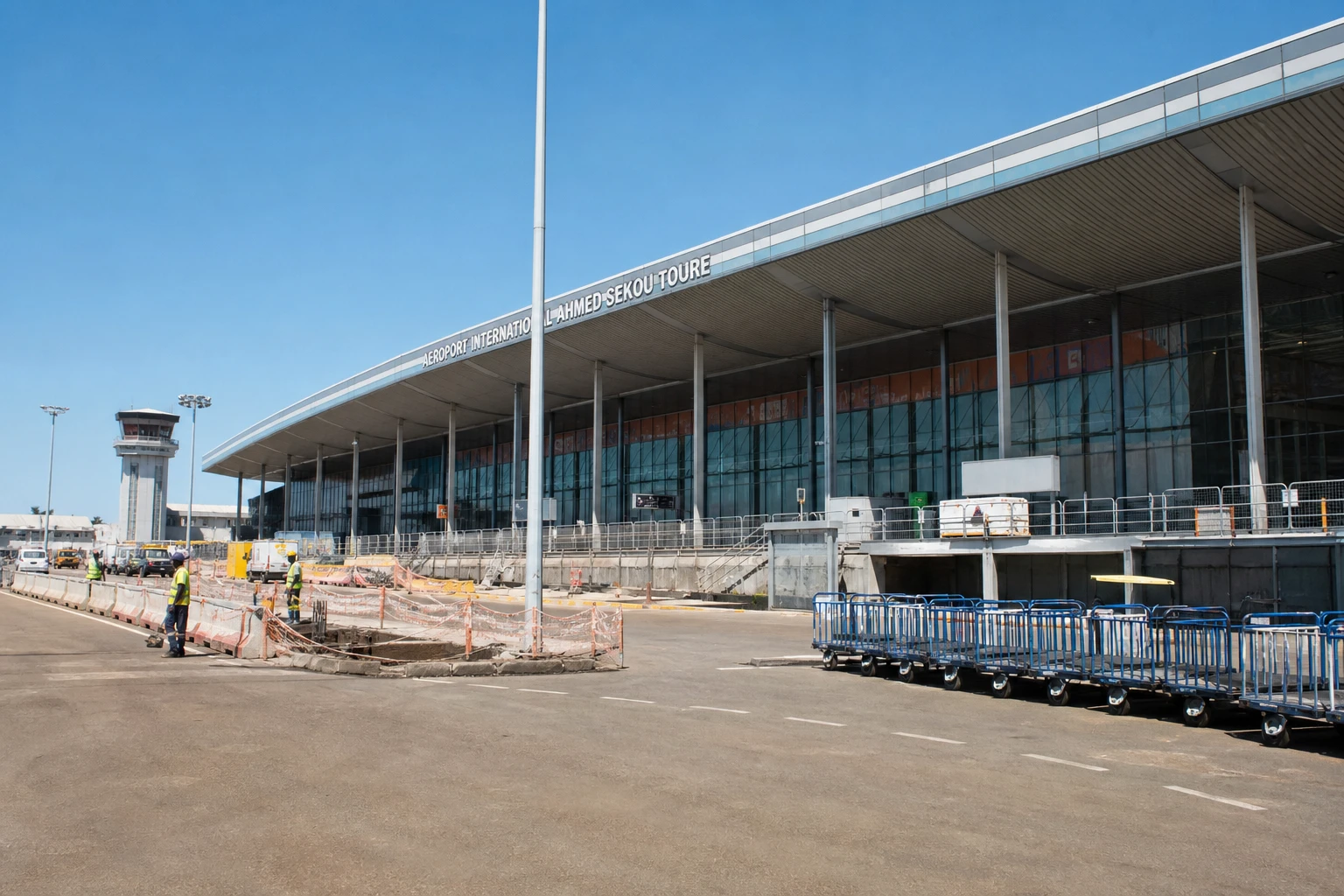
In Conakry, flying is no longer just a way to reach the region or Europe. It is also becoming an indicator of the role Guinea wants to play in West African trade. When an airport approaches one million passengers a year, the question is no longer simply how many tickets are sold. It concerns a country’s ability to handle flows, process freight and provide reliable services.
This expansion is taking place as Guinea pursues the trajectory set out in the Simandou 2040 programme, which the authorities present as a framework for long-term economic transformation. The modernisation of Ahmed Sékou Touré International Airport is part of this strategy. Conakry is seeking to improve links between its capital and the rest of West Africa, as well as more distant markets. In a sub-region undergoing political realignments, air connectivity is becoming a strategic asset as well as a tool for growth.
Figures rising month after month
Data published by the Guinea Airports Management Company show a clear increase in traffic at Conakry. In the first half of 2026, the airport handled 545,330 passengers, compared with 446,335 over the same period in 2025, an increase of 22.18%. Domestic traffic grew even faster, with 35,596 passengers compared with 21,708 a year earlier. In May and June, passenger numbers each exceeded the 100,000 mark, reaching 101,830 and 101,888 respectively.
This trend continues a movement already evident in 2025. The airport ended the year with 957,820 passengers, compared with 788,879 in 2024, according to official figures for the airport. In 2023, traffic stood at 742,123 passengers. In other words, the growth is not an isolated surge. It is becoming sustained. At this rate, the symbolic one-million-a-year mark is within reach if traffic remains strong in the second half of the year.
Freight is following the same trajectory. In the first six months of 2026, 4,973 tonnes of goods were handled, compared with 4,115 tonnes a year earlier, an increase of 20.85%. This, too, is significant. An airport carrying more passengers and more freight is responding not only to demand for mobility. It is becoming a logistics link for imports, exports and nearby trade.
Infrastructure under pressure, with expectations high
The increase comes as work is under way on the infrastructure. Guinean authorities have confirmed the expansion and modernisation of Ahmed Sékou Touré International Airport, with one phase of work already under way in 2025, followed by further stages in 2026. The project aims to raise the airport’s capacity to 1.5 million passengers a year, or even more, according to the most ambitious projections cited by public agencies and project partners.
The details matter. When an airport grows faster than its facilities, the smooth flow of passengers and goods becomes vulnerable. Queues, baggage handling, aircraft parking, security checks and the movement of goods then take on immediate economic significance. In Conakry, the challenge is therefore not simply to accommodate more travellers. It is also to prevent rising traffic from leading to delays, additional costs or a poorer passenger experience.
The authorities place this project within the broader narrative of Simandou 2040, which brings together infrastructure, connectivity and economic transformation. The Ministry of Transport has itself linked several major projects to this roadmap. The logic is clear: if Guinea wants to attract more investment and better integrate its economy into regional corridors, it must strengthen its gateways. Conakry airport is a shop window, but also an operational hub.
An economic stake for Guinea, a signal for West Africa
For travellers, rising traffic could mean more routes, greater frequency and a clearer transport offer. For businesses, it opens up a different prospect: better access to neighbouring markets, supply chains and high-value freight flows. For the state, finally, a busier airport could bolster the image of a capital reclaiming its place as a regional gateway.
But the impact will not be the same everywhere. In Conakry, the effects will first be felt in services, logistics, hospitality, urban transport and jobs linked to cargo handling. In the rest of the country, the benefits will depend above all on the ability to strengthen domestic connections. The rise in domestic traffic in the first half of 2026 shows that this segment is beginning to gain ground. That is a useful signal for an economy in which travel between the capital and the regions remains a practical challenge.
The regional dimension matters just as much. West Africa remains an area of intense mobility, but also of competition between hubs. Dakar, Abidjan, Lomé and Accra already occupy strong positions in air traffic. Conakry is seeking to establish itself alongside them, drawing on its own strengths, within an ECOWAS still marked by political tensions but remaining Guinea’s main framework for integration. The stability of routes, procedures and investment will therefore matter as much as the raw number of passengers.
The next phase will play out on two fronts. One is the effective completion of the modernisation work and the commissioning of suitable equipment. The other is the ability to sustain steady traffic growth without congesting the airport. If both conditions are met, Conakry airport will be able to move beyond its status as a purely national infrastructure project. It will then become a more robust instrument for Guinea’s economic ambitions and a platform for its regional aspirations.