Algeria
 Egypt
 Libya
 Morocco
 Sudan
 Tunisia
 Benin
 Burkina Faso
 Cabo Verde
 Côte d'Ivoire
 Ghana
 Guinea
 Guinea-Bissau
 Liberia
 Mali
 Mauritania
 Niger
 Nigeria
 Sierra Leone
 The Gambia
 Togo
 Cameroon
 Central African Republic
 Chad
 DR Congo
 Equatorial Guinea
 Gabon
 Republic of the Congo
 São Tomé and Príncipe
 Burundi
 Comoros
 Djibouti
 Eritrea
 Ethiopia
 Kenya
 Madagascar
 Malawi
 Mauritius
 Mozambique
 Rwanda
 Seychelles
 Somalia
 South Sudan
 Tanzania
 Uganda
 Angola
 Botswana
 Eswatini
 Lesotho
 Namibia
 South Africa
 Zambia
 Zimbabwe
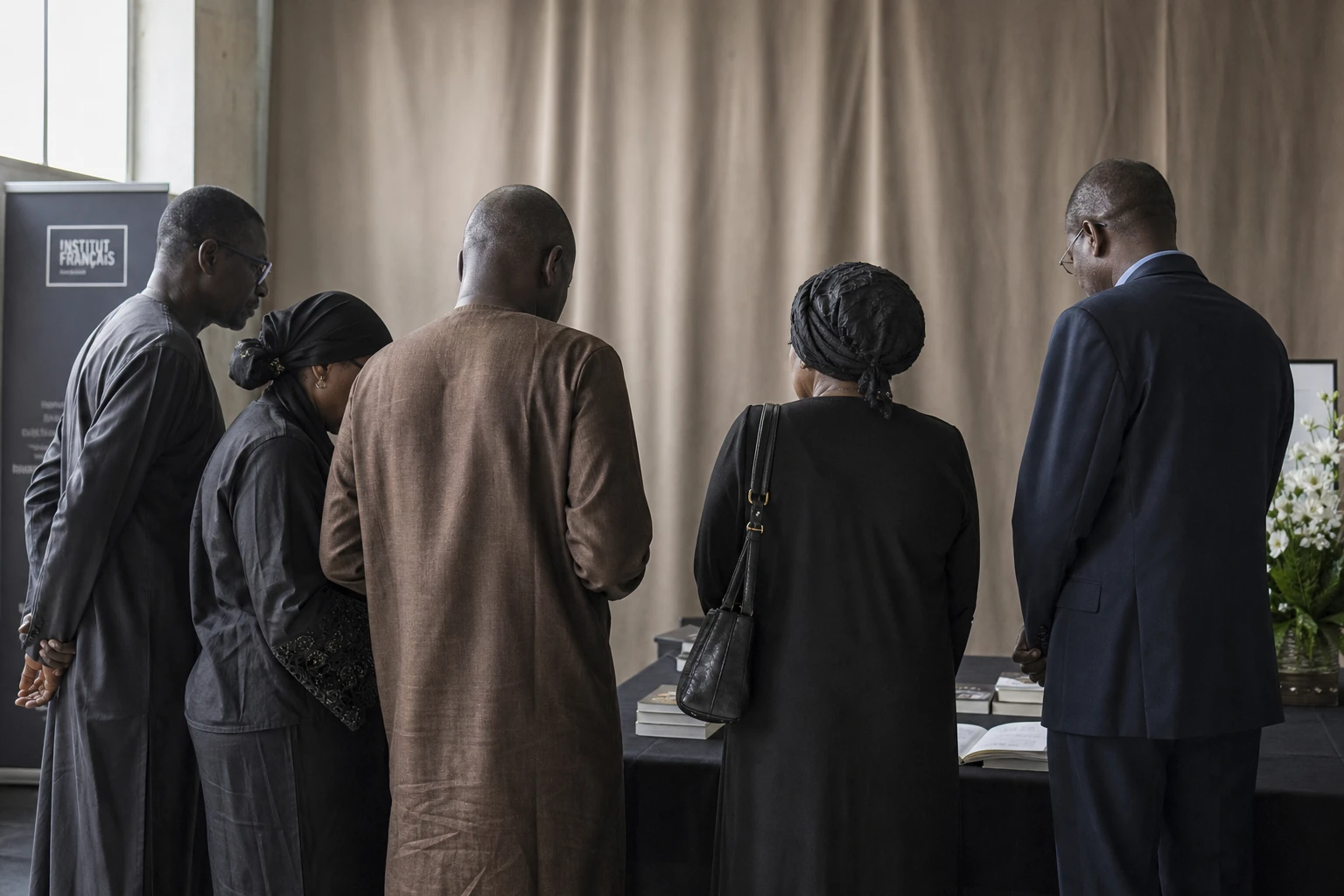
In Dakar, the death of Cheikh Hamidou Kane has prompted a moment of remembrance for several generations of African readers. For more than six decades, his work has engaged with a question that remains pressing: how can we learn from the world without losing our connection to ourselves?
A death that touches Senegal far beyond literary circles
The Senegalese writer died in Dakar at the age of 98. The news was reported on Sunday 4 October 2026 by the Senegalese Press Agency and Senegalese Radio and Television Broadcasting. According to the APS, he died on Saturday evening. Senegalese authorities and several prominent figures quickly paid tribute to a major figure in the country’s intellectual life.
President Bassirou Diomaye Faye paid tribute to an author whose thought, he said, belongs to the heritage of Senegal and all of Africa. The head of state highlighted in particular the tension between openness to the world’s knowledge and the preservation of a distinct identity. This reading sums up the special place Cheikh Hamidou Kane occupies in French-language African literature.
His career, however, extended beyond literature. Born on 2 April 1928 in Matam, in north-eastern Senegal, he attended Quranic school, received a French education and went on to study in France. He studied law and philosophy before joining the civil service and senior public administration.
A novel that became a compass for generations
Published in 1961, Ambiguous Adventure tells the story of Samba Diallo, a young man confronted with two worlds of education. On one side is the spiritual and philosophical teaching of his community. On the other are the methods and promises of Western schooling.
The novel does not reduce this encounter to a simple opposition between a traditional Africa and a modern West. Instead, it describes an inner turmoil. Knowledge can liberate, but it can also create distance. Modernity can broaden horizons without answering every human question.
This complexity explains the book’s longevity. Awarded the Grand Prix littéraire d’Afrique noire in 1962, it has become a classic studied in Senegal, several African countries and universities abroad. Its protagonist continues to speak to young readers grappling with mobility, overseas study, new technologies and the rapid transformation of their societies.
The book also helped establish in literary debate an African voice that did not demand a choice between heritage and knowledge. Cheikh Hamidou Kane argued for an active appropriation of knowledge. The point was not to reject the outside world, but to approach it with discernment.
A life spanning literature, government and African cooperation
After this first novel, Cheikh Hamidou Kane gave priority to public service for many years. He held administrative and government posts in Senegal, notably under the presidencies of Léopold Sédar Senghor and Abdou Diouf.
He also worked for Unicef, the United Nations agency devoted to children. In this role, he helped lead initiatives in several sub-Saharan African countries. The experience brought him into contact with different national realities, beyond a vision confined to Dakar or a single cultural tradition.
This career gives his work particular depth. Cheikh Hamidou Kane was not merely a writer observing change in Africa. He also helped shape it through public administration, cooperation and public policy. His path thus connected thought, decision-making and experience on the ground.
In 1995, he published The Guardians of the Temple, his second novel. The book extended the first novel’s questions about the continent’s political, social and cultural upheavals. The long silence between the two works was therefore not a withdrawal from African life. It also coincided with a period of professional and institutional commitment.
Ideas that resonate in contemporary Africa
Cheikh Hamidou Kane’s death comes at a time when Senegal is once again questioning its relationship with history, sovereignty and development models. The country remains an important player in the Economic Community of West African States, or ECOWAS, an organisation seeking to co-ordinate economic integration and regional stability.
In West Africa, where education, the movement of skilled workers, languages and institutional legacies are all subjects of debate, the writer’s questions remain relevant. How can citizens be equipped to master science and technology without devaluing local knowledge? How can societies engage with one another without defining themselves solely through the eyes of others?
These questions also concern Senegalese people living abroad. Student and professional mobility is deepening exchanges between Dakar, other African capitals, Europe, North America and the Middle East. It creates opportunities, but also raises questions about cultural transmission and the return of skills.
Cheikh Hamidou Kane’s significance lies precisely in his ability to transcend his era. His work does not portray Africa as a frozen space. It depicts societies that make choices, debate, resist, borrow and transform. It also reminds us that identity is not a fortress. It is built through movement, provided that those who live it remain in control of it.
A legacy to pass on, not merely celebrate
The tributes paid in Dakar highlight an essential aspect of his career: Cheikh Hamidou Kane refused to separate culture from public responsibility. For him, writing, public administration and service to the community all demanded the same clear-sightedness.
His legacy is therefore measured in libraries and classrooms, as well as in debates about the continent’s future. It belongs to readers rediscovering Samba Diallo, teachers explaining the novel and those seeking a path between international openness and self-affirmation.
In Dakar and across other parts of French-speaking Africa, the writer’s death leaves behind a body of work small in the number of novels, but vast in the questions it continues to raise. Cheikh Hamidou Kane is gone. His dialogue with the world remains open.