Algeria
 Egypt
 Libya
 Morocco
 Sudan
 Tunisia
 Benin
 Burkina Faso
 Cabo Verde
 Côte d'Ivoire
 Ghana
 Guinea
 Guinea-Bissau
 Liberia
 Mali
 Mauritania
 Niger
 Nigeria
 Senegal
 Sierra Leone
 The Gambia
 Togo
 Cameroon
 Central African Republic
 DR Congo
 Equatorial Guinea
 Gabon
 Republic of the Congo
 São Tomé and Príncipe
 Burundi
 Comoros
 Djibouti
 Eritrea
 Ethiopia
 Kenya
 Madagascar
 Malawi
 Mauritius
 Mozambique
 Rwanda
 Seychelles
 Somalia
 South Sudan
 Tanzania
 Uganda
 Angola
 Botswana
 Eswatini
 Lesotho
 Namibia
 South Africa
 Zambia
 Zimbabwe
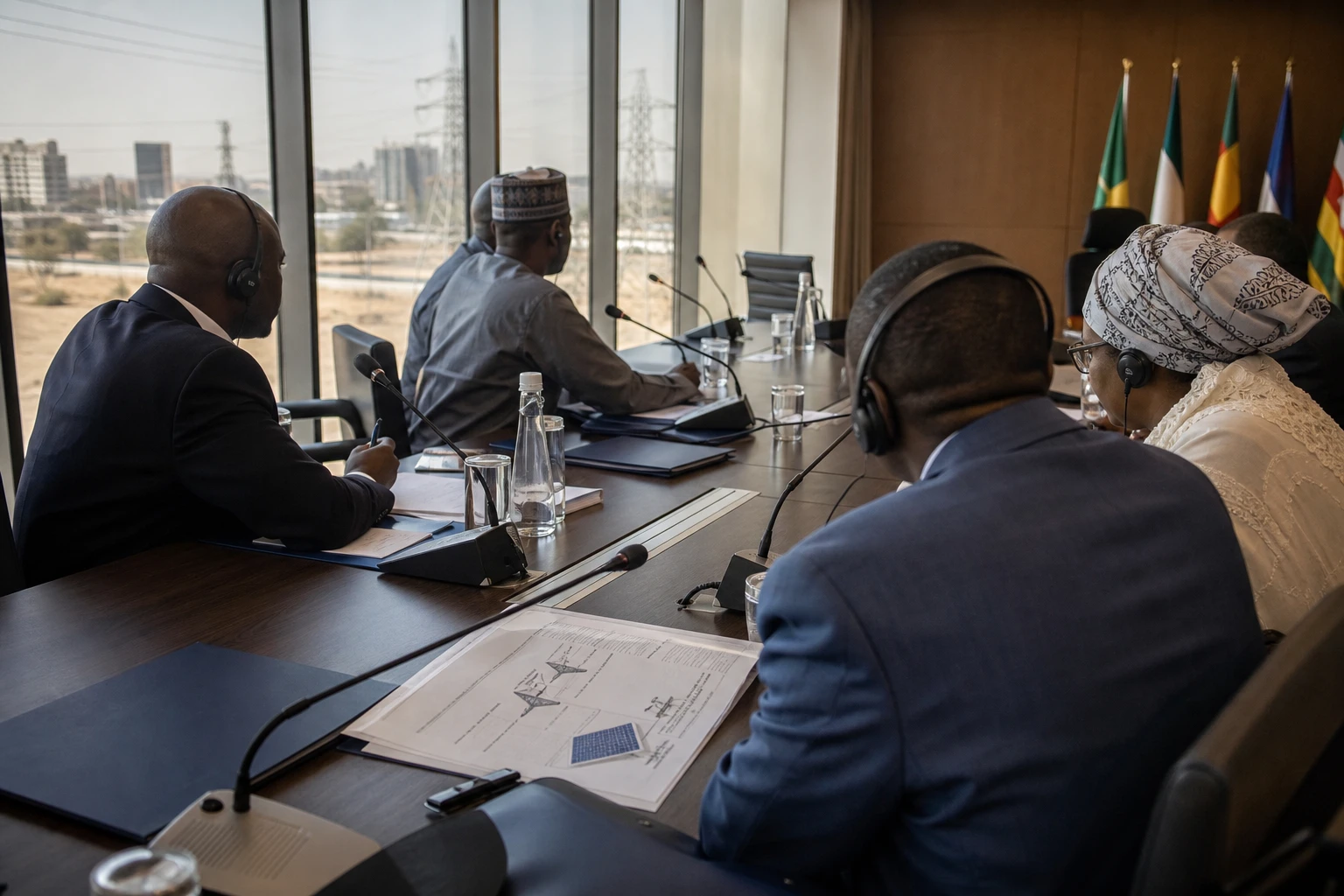
In N’Djamena, the challenge is not simply to install solar panels. It is to make electricity supply more reliable in a city where demand is rising rapidly, while reducing dependence on thermal power generators. The financial close of two hybrid power plants at Gassi and Lamadji marks a new stage for Chad’s electricity system.
Two power plants on the outskirts of N’Djamena
On 25 September 2026, the African Development Bank Group (AfDB) announced the financial close and first disbursement for projects developed by Qair in Chad. The two facilities will be located at Gassi, in the 7th arrondissement, and Lamadji, in the 10th, near the capital.
Together, they are expected to provide 30 megawatt-peak (MWp) of photovoltaic capacity. This unit measures the theoretical maximum output of panels under standard sunlight conditions. The plants will also have an 8 megawatt-hour (MWh) battery storage system.
The batteries are intended to store some of the electricity generated during favourable periods, then help stabilise the amount fed into the grid. This is important in a city where production and consumption do not always coincide, particularly during peak demand.
The facilities will be connected to N’Djamena’s 90-kilovolt electricity loop. Their output is to be sold under a 20-year power purchase agreement with Tchadelec, the national operator responsible for running the grid.
Qair also describes the plants as projects that will be built and operated before being transferred to the Chadian state under a BOOT-type contract. This mechanism allows a private operator to finance and run infrastructure before its planned transfer to the public authorities.
Financing designed to reduce risk
The financing package is worth €37.9 million. It brings together several instruments and partners. The AfDB and Proparco, a subsidiary of the French Development Agency focused on the private sector, are providing loans, among other contributions. The Sustainable Energy Fund for Africa (SEFA), managed by the AfDB, is complementing the operation with concessional financing.
The Green Climate Fund is also involved in the package. An €8 million partial risk guarantee, jointly provided by the African Development Fund and the Green Climate Fund, is intended to support the letter-of-credit mechanism linked to payments by Tchadelec.
This structure addresses a central challenge in fragile electricity markets: a project may be technically viable without being sufficiently secure to attract private lenders. The guarantee does not eliminate risk. However, it reduces financiers’ exposure when the public buyer faces cash-flow pressures or operational constraints.
The package illustrates the role of blended finance. Loans, repayable grants and public guarantees are combined to make investment possible in a sector where revenues remain sensitive to tariff levels, grid quality and customers’ ability to pay.
One part of Chad’s energy reform
The project comes as N’Djamena’s grid is being strengthened. In May 2025, Chadian authorities launched work linked to the Gassi, Lamadji and Klessoum power plants, as well as the rehabilitation and expansion of the capital’s grid. High-voltage connections and substations are essential to turn generation capacity into electricity that is actually distributed.
The grid is critical. An additional solar plant is not enough if lines are overloaded, substations lack capacity or connections remain limited. Investment in generation must therefore go hand in hand with spending on transmission, distribution and maintenance.
The project is also part of a broader national programme. The Chad Energy Access Scale-up Project aims, among other things, to expand N’Djamena’s grid, develop mini-grids in several secondary cities and deploy off-grid solar systems in rural areas and communities hosting refugees.
The impact will therefore vary between regions. In the capital, the expected improvement is primarily in service continuity for households, shops, public services and small businesses. In secondary cities and rural areas, access will depend more on mini-grids or off-grid systems, with different connection and maintenance challenges.
For formal-sector businesses, a more stable power supply could reduce reliance on generators and fuel costs. For informal businesses, the outcome will depend above all on the final price of electricity and the grid’s ability to reach outlying neighbourhoods. Additional generation alone therefore does not guarantee an immediate reduction in bills.
From Chad to the Sahel
The AfDB links the Gassi and Lamadji plants to two continental initiatives. The first, Desert to Power, aims to develop solar power on a large scale in Sahel countries. The second, Mission 300, seeks to accelerate access to electricity for 300 million Africans by 2030, by mobilising governments, financial institutions and private investors.
Chad occupies a particular position in this strategy. The country has significant solar potential, but its grid remains concentrated around a few urban centres. The project’s success will therefore depend as much on building the plants as on integrating them into the national electricity system and extending connections.
The regional dimension also involves the Central African Economic and Monetary Community (CEMAC), which includes Chad, Cameroon, the Central African Republic, the Republic of the Congo, Equatorial Guinea and Gabon. Electricity exchanges between CEMAC countries remain limited, but diversifying sources of generation could eventually strengthen discussions on interconnecting grids.
The next measure will be the actual delivery of the work: the construction schedule, connection to N’Djamena’s loop, commissioning and real availability levels. It will also be important to monitor Tchadelec’s ability to honour the power purchase agreement and the authorities’ ability to extend connections beyond areas already served.
The first disbursement therefore marks an important step, but not the completion of the project. For Chadians, the most tangible measure will be the quality of the electricity available to homes and businesses. For regional partners, the operation will be a test of a model’s ability to turn complex financing into a reliable electricity service.
For more detailed technical information on the project, the African Development Bank, Proparco and Qair in Chad have published further information on financing, grid connections and the infrastructure timetable.