Algeria
 Egypt
 Libya
 Morocco
 Sudan
 Tunisia
 Benin
 Burkina Faso
 Cabo Verde
 Côte d'Ivoire
 Ghana
 Guinea
 Guinea-Bissau
 Liberia
 Mali
 Mauritania
 Niger
 Nigeria
 Senegal
 Sierra Leone
 The Gambia
 Togo
 Cameroon
 Central African Republic
 DR Congo
 Equatorial Guinea
 Gabon
 Republic of the Congo
 São Tomé and Príncipe
 Burundi
 Comoros
 Djibouti
 Eritrea
 Ethiopia
 Kenya
 Madagascar
 Malawi
 Mauritius
 Mozambique
 Rwanda
 Seychelles
 Somalia
 South Sudan
 Tanzania
 Uganda
 Angola
 Botswana
 Eswatini
 Lesotho
 Namibia
 South Africa
 Zambia
 Zimbabwe
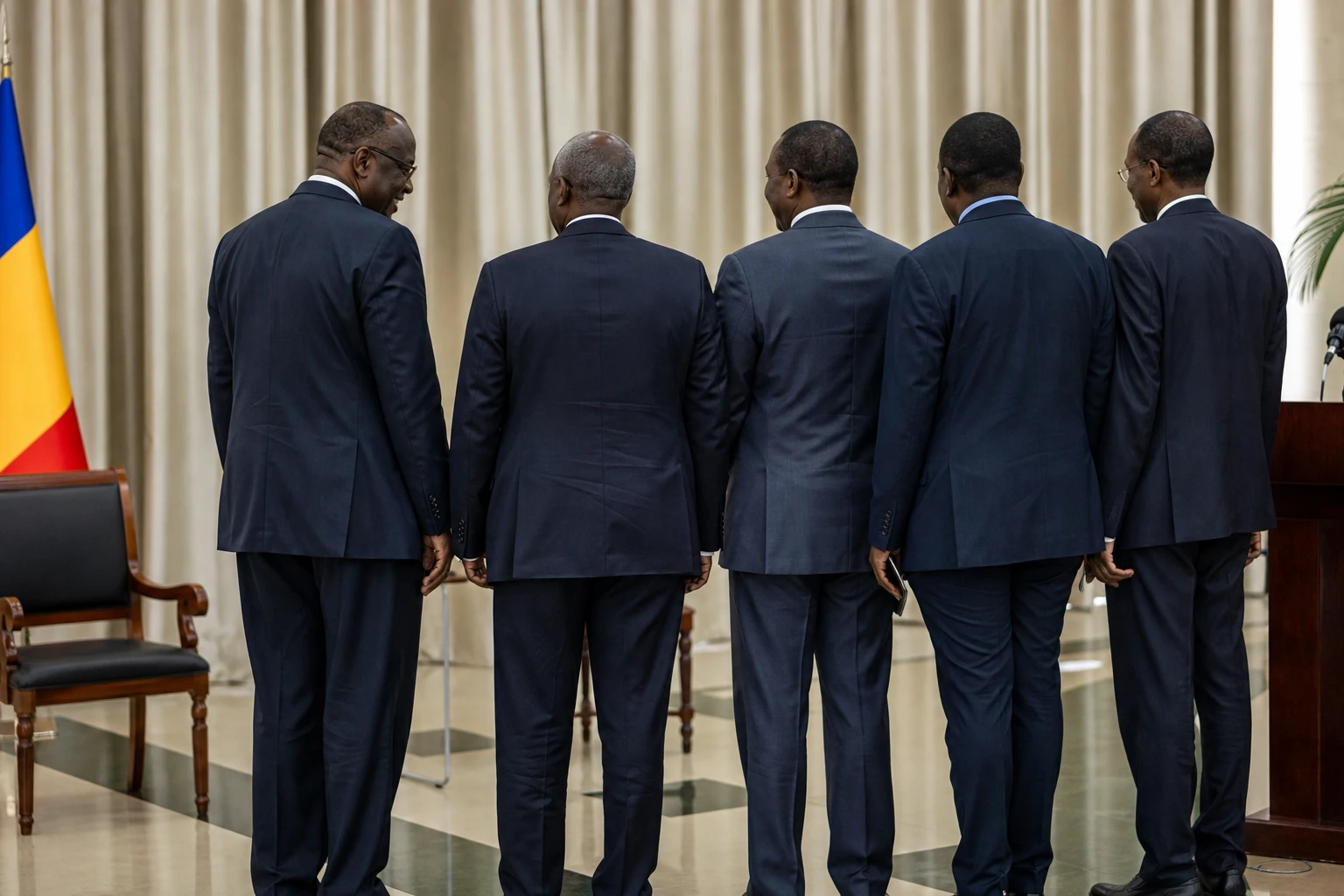
A conciliatory gesture at a moment of national symbolism
In Chad, important dates are not only for commemorating events. They also test the strength of the bond between the state and its citizens. On 11 August 2026, as the country celebrated the 66th anniversary of its independence, President Mahamat Idriss Deby Itno announced a presidential pardon for several convicted people. The head of state presented the decision as an extension of his policy of conciliation and reconciliation.
In a country marked by a transition that began after the death of Idriss Déby Itno in 2021, followed by a return to constitutional order with the 2024 presidential election, an announcement of this kind goes beyond criminal justice. It touches on how N’Djamena wants to close periods of crisis without giving the impression that it is erasing the tensions that produced them.
Chad and its regional context: domestic peace, unstable neighbourhood
Chad is a member of CEMAC, the Economic and Monetary Community of Central Africa, and the African Union. This position gives it a particular role in Central Africa, where security and monetary balances remain closely linked. The African Union notes that Chad is one of its member states and plays an important role in collective security and the fight against terrorism.
This regional position weighs on every political signal sent from N’Djamena. The country remains engaged in a process of institutional consolidation following the transition that began in 2021 and the electoral phase that led to Mahamat Idriss Deby Itno’s inauguration in 2024. At the same time, the government promotes a policy of an “outstretched hand”, already featured in several official speeches, notably in connection with dialogue with politico-military groups and disarmament, demobilisation and reintegration.
The regional context also explains the significance of these gestures. Chad remains surrounded by fragile areas, from the Lake Chad Basin to the Sahel, and is often seen as a security anchor in the region. In this context, a pardon can serve as a domestic political signal as well as a message to African and international partners: the government wants to show that stability also depends on social conciliation.
What the president announced
In his address to the nation delivered on the eve of the national holiday, Mahamat Idriss Deby Itno said that, in accordance with the powers granted to him by the Constitution, he would issue “a presidential pardon” for several Chadians who had been convicted. The president did not give the number or identities of those concerned. These details are due to appear when the presidential decree is published.
The head of state chiefly framed the decision in terms of cohesion. He linked the pardon to social peace, living together and national unity. He also reiterated his policy of an outstretched hand, presented as one of the cornerstones of Chad’s transition and the gradual move away from periods of armed confrontation.
The announcement comes at a time when the government is seeking to consolidate its legitimacy through visible political gestures. Since 2024, the authorities have promoted the idea of a Chad reconciled with itself and committed to institutional stability. Official discourse often couples state firmness with gestures of clemency, to show that restoring public authority does not rule out forgiveness.
A political message as much as a legal act
In practical terms, a presidential pardon can change the lives of detainees and their families, but it also serves as a tool of governance. It can ease pressure on prisons, defuse local social tensions and create room for normalisation with certain groups or individuals who have already embarked on a return to the legal framework. Its impact, however, will depend on the exact list of beneficiaries and the conditions set out in the presidential decree, which had not yet been published at the time of the announcement.
For the institutions, the stakes are different. The executive is seeking to show that it controls the pace of reconciliation. Politico-military groups, meanwhile, read this kind of signal as confirmation that the path of dialogue remains open, provided they accept the framework set by the state. For people in cities and more remote areas alike, the central question remains a practical one: will the promised peace mean less fear, less arbitrariness and greater day-to-day security?
It is also worth noting that Chad has recently shown, in its official communications, a desire to link political stability with social stability. In 2026, the government highlighted dialogue frameworks on social stability, while the presidency stressed the continuity of national reconciliation. The presidential pardon is therefore part of a broader effort: that of a state seeking to close divisions without losing its grip on the political process.
Significance beyond N’Djamena
Beyond Chad, the announcement is a reminder of a simple pan-African reality: in several countries across the continent, moving on from a crisis depends as much on institutional reforms as on gestures of de-escalation. When a head of state grants or promises a pardon during a national holiday, the signal says something about their conception of authority, but also about their view of political forgiveness as a tool for consolidating public order.
For Central Africa, the implications are even clearer. CEMAC and African cooperation frameworks are watching Chad’s stability closely, as it affects security balances, regional movement and the ability of states to maintain a minimum level of predictability. The next steps to watch are the publication of the pardon decree, followed by the list of beneficiaries and the reactions of political, judicial and social actors. That is when the announcement will take on its true significance.